At Handover: Snagging, Defect Liability and Who Fixes What

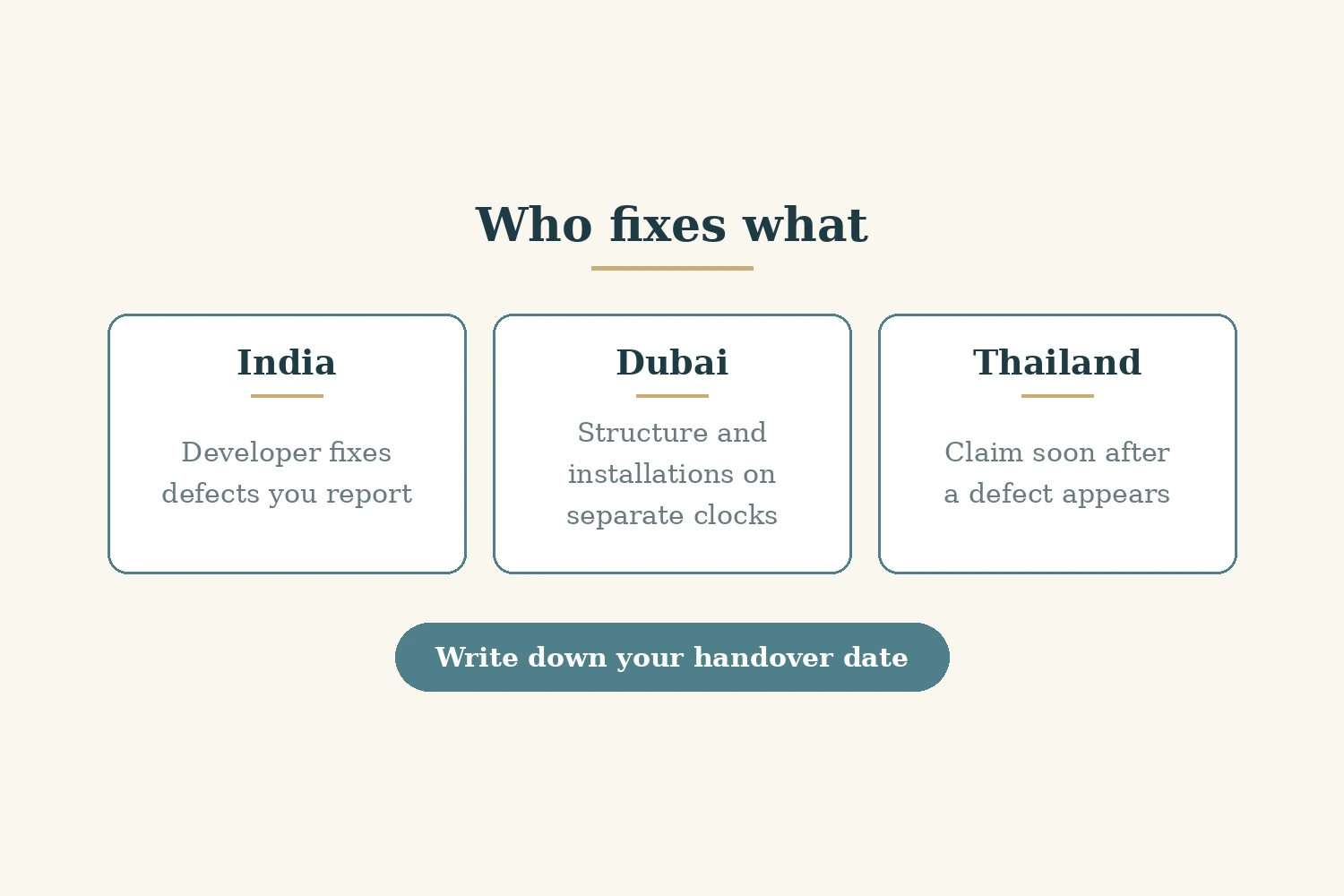
Handover day feels like the end of a long purchase. The keys are ready, the final payment is due, and the developer wants a signature. It is also the last moment when you, as the buyer, have real leverage. Once you sign for the property, every defect you find has to be claimed against a legal clock, and that clock differs between India, Dubai and Thailand: in what it covers, how long it runs and from which date it starts. This guide explains the snag list you sign against, the defect periods each market sets, and the dates a non-resident Indian (NRI) buyer should write down on the day. It is not legal advice, and it does not suggest any law makes a purchase free of risk.
Why handover is the moment that matters
A snag list is a written record of every defect you can see at handover: cracks, leaks, doors that do not close, missing fittings, sockets that do not work, finishes that do not match the agreement. It is your evidence. A defect on a dated list, signed by the developer's representative, is much harder to dispute later than one you mention months afterwards.
A practical snagging walk covers each room against the sale agreement and its specifications:
- walls, ceilings and floors, for cracks, damp and uneven finishes;
- doors, windows and locks, for fit and operation;
- plumbing, for leaks, water pressure and drainage;
- electrical points, lights and any installed appliances;
- the measured area, against the figure in your agreement, in square metres.
Take dated photographs of every item, and keep a copy of the list signed by both sides. Be careful with any handover form that says you accept the property without reservation. Write your snag list onto it, or attach it, before you sign. Our guide to area measurement across markets explains how to check the area figure, and our guide to how to read project status covers the stages before handover.
India: RERA's five years and 30 days
In India, the Real Estate (Regulation and Development) Act 2016 (RERA) sets the defect rule. Under section 14(3), if a structural defect, or any other defect in workmanship, quality or provision of services, or any other obligation of the promoter under the agreement for sale, is brought to the promoter's notice by the allottee within five years from the date of handing over possession, the promoter must rectify it without further charge within 30 days. If the promoter does not, the allottee is entitled to appropriate compensation under the Act (Real Estate Act, Goa RERA official copy, read 5 Nov 2026).
Two details matter. First, the five years run from the date possession is handed over, so that date should be on paper. Second, the defect has to be brought to the promoter's notice, so tell them in writing, keep proof that you sent it, and note the date the 30 days start.
Section 19(10) of the same Act says every allottee must take physical possession within two months of the occupancy certificate (Goa RERA official copy, read 5 Nov 2026). That gives you a window for the snagging walk, but not an open-ended one. The state rules that set out complaint procedures differ, and this guide does not cover them. Our guide to checking a Goa RERA project shows how to read a project's registration, and our Goa guide gives the local picture.
India: complaining when the developer does not fix it
If the 30 days pass without a repair, RERA gives you a route. Under section 31(1), any aggrieved person may file a complaint with the Authority or the adjudicating officer for any violation or contravention of the Act, or the rules and regulations made under it, against a promoter, allottee or real estate agent. Under section 71(1), compensation under sections 12, 14, 18 and 19 is decided by an adjudicating officer, a judicial officer who is or has been a District Judge (Goa RERA official copy, read 5 Nov 2026).
In practice, your complaint is only as strong as your record: the handover date, the snag list, the written notice and the date it was sent. Keep them together. Our guide to buyer protection for under-construction homes covers the protections before possession, and our guide to booking amount refund rules covers what happens if a deal falls through earlier.
Dubai: one year for installations, ten years for structure
In Dubai, the main rule for a unit buyer is in Law No. 6 of 2019 on the ownership of jointly owned real property. Article 40(a) says the developer remains liable for ten years from the date of the project's completion certificate to remedy or rectify defects in the structural parts. Article 40(b) says the developer remains liable for one year from the date the unit is handed over to the owner for repairing or replacing defective installations, including mechanical and electrical works, and sanitary and sewerage installations. If the owner refrains from taking possession, that year runs from the completion certificate instead (Dubai Legislation Portal, read 5 Nov 2026).
Two more parts of article 40 protect the buyer. Article 40(c) says nothing in the law prejudices rights or warranties owners have against developers under other legislation. Article 40(d) says an agreement made after the law came into force that contradicts article 40 in any way is null and void (Dubai Legislation Portal, read 5 Nov 2026). So a contract clause that cuts these periods short does not override them.
Notice that the two clocks start on different dates. The ten years for structure start at the project's completion certificate, which may be well before you take your keys. The one year for installations starts at your own handover. If you take possession late, part of the structural period has already run. Our guides to Oqood, Dubai's off-plan title, escrow protection on off-plan homes and Dubai service charges and running costs cover the stages around handover, and our Dubai guide gives the wider market.
Behind article 40 sits the United Arab Emirates (UAE) federal civil law. Article 40(a) still refers to Federal Law No. 5 of 1985, the earlier Civil Transactions Law. That law has been replaced: Federal Decree-Law No. 25 of 2025 promulgating the Civil Transactions Law was issued on 1 October 2025, took effect on 1 June 2026, and is listed as active (UAE Legislation portal, read 5 Nov 2026). The new law's article on the ten-year liability of engineers and contractors, its numbering and its text we could not confirm on an official government site as of 5 Nov 2026. That liability runs between contractor and developer in any case; as a unit buyer, article 40 is the rule you rely on. A procedure from the Dubai Land Department (DLD) for snagging or handover inspections we could not confirm on an official government site as of 5 Nov 2026.
Thailand: the condo contract minimums and a reported one-year deadline
In Thailand, the defect periods most often quoted for condominiums do not come from the Condominium Act. They are reported to come from a 2000 notification of the Contract Committee under the Consumer Protection Act, which makes condominium sales a controlled-contract business. As reported, the developer must be liable for the structure and major building components for not less than 5 years, and for other parts for not less than 2 years, counted from condominium registration, and must start repairs within 30 days of written notice. We could not confirm this on an official government site as of 5 Nov 2026, including on the site of the Office of the Consumer Protection Board (OCPB).
Behind that sits the Civil and Commercial Code on hire of work, which governs a contractor and the person who hired them, not directly a developer and a condo buyer. As reported in translations, section 600 makes the contractor liable, unless the contract says otherwise, for defects that appear within 1 year of delivery, or 5 years for a structure on land other than a wooden building, and section 598 says accepting defective work without reservation bars a claim unless the defect could not have been found or was concealed. We could not confirm this on an official government site as of 5 Nov 2026.
The Civil and Commercial Code is reported to require a claim against a contractor for a defect to be brought within 1 year of the defect appearing. We could not confirm this on an official government site as of 5 Nov 2026. Treat that year as short: once you see a defect, put the claim in writing quickly.
The "without reservation" point is why the snag list matters as much in Bangkok as anywhere. Our guides to Bangkok condominium common fees and the juristic person and the condominium foreign quota cover the building you are buying into, and our Bangkok guide and Phuket guide describe the markets.
Side by side: the clocks to write down
On handover day, write down these dates for your market.
India
- What: structural defects, and defects in workmanship, quality, services or other agreed obligations.
- How long: five years.
- From: the date possession is handed over.
- Deadline to act: notify within the five years; the promoter has 30 days to fix.
Dubai
- Structure: ten years from the project's completion certificate.
- Installations: one year from your unit handover, or from the completion certificate if you refrain from taking possession.
- Contract terms that contradict article 40: void.
Thailand
- Condo contract minimums, as reported: 5 years for structure and major components, 2 years for other parts, from condominium registration; not confirmed on an official site.
- Deadline to sue a contractor, as reported: 1 year from the defect appearing; not confirmed on an official site as of 5 Nov 2026.
As an illustrative example, with hypothetical dates, take a Dubai unit whose project completion certificate was issued in March 2026, with keys handed over in September 2026. The installation year runs from September 2026, so it ends in September 2027. The structural ten years run from March 2026, so they end in March 2036. That is 10 years from completion, not 10 years from your keys.
Buying from abroad: who walks the snag list
If you cannot be there on handover day, someone has to walk the property for you. That person needs your authority, the sale agreement, the specifications and a checklist, and they should send you dated photographs before anything is signed. If they sign a handover form on your behalf, make sure the snag list goes on or with it, and that you receive a copy the same day. Our guide to what needs you there when buying remotely covers powers of attorney in each market.
Keep one folder per property: the agreement, the completion or occupancy certificate, the handover date, the snag list, the photographs, every notice you send and every reply. Each of the clocks above depends on a date in that folder.
Who this is not for
This is not for buyers of land or plots without a building, or for owners in a dispute who need representation now. It does not cover state RERA rules, building insurance or disputes between developers and their contractors. It is not legal advice; for a defect claim, a lawyer in the market concerned should read your documents. It makes no claim about what a property might earn or be worth.
Where that leaves you
Handover is the last point where the paperwork works in your favour without a fight. Walk the property, write every defect down, take dated photographs and do not accept it without reservation. Then note the clock: in India, five years from possession with 30 days to fix; in Dubai, one year from handover for installations and ten years from completion for structure, with contrary terms void; in Thailand, the reported condo contract minimums and a reported one-year deadline once a defect appears, neither confirmed on an official site as of 5 Nov 2026. Same defect, three different clocks.
Sources
- Real Estate (Regulation and Development) Act 2016, Goa RERA official copy
- Dubai Law No. 6 of 2019 on Jointly Owned Real Property, Dubai Legislation Portal%20of%202019%20Concerning%20Ownership%20of%20Jointly%20Owned%20Real%20Property%20in%20the%20Emirate%20of%20Dubai.pdf)
- Federal Decree-Law No. 25 of 2025 Promulgating the Civil Transactions Law, UAE Legislation
Ready to find your next holiday home?
Browse our curated collection of vacation homes and managed farmland across India and beyond.