Buying From Abroad: What Can Be Done Remotely and What Needs You There

Much of a purchase abroad can be done from your desk, until the transfer itself. In India, Dubai, Thailand and Bali, the deed is presented, signed or recorded in a government office or in front of an official, and the law cares who is in that room. If you are a non-resident Indian (NRI) buying in any of these four markets, the real question is not whether you can do it all remotely. It is which steps can be handed to someone you trust, how that person proves they act for you, and how narrowly you can limit what they are allowed to do. It is not legal advice, and remote buying is never risk-free; a local lawyer acting for you matters at every stage.
The short version: four markets, one pattern
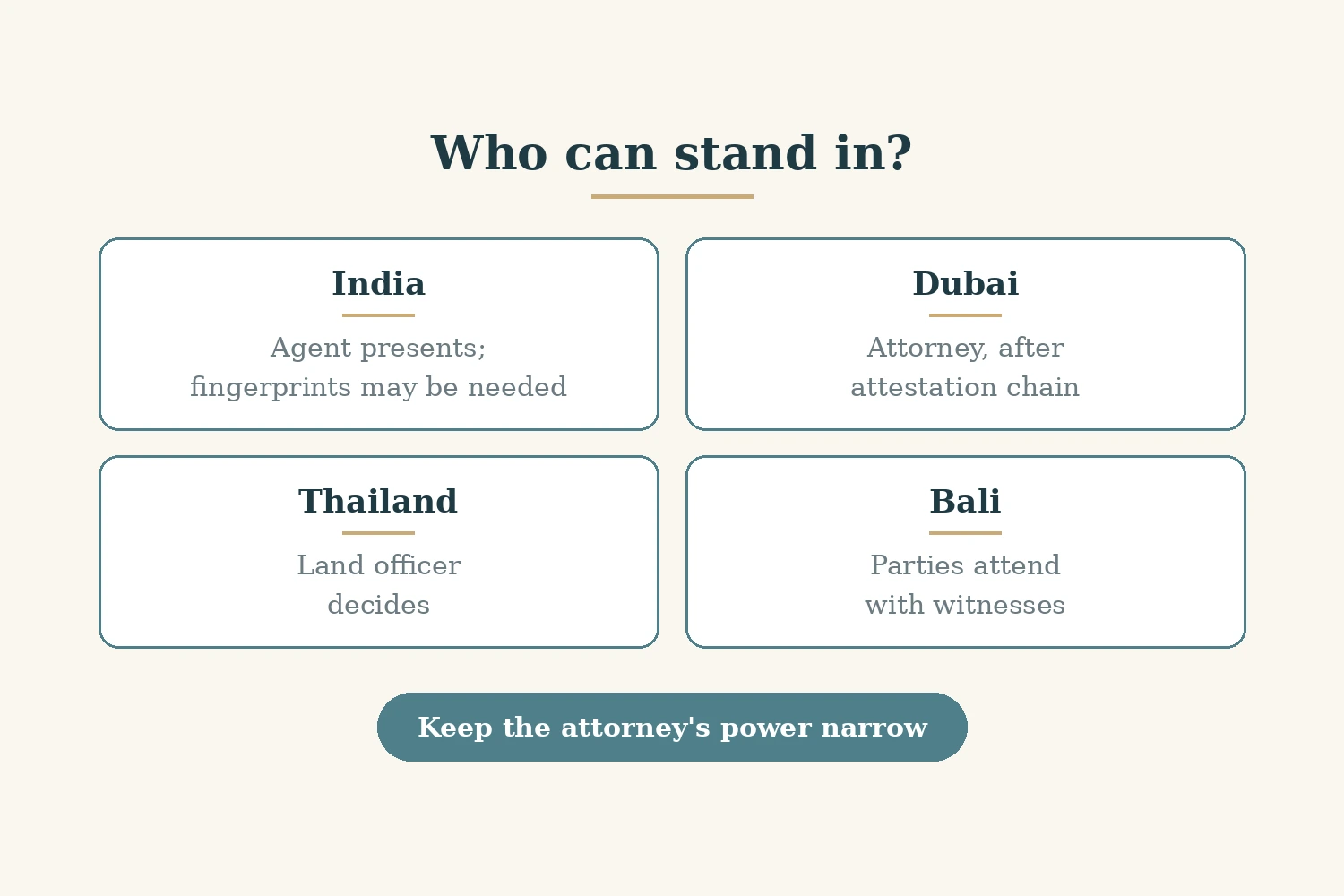
In each market, the person who cannot be present usually signs a power of attorney (POA): a document that lets someone else, the attorney, act for them. What changes from market to market is how that POA must be signed and certified abroad, and what the receiving office still insists on seeing:
- India: unofficial copies of the Registration Act 1908 say a POA signed outside India is executed before a notary, a court, a magistrate, an Indian consul or a similar authority, that an agent can then present the deed, and that the buyer's photograph and fingerprints are still required on a property transfer; we could not confirm this on an official government site as of 4 Nov 2026.
- Dubai: a POA issued outside the United Arab Emirates (UAE) must pass through a four-step attestation chain before the Dubai Land Department (DLD) will act on it.
- Thailand: the Department of Lands (DOL) expects its own POA forms, a POA made abroad should be certified by a Thai embassy, consulate or notary, and the land officer judges whether the document is clear and credible.
- Bali, Indonesia: the land deed is made before a land deed official (PPAT, Pejabat Pembuat Akta Tanah) with the parties present and at least two witnesses.
The Apostille Convention of the Hague Conference on Private International Law (HCCH) replaces the legalisation chain with a single certificate between member states. The HCCH status table shows India as a party since 14 July 2005 and Indonesia since 4 June 2022. Thailand acceded on 30 June 2026, but the convention only comes into force there on 28 February 2027. The UAE is not listed as a party (HCCH, read 4 Nov 2026). So in November 2026, an apostille does not replace the full legalisation chain for Dubai, and does not yet do so for Thailand.
Remote buying, then, means sending someone into the room under a power that says exactly what they may do. Our guide to cross-border property due diligence covers the checks to run before any of this.
India: what an NRI can sign abroad
Unofficial copies of the Registration Act 1908, which we could not confirm on an official government site as of 4 Nov 2026, say that a document is presented for registration at the proper office by the person who signed it, the person claiming under it, their representative or assign, or their agent, provided that agent holds a POA executed and authenticated in the manner the Act sets out (section 32). According to those copies, where the principal does not live in India, section 33(1)(c) lets them sign that POA before, and have it authenticated by, a notary public, any court, judge or magistrate, an Indian consul or vice-consul, or a representative of the central government. Those copies also say section 33(4) allows such a POA to be accepted on production, without further proof, if it appears on its face to have been executed and authenticated that way, and that a principal who lives in India instead executes the POA before the sub-registrar of their district (section 33(1)(a)). Check the current text with the sub-registrar before relying on it.
The same caveat applies to section 32A, inserted in 2001. As reproduced in those copies, it requires every person presenting a document to affix a passport-size photograph and fingerprints, and, for a transfer of ownership of immovable property, the photograph and fingerprints of each buyer and seller named in the document as well. We could not confirm this on an official site as of 4 Nov 2026. If it applies as written, the buyer's photograph and fingerprints still have to reach the deed. How each state's sub-registrar collects them from a buyer who is not in India, we could not confirm as of 4 Nov 2026, so ask the sub-registrar's office or your lawyer before you rely on a POA alone.
Because India is a party to the Apostille Convention (HCCH, read 4 Nov 2026), a document going between India and another member state can be apostilled instead of legalised. Whether a POA signed abroad must also be stamped or adjudicated under the stamp law of the state where the property sits, and within what time, we could not confirm from an official source as of 4 Nov 2026. Our guide to stamp duty and registration by state sets out the charges at registration, and our guide to the Liberalised Remittance Scheme (LRS) for buying abroad covers money moving the other way. For coastal India, our Goa guide gives the local picture.
Dubai: the attestation chain
The DLD's own frequently asked questions set out the route for a POA signed abroad. Any POA issued outside the UAE must be formally ratified before the DLD will accept it for a transaction: by the notary public and the Ministry of Foreign Affairs in the country where it was signed, then by the UAE embassy in that country, and finally by the UAE Ministry of Foreign Affairs (MOFA) (DLD, read 4 Nov 2026). Because the UAE is not a party to the Apostille Convention (HCCH, read 4 Nov 2026), an apostille does not shorten the chain.
Each stage takes time, and a mistake at any stage can mean starting again, so build the chain into any deadline in your sale agreement.
Some steps that sit around a transfer are already handled by others. The DLD's mortgage registration service, for example, can be completed through registration trustee offices or electronically by the bank, and lists a copy of the passport for non-resident foreigners among the documents; for an off-plan unit, the developer issues an electronic no-objection certificate through the Dubai REST app (DLD, read 4 Nov 2026). Whether a non-resident can complete a full ownership transfer by app, without anyone attending, we could not confirm on an official page as of 4 Nov 2026.
Our guides to Oqood, Dubai's off-plan title and mortgages for non-resident buyers in Dubai cover the registrations before and around the transfer, and our Dubai guide and UAE guide give the wider market.
Thailand: land office forms and the officer's judgement
In Thailand, the DOL's regulation of 2555 in the Thai calendar (2012) on powers of attorney for registering rights and juristic acts over immovable property sets the rules a land officer applies (DOL, read 4 Nov 2026). Clause 5 says a POA should be on the DOL's own form, or be a document clear enough to show who is authorised to do what, to what extent, and over which land or property; whether it is clear enough is for the officer to decide. Clause 6 says a POA should have at least one witness, and two witnesses if the principal uses a thumbprint rather than a signature. Clause 7 says erasing, adding or changing anything material, such as the plot or the type of registration, makes the POA defective unless the principal initials the change.
Clause 8 covers a POA made abroad. It should be certified by a Thai embassy or consulate, a notary public, or a person whom local law allows to witness documents. Without such a certification, the officer decides how far to trust the document, and may look into it further or refuse it (DOL, read 4 Nov 2026). Thailand's Apostille Convention membership does not take effect until 28 February 2027 (HCCH, read 4 Nov 2026), so do not plan on an apostille being enough for a POA signed before then.
The land office's own POA forms are listed by the Royal Thai Embassy in Washington (Tor.Dor.21 for land, Tor.Or.4 for land without a title deed and Or.Chor.21 for a condominium unit) among the documents it will certify (Royal Thai Embassy, Washington, read 4 Nov 2026). The same embassy notes two points worth knowing wherever you sign: it certifies only the signature, not the contents of the document, and it will not certify a form that has not been filled in completely.
For condominium buyers, our guides to the condominium foreign quota, the foreign exchange transaction form for moving money in and Thai property taxes and fees cover those, and our Thailand guide gives the wider picture.
Bali: the land deed official and who must attend
In Indonesia, the transfer of a land right is made by a deed before a PPAT. Government Regulation (PP, Peraturan Pemerintah) 24 of 1997 on land registration says, in article 38(1), that making that deed is attended by the parties to the legal act and witnessed by at least two witnesses who qualify to act as witnesses (Indonesian Supreme Audit Board legal database, read 4 Nov 2026).
Where a notary is involved, Law (UU, Undang-Undang) 2 of 2014, which amends the law on notaries, sets the rules in the room. Article 16(1)(m) requires the notary to read the deed aloud to the people appearing, with at least two witnesses present, and to have it signed there and then by those people, the witnesses and the notary. Article 16(1)(c) requires the appearers' fingerprints to be attached to the original deed kept by the notary. Article 16(3)(d) lists a power of attorney deed (akta kuasa) among the deeds a notary may issue in original form (Indonesian Ministry of Defence copy of UU 2/2014, read 4 Nov 2026).
Presence is the default in Bali. Indonesia has been a party to the Apostille Convention since 4 June 2022 (HCCH, read 4 Nov 2026), which simplifies a document signed in India for use there. Whether, and on what terms, a PPAT will accept an attorney attending the land deed on your behalf, we could not confirm on an official site as of 4 Nov 2026, so put that question to the PPAT in writing before you plan the trip. Our guide to Indonesian land title types explains what is being transferred, and our Bali guide covers the island itself.
How to word a narrow power of attorney
Every market above lets someone act for you, and every one of them puts the risk on the wording of the POA. A general power lets the attorney do things you never intended, and the official rules point towards narrow ones:
- Name the transaction. Thailand's clause 5 asks for a document showing who may do what, to what extent, over which property. Write the property's identifiers, the buyer and seller, and the act (purchase, or registration of a mortgage) and nothing wider.
- Do not leave blanks. The Washington embassy will not certify an incomplete form, and Thailand's clause 7 treats material changes without initials as a defect. Fill every field before you sign and initial any correction.
- Get the right certification for the country receiving it. For India, unofficial copies of the Registration Act describe a POA executed before a notary or Indian consul abroad, which we could not confirm on an official site; Dubai needs the four-step chain; Thailand expects certification by an embassy, consulate or notary; Indonesia accepts an apostille from a member state.
- Use witnesses as the form requires: at least one in Thailand, and two if you use a thumbprint.
- Set an end. A POA that runs only until the transaction completes, or a fixed date, leaves less to go wrong afterwards. Revoke it once the deal is done.
Which registration offices in India, or land offices elsewhere, will complete a purchase online for a buyer abroad, we could not confirm on official pages as of 4 Nov 2026. Assume an office visit unless the office tells you otherwise in writing.
A checklist per market before you book a flight:
- India: ask the sub-registrar's office how they take the buyer's photograph and fingerprints if you are abroad; sign the POA before a notary or Indian consul, and apostille it; ask your lawyer whether it must be stamped in the state concerned.
- Dubai: start the four-step attestation chain early and confirm with the DLD what it needs on the day.
- Thailand: use Tor.Dor.21 or Or.Chor.21 as the property requires; complete every field; have it certified by a Thai embassy, consulate or notary; remember that the land officer has the final word.
- Bali: ask the PPAT whether an attorney may attend for you, under what form of POA, and whether they want an apostille.
Paying a deposit before any of this is settled has its own risks; our guide to booking amount refund rules in India, Dubai and Thailand explains what you can expect back if a deal falls through.
Who this is not for
This is not for buyers who want to complete a purchase without anyone they trust on the ground. Every market here assumes either you or your attorney will be present. It does not cover company ownership, inheritance or selling. It is not legal advice, and the Indian statutory text is given as reproduced, not as confirmed on an official site. It makes no claim about what a property might earn or be worth.
Where that leaves you
You can do much of a cross-border purchase from home, but the transfer itself happens in a room, and each country decides who may stand in for you there. In India, unofficial copies of the Registration Act let an agent present the deed but still ask for the buyer's photograph and fingerprints, which we could not confirm on an official site; Dubai wants a four-step chain; Thailand's land officer has the final word; Bali expects the parties and two witnesses present. In every case, the safeguard you control is the POA itself: narrow, complete, certified correctly and time-limited. Decide what you are willing to delegate before you decide whether to fly.
Sources
- HCCH, Apostille Convention status table
- Dubai Land Department, frequently asked questions
- Dubai Land Department, request for mortgage registration
- Department of Lands, Thailand, regulation on powers of attorney B.E. 2555
- Royal Thai Embassy, Washington, land and condominium power of attorney
- Government Regulation 24 of 1997 on land registration (Indonesian Supreme Audit Board legal database)
- Law 2 of 2014 amending the law on notaries (Indonesian Ministry of Defence copy)
Ready to find your next holiday home?
Browse our curated collection of vacation homes and managed farmland across India and beyond.