Pulling Out Before Handover: Booking Amount and Refund Rules in India, Dubai and Thailand

Paying a booking amount on an off-plan home is easy from abroad: a transfer, a form, a receipt. Getting it back if you change your mind, or if the project stalls, is a different matter, and the rules are not the same in India, Dubai and Thailand. For a non-resident Indian (NRI) comparing homes across the three, the useful question is not "is my token refundable?" but "which document governs my token, and which rule applies if someone walks away?" This guide sets out what the law says in each market, using official texts read on 3 November 2026, and says plainly where we could not confirm a point. It is general information, not legal advice.
The short version: three markets, three exit rules
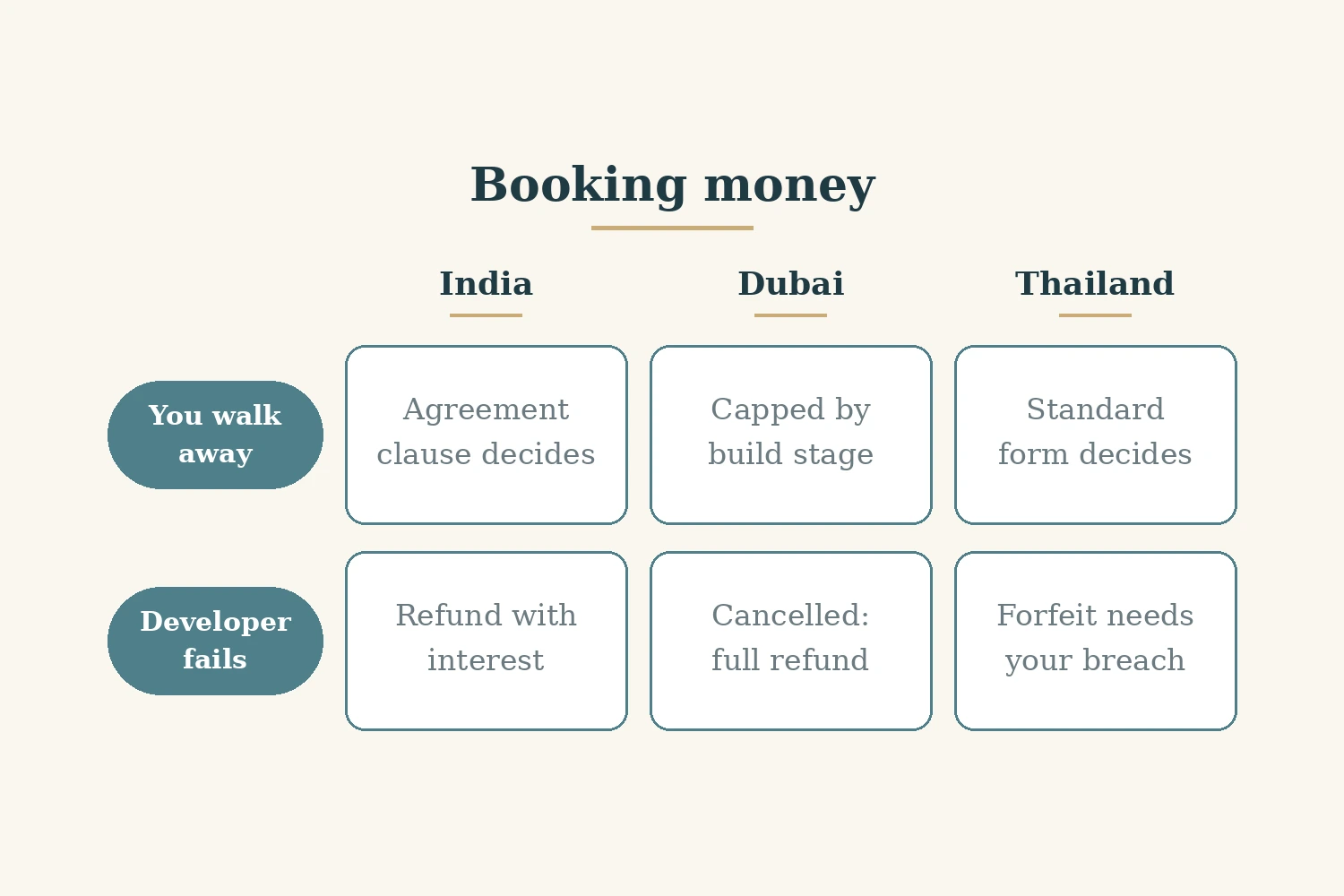
In India, the Real Estate (Regulation and Development) Act 2016 (RERA) caps how much a promoter may take before a registered agreement for sale, and gives the buyer a refund with interest if the promoter defaults. What the buyer loses on walking away is set by the agreement's booking amount clause, which the Act does not size.
In Dubai, the law sets no cap on what may be taken before a sale agreement, but it does cap what a developer may keep if the buyer defaults, in bands set by how far construction has progressed.
In Thailand, the rule works the other way round: since 31 January 2025, the condominium reservation itself must use a standard form, and the seller may forfeit money only where the buyer is at fault.
So before paying, find out which document your money is paid under, and which of the rules below applies to it.
India before the agreement: the 10% line
Section 13(1) of the RERA Act says a promoter may not accept more than 10% of the cost of an apartment, plot or building as an advance or application fee without first entering into a written agreement for sale and registering it (RERA Act, Goa RERA copy, read 3 November 2026). That is a cap on what can be taken before the agreement; it is not a rule about how much a buyer forfeits on cancelling. Our guide to buyer protection for under-construction homes covers it in more detail, and our guide to stamp duty and registration by state covers registering the agreement.
As a worked example, on a home priced at Rs (Indian rupees) 20,00,000, ten per cent is Rs 2,00,000, so that is the most the promoter could take before a registered agreement.
India, if the promoter defaults
Section 18(1) of the RERA Act says that if a promoter fails to complete or give possession as the agreement provides, or discontinues business because its registration is suspended or revoked or for any other reason, it must, on demand, return the money received with interest at the prescribed rate, plus compensation, if the buyer wishes to withdraw. A buyer who stays on is paid interest for every month of delay until possession (RERA Act, read 3 November 2026). Section 19(4) gives the buyer the same entitlement. Section 2(za) says the rate a promoter charges a defaulting buyer is the same rate it pays when it defaults.
The prescribed rate is set by each state's rules. In Maharashtra, the Maharashtra Real Estate Regulatory Authority (MahaRERA) explains in its frequently asked questions that rule 18 of the state's 2017 rules sets the rate at the State Bank of India (SBI) highest marginal cost of funds based lending rate (MCLR) plus two per cent (MahaRERA FAQ, read 3 November 2026). That is Maharashtra only. The rule text itself, and the rates in Goa, Karnataka and other states, we could not confirm from an official source as of 3 November 2026. The same FAQ says a developer should normally not be selective in cancelling units when customers default. Our Goa RERA project check and guide to reading a project's status show how to check a promoter's registration first.
India, if you walk away
What a buyer loses on withdrawing is set in the agreement for sale. The model agreement form on Goa RERA's website says that if the allottee cancels without any fault of the promoter, the promoter may forfeit the booking amount, and the balance is returned within 45 days (model agreement form on Goa RERA's site, read 3 November 2026). If the allottee does not sign the agreement and does not put this right within the notice period, the form says all sums, including the booking amount, are returned without interest or compensation. The copy we read is marked as a draft, so whether it is the notified form we could not confirm from an official source as of 3 November 2026.
Neither the Act nor that form sets the size of the booking amount. Whether any state rule caps the booking amount a promoter may forfeit, we could not confirm from an official source as of 3 November 2026. So the number that matters is the one written into your agreement: ask for it, in rupees, before you pay. The cancellation clause of MahaRERA's own model agreement we also could not confirm as of that date.
Dubai: if you stop paying, or the project is cancelled
In Dubai, the rule is in article 11 of Law No. 13 of 2008, as replaced by Law No. 19 of 2017, published in English by the Supreme Legislation Committee (Dubai Legislation Portal, read 3 November 2026; the Arabic text prevails). An earlier version of article 11 was replaced in 2009; the 2017 text is the one to use.
If a buyer breaches the off-plan sale agreement, the developer notifies the Dubai Land Department (DLD), which must serve 30 days' written notice on the buyer and, where possible, mediate a settlement. If the matter is not resolved, the DLD confirms the unit's completion percentage, and the developer may then act without going to court or arbitration:
- Over 80% complete: keep the contract, keep everything paid and claim the balance; ask the DLD to auction the unit; or terminate and keep up to 40% of the unit's value.
- 60% to 80% complete: terminate and keep up to 40% of the unit's value.
- Work started but under 60%: terminate and keep up to 25% of the unit's value.
- Work not started for reasons outside the developer's control: terminate and keep up to 30% of the amounts paid, refunding the rest within 60 days.
In the first three cases, any excess is refunded within one year of termination or 60 days of resale, whichever is earlier. The buyer may still go to court or arbitration if the developer abuses these powers.
As a worked example, take an apartment in Dubai listed from AED (United Arab Emirates dirham) 1,690,000, as listed on avacasa.life, 3 November 2026. Under 60% complete, 25% of 1,690,000 is AED 422,500. From 60%, 40% of 1,690,000 is AED 676,000. These are ceilings on what the developer may keep, not a statement of this project's stage, which we have not confirmed. Whether Dubai limits a booking or expression of interest (EOI) amount paid before the sale and purchase agreement (SPA), we could not confirm from an official source as of 3 November 2026.
If the project itself is cancelled, article 11 as replaced says that where a project is cancelled by a reasoned decision of the Real Estate Regulatory Agency, the developer must refund all buyer payments under Law No. 8 of 2007 on escrow accounts. The provisions do not apply to land sold without an off-plan sale, and they are a matter of public order, so terms that conflict with them are void (Law No. 19 of 2017, read 3 November 2026). Article 10 of Law No. 13 of 2008 says off-plan contracts in unapproved projects are null and void (Law No. 13 of 2008, read 3 November 2026). Our guides to escrow protection on Dubai off-plan homes, Dubai's Oqood off-plan title, freehold and leasehold zones and the Dubai guide go further.
Thailand: the reservation is now a controlled contract
In Thailand, the rule on reservations comes from the Contract Committee under the Consumer Protection Act, not from the Condominium Act. A notification making the sale of condominium units with a reservation a contract-controlled business was published in the Royal Gazette, volume 141, on 3 October 2024, and took effect 120 days later, on 31 January 2025. We read it through Thai local government pages relaying the Office of the Consumer Protection Board (OCPB), not the Gazette itself; the English is our paraphrase (Bang Tanot and Tha Lo municipality pages, read 3 November 2026).
According to those pages, a seller taking a reservation must use the OCPB's standard reservation contract, in clear Thai with letters no smaller than 2 millimetres, in two identical copies, one handed to the buyer on signing. The same applies to reservations made online and through digital platforms. Unfair terms are banned, including terms that:
- exclude or limit the seller's liability for its own breach;
- let the seller cancel without written notice, or when the buyer is not in breach;
- let the seller forfeit all or part of the money unless the buyer is in breach;
- charge the buyer a fee to transfer the reservation.
Thailand, when someone walks away
The detailed terms of the standard reservation form, including any refund period, the grounds on which either side may cancel, and when the seller may keep the reservation money, we could not confirm from an official source as of 3 November 2026. Rules on the later sale and purchase agreement, as opposed to the reservation, we also could not confirm.
What we can say is that the OCPB acts on refund complaints. In an August 2024 news item, before the notification took effect, the OCPB reported deciding to bring civil suits against condominium sellers in two cases: one where a seller refused refunds and kept reservation, contract and down payment money of THB (Thai baht) 2,352,000, and one where a seller had not finished building, with a refund of THB 1,194,375 plus interest sought (OCPB, read 3 November 2026).
As a worked example, a Bangkok condominium listed from THB 3,890,000, as listed on avacasa.life, 3 November 2026, gives no reservation percentage we can tie to a rule, so the question is what the standard form you sign says. Our guides to the condominium foreign quota, common fees and the juristic person, the Bangkok guide and the Thailand guide cover the rest.
Who this is not for
This is not legal advice, and it does not cover resale homes, land, or tax. It does not replace a lawyer reading the agreement you are about to sign. The dirham and baht figures are not converted into rupees.
Where that leaves you
Before you pay any token, ask five questions. What document is this money paid under: an application, a reservation form, or a registered agreement? Has it been registered, where that is required? Which rule applies if you withdraw: the booking amount clause in India, the completion bands in Dubai, or the standard reservation form in Thailand? How long does the refund take, in writing? And who do you complain to: the state RERA authority under section 31 in India, the DLD in Dubai, or the OCPB on its 1166 hotline in Thailand? Our guide to cross-border due diligence and measuring area across markets add the other checks, and our Goa guide covers one Indian market in depth.
Sources
- Real Estate (Regulation and Development) Act 2016, Goa RERA copy
- MahaRERA frequently asked questions
- Model agreement for sale form on Goa RERA's site
- Dubai Law No. 19 of 2017 amending Law No. 13 of 2008
- Dubai Law No. 13 of 2008%20of%202008.html)
- Bang Tanot municipality: OCPB notification on condominium reservations (Thai)
- Tha Lo municipality: OCPB notification on condominium reservations (Thai)
- OCPB news, 22 August 2024 (Thai)
Ready to find your next holiday home?
Browse our curated collection of vacation homes and managed farmland across India and beyond.