Goa RERA: Checking a Project Before You Pay

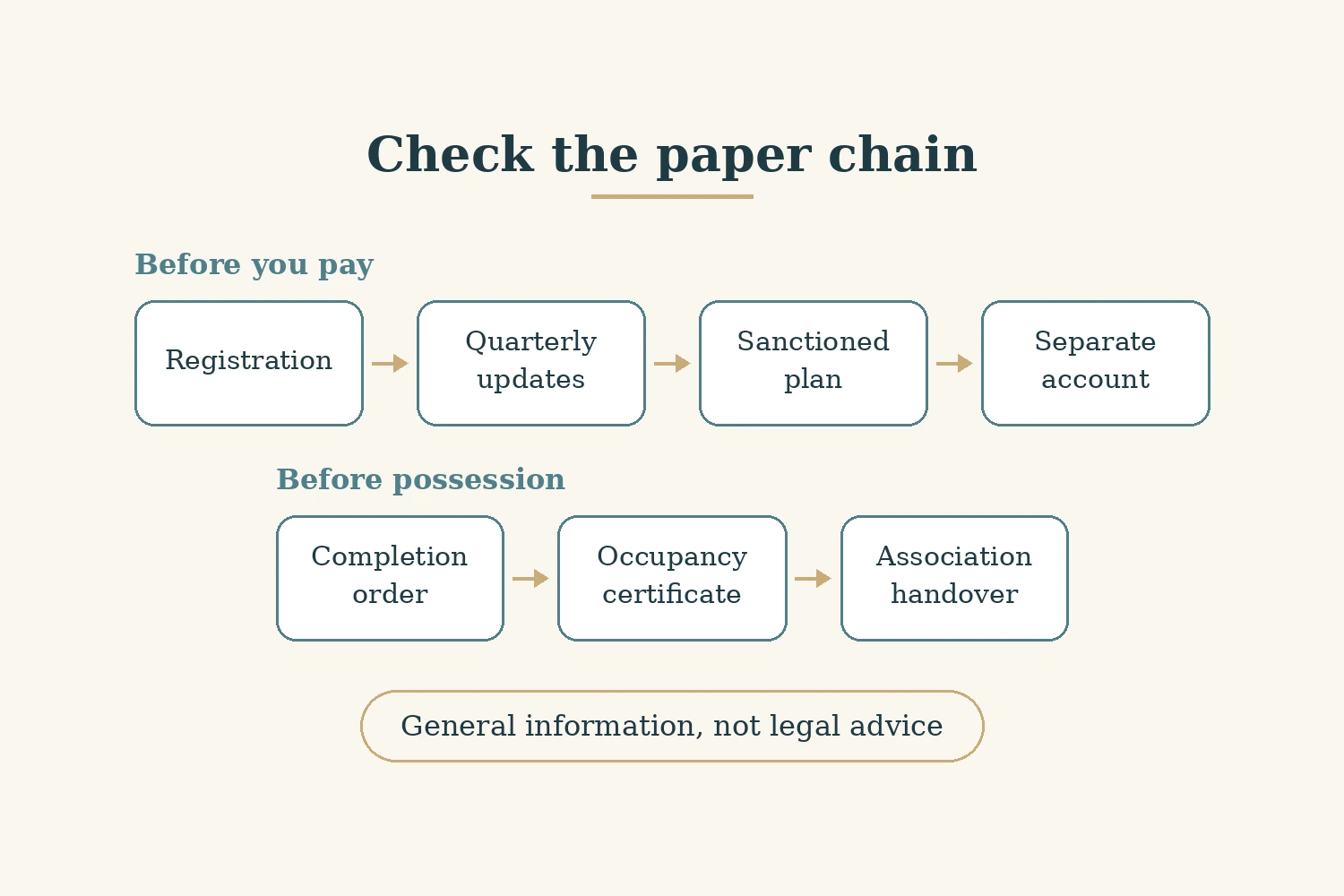
If you are buying an apartment in Goa that is still being built, the developer will almost certainly show you a Real Estate Regulatory Authority (RERA) registration number. It tells you less than many buyers assume: it shows a project was registered, not that the finished building may lawfully be lived in. In Goa that right comes from two papers issued outside RERA: a completion order from the planning authority, then an occupancy certificate from the municipal council or village panchayat. This guide walks a domestic high-net-worth individual (HNI) buyer through the chain of papers to check before paying, from the registration to the handover of common areas, using official sources we read on 1 November 2026. It is general information, not legal advice.
What a Goa RERA registration actually is
The Real Estate (Regulation and Development) Act, 2016 says in section 3(1) that no promoter may advertise, market, book, sell or offer for sale any plot, apartment or building in a real estate project in a planning area without first registering the project with the authority, and that ongoing projects without a completion certificate must apply too (Real Estate Act, Goa RERA copy, read 1 November 2026).
Section 3(2)(a) then exempts some projects. Its text says no registration is required "where the area of land proposed to be developed does not exceed five hundred square meters or the number of apartments proposed to be developed does not exceed eight inclusive of all phases", and lets the government lower that threshold; read literally, either test could exempt a project. Goa RERA's own frequently asked questions (FAQ) read it the other way: "Every real estate project which has land area more than 500 sq.mts or has more than 8 apartments needs to be registered" (Goa RERA FAQ 2, read 1 November 2026). The same FAQ then adds an explanatory note on a 10 July 2019 ruling of the Maharashtra Real Estate Appellate Tribunal, which read the clause so that a project is registrable only if it is on more than five hundred square metres and has more than eight units (Goa RERA FAQ 2, read 1 November 2026). So even Goa RERA's own document records both readings. If a developer tells you a project is too small to need registration, ask which reading they rely on and take advice.
Our guides to reading a project's status and buyer protection for under-construction homes explain what it does and does not cover.
Finding the project on Goa RERA's website
Goa RERA's FAQ says buyers can search project and agent names using the search engine on the home page of its portal, with no login required. The home page offers searches by project or agent, district (North Goa or South Goa), taluka, village and project type, from residential or group housing to plotted development and redevelopment (Goa RERA home page, read 1 November 2026). The same site publishes lists of defaulter projects and of cancelled, withdrawn and rejected projects. Search the project and promoter in each.
When you find the entry, note two details. A registration is valid for the period the promoter declared for completing the project or phase, under section 5(3) of the Act, as the FAQ explains; that date is the promoter's own commitment. And each phase of a project is registered separately, so check that the number you have been given covers the phase and building you are buying into.
We could not confirm from an official source as of 1 November 2026 what fields an individual project's page shows in Goa, because the search sits behind a verification step we could not complete. Our Goa guide and North Goa guide cover the area.
The quarterly updates and the sanctioned plan
The useful material is what the promoter must keep updating. Under section 11(1), the promoter creates a web page on the authority's website with the project's details and updates it every quarter with the number of apartments booked, the garages booked, the list of approvals taken and those still pending after the commencement certificate, and the status of the project. Under section 11(2), every advertisement must show the authority's website and the registration number.
At registration, the promoter also files authenticated copies of the approvals and commencement certificate (section 4(2)(c)), the sanctioned plan, layout plan and specifications (section 4(2)(d)), and details of its projects launched in the past five years, with their status, any delays and any pending cases (section 4(2)(b)). A pending approval in a recent update, or a record of past delays, is a question to ask before you pay.
Project papers do not replace a land title check; our guides to Goa's Form I and XIV land records and title searches using the inscription and description registers cover that side.
The separate account, and when it does not apply
Section 4(2)(l)(D) of the Act requires that seventy per cent of the amounts realised from allottees be deposited in a separate account in a scheduled bank, to cover the cost of construction and the land cost and used only for that purpose, with withdrawals in proportion to the completion of the project and certified by an engineer, an architect and a chartered accountant (read 1 November 2026). The central ministry's FAQ describes it as a "separate account" (FAQ 1, read 1 November 2026), so call it that rather than an escrow.
Goa RERA's FAQ adds four points worth knowing (read 1 November 2026):
- The separate account and the certificates are not mandatory for a self-financed project; it applies where money is taken from allottees.
- An escrow account opened with the bank that has lent to the project cannot be treated as the separate account.
- There should be one designated bank account for each registered project or phase.
- Stamp duty, registration charges, society share money, maintenance deposits, corpus funds, infrastructure charges and parking charges collected from allottees go into the designated account, as part of the project cost.
So check that your payments go to the project's designated account, not the developer's general account. It governs how money is used; it promises no outcome.
Once building starts, under section 14(1), the project must be developed according to the sanctioned plans, layout plans and specifications. Under section 14(2), the promoter may not make additions or alterations to the plans, fixtures or amenities disclosed to you without your previous consent, apart from minor changes. Under section 14(3), if a structural defect or a defect in workmanship is brought to the promoter's notice within five years of handing over possession, the promoter must rectify it free of charge within thirty days, or the allottee is entitled to compensation (read 1 November 2026).
Compare the sanctioned plan filed on Goa RERA's website with the brochure and the site. If they differ, ask for the revised approval and the allottees' consent. Our guide to villa checks near Hyderabad uses the same logic of making the papers match the building.
Completion order and occupancy certificate: three different papers
Goa's terms trip buyers up here. The Act defines a "completion certificate" in section 2(q) as a certificate, by whatever name called, from the competent authority certifying that the project has been developed according to the sanctioned plan under local laws, and an "occupancy certificate" in section 2(zf) as a certificate, by whatever name called, permitting occupation of a building under local laws, with civic infrastructure such as water, sanitation and electricity. The central ministry's FAQ says that where a state issues only one certificate covering both, that is enough.
In Goa, the local law is the Goa Land Development and Building Construction Regulations, 2010, in the Town and Country Planning (TCP) department's consolidation incorporating amendments up to September 2018. Regulation 3.11(a) says no building may be occupied, in whole or in part, until two papers have been issued (TCP regulations, read 1 November 2026):
- a completion order from the Planning and Development Authority (PDA), or from the Town and Country Planning Department (TCPD), as applicable; and
- an occupancy certificate (OC) from the municipal council (or the Corporation of the City of Panaji) or the village panchayat.
Regulation 3.11.1 sets out two steps. The owner first applies for the completion order; the application to the council or panchayat for the OC then encloses that completion order, a completion certificate from the architect or engineer that the work was supervised and conforms to the approved plans, and a structural stability certificate. Regulation 3.11(b) requires fire services clearance before an OC for high-rise buildings.
The three papers side by side
The completion order comes from the PDA or the TCPD and confirms the building matches its permission. The architect's or engineer's completion certificate is a professional's statement, used to apply for the order and the OC; it is not permission to occupy. The OC comes from the municipal council (or the Corporation of the City of Panaji) or village panchayat and is the paper that allows occupation. Ask for all three by name.
We could not confirm from an official source as of 1 November 2026 which villages, including Parra, Nerul and Siolim, fall under a PDA rather than the TCPD, or whether regulation 3.11 has been amended since September 2018. Ask the panchayat which authority issued the completion order. Our guide to Parra, Nerul and Siolim and our Parra, Nerul and Siolim guides cover the villages.
Possession, conveyance and the association
The Act ties the handover to the OC. Under section 17(1), the promoter must execute a registered conveyance deed in your favour, with an undivided proportionate title in the common areas to the association of allottees, and hand over physical possession, within the period under local laws; in the absence of any local law, the conveyance must be done within three months from the date of issue of the OC (read 1 November 2026). Under section 19(10), you must take physical possession within two months of the OC for your apartment, and under section 19(11), you must take part in registering the conveyance deed.
We could not confirm from an official source as of 1 November 2026 whether a Goa law sets its own conveyance period in place of the Act's three-month default, so we give no Goa-specific deadline. Ask your lawyer to check. Our guide to stamp duty and registration by state covers the cost of registering the deed.
Then comes the association. Under section 11(4)(e), the promoter must enable the formation of an association or society of allottees, within three months of a majority of allottees booking where there is no local law. Goa RERA's FAQ puts it as within three months of fifty-one per cent of allottees having booked (Goa RERA FAQ 2, read 1 November 2026). Under section 17(2), after the OC and the handover of possession, the promoter must hand over the documents and plans, including the common areas, to the association. Under section 19(5), you are entitled to those documents and plans after taking possession.
If no association exists long after most units are sold, or common areas are not handed over after the OC, raise it with the promoter and, if needed, the authority.
When the chain breaks: refunds and complaints
Under section 18(1), if the promoter fails to complete or give possession by the date in the agreement, or its registration is suspended or revoked, an allottee who withdraws is entitled on demand to the return of the money paid, with interest at the prescribed rate and compensation; an allottee who stays is to be paid interest for every month of delay. Under section 31(1), any aggrieved person may file a complaint with the authority or the adjudicating officer for any violation of the Act, its rules or regulations (read 1 November 2026).
Goa's own rules, which the FAQ names as the Goa Real Estate (Regulation and Development) Rules, 2017, set the interest rate and disclosure lists, but we could not confirm from an official source as of 1 November 2026 their rates or other terms, or the contents of the regulations Goa RERA notified in 2020, so we give no figures. For comparison, our guide to off-plan protection in Dubai shows how another market handles buyers' money.
As listed on avacasa.life on 1 November 2026, we had 94 listings tagged Goa, of which 90 were in Goa itself, and 23 of those were apartments. The RERA field on many of our Goa listings was empty, marked not available, or not in the format of Goa RERA project numbers, which begin with PRGO, and we have not checked any number against the register. Treat any number on a listing, ours included, as something to look up yourself.
Who this is not for
This is not legal advice, and it does not replace a lawyer reading the agreement, the title and the approvals for your unit. It does not cover the land title chain in detail, villas on individual plots outside a registered project, or tax. It gives no Goa interest rate, fee or conveyance deadline, because we could not confirm those from official sources as of 1 November 2026. And it says nothing about what any project will be worth.
Where that leaves you
A Goa RERA number is the start of the paper chain, not the end. Before you pay, find the project on Goa RERA's site and check its validity date, its phase and the lists of cancelled and defaulter projects. Read the quarterly updates and the sanctioned plan, and confirm which account your money goes into. Before you take possession, ask for the completion order, the architect's completion certificate and the OC by name, then watch for the conveyance deed and the association. This is general information, not legal advice.
Sources
- Real Estate (Regulation and Development) Act, 2016, gazette copy hosted by Goa RERA
- Goa RERA: FAQ 2 (18.01.2023).pdf)
- Goa RERA: FAQ 1 (central ministry FAQ)
- Goa RERA: home page and project search
- Town and Country Planning Department, Goa: Goa Land Development and Building Construction Regulations, 2010, amendments up to September 2018
Ready to find your next holiday home?
Browse our curated collection of vacation homes and managed farmland across India and beyond.