Stamp Duty and Registration Costs: Maharashtra, Uttarakhand and Tamil Nadu Side by Side

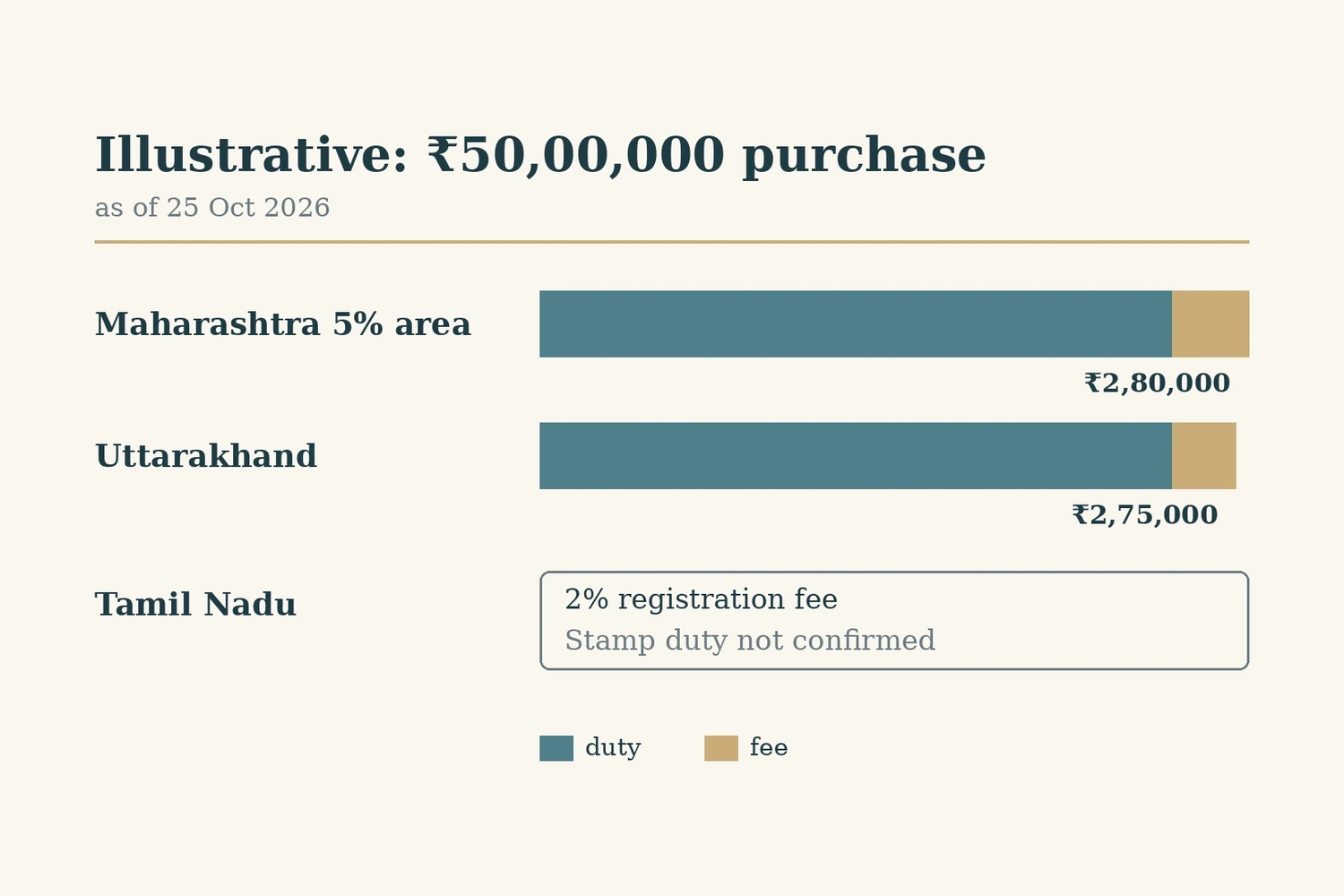
The stamp duty rate on a state's poster is the wrong number to compare. What you actually pay when a sale deed is registered depends on three things that the headline rate hides: the value the duty is charged on, whether the registration fee has a ceiling, and whether a concession you have heard about really applies to your purchase. This piece compares three states where we list property: Maharashtra and Uttarakhand, where we found official rates, and Tamil Nadu, where we could confirm only part of the picture. For each one we give the rate, the official source and the date we read it, then run the same two purchases through the numbers. Where an official page would not load or did not confirm a figure, we say so and leave the figure out. Everything here was read on 25 October 2026, and every sum is illustrative.
What value the duty is charged on
Stamp duty is not simply a percentage of the price you agree. Maharashtra's Stamp Act charges conveyance duty on the market value of the property (Schedule I, Article 25, Inspector General of Registration (IGR) Maharashtra master copy dated 31 July 2026). Tamil Nadu's women's fee concession, discussed below, tests the value by the market value or guideline rate on the day the document is presented, not by the agreed price. In practice, that means the state's own valuation, published as the ready reckoner in Maharashtra, can set the base even when your agreed price is lower.
So before you compare states, find out the official value of the specific property and use the higher figure in your budget. The percentages below are only as useful as the base you apply them to. Our list of questions before signing a land deal covers the wider points to raise with a seller, and our total cost of ownership comparison puts closing costs next to the cost of holding land.
Maharashtra: 5% or 4% by area, and a ₹30,000 fee cap
Under Article 25(b) of Schedule I to the Maharashtra Stamp Act, conveyance duty on immovable property is 5% of market value within a municipal corporation or urban area, and the same rate applies within a municipal council, nagar panchayat, a rural area inside the Mumbai Metropolitan Region Development Authority (MMRDA) limits or the influence areas named in the annual statement of rates. It is 4% within a gram panchayat area outside those categories (IGR master copy dated 31 July 2026, which shows the same rates as the June 2022 consolidation). Whether a rural plot falls in a gram panchayat area depends on the village, so confirm the category for the specific survey number before you budget, because one percentage point on a large purchase is a meaningful sum.
The registration fee is set by the Table of Fees under section 78 of the Registration Act, 1908. For a value above ₹10,000 it is ₹100 plus ₹10 for every ₹1,000 or part above ₹10,000, with a maximum of ₹30,000 (IGR Maharashtra fee table, read 25 October 2026). The cap is reached quickly. On ₹50,00,000, the uncapped formula would give ₹100 + ₹10 x 4,990 = ₹50,000, so the ₹30,000 ceiling applies.
The sums in this piece include only the duty and fee shown in the official documents cited, so treat them as a floor and ask the sub-registrar whether anything else applies to your property. Our Maharashtra guide and Karjat guide describe the areas, and our pieces on the land revenue code, reading a 7/12 extract and checks before you pay a token cover what to check before you reach registration.
Uttarakhand: 5%, a lower rate for some women buyers, and a capped fee
The Uttarakhand Stamp and Registration Department's schedule gives stamp duty on a conveyance or sale deed of immovable property (Article 23) as 5% in general, and 3.75% for a female buyer up to ₹25 lakh, with 5% thereafter (department schedule uploaded March 2025, read 25 October 2026). The registration fee is 2% of the value or consideration, with a maximum of ₹25,000 in that schedule.
The department also lists a notification under section 78 of the Registration Act that substitutes "fifty thousand rupees" for "twenty-five thousand rupees" in the table of registration fees. The notice itself was digitally signed on 16 November 2025 and says it takes effect from the date of its publication in the Official Gazette. We could not confirm that publication date, so the sums below use the ₹25,000 cap from the schedule. A higher cap of ₹50,000 has been notified, so ask the sub-registrar which cap applies on the day you register. Our guides to buying land in Uttarakhand and the land law for outsiders, and our Uttarakhand and Rishikesh guides, cover the wider rules.
Tamil Nadu: what we could confirm, and what we could not
Tamil Nadu is the gap in this comparison. On the registration fee, the Tamil Nadu Commercial Taxes and Registration Department's policy note for 2024-25 (section 7) says the fee on sale, exchange, gift and settlement among non-family members was lowered from 4% to 2% when the restored guideline values took effect on 1 April 2023 (read 25 October 2026). The stamp duty rate on a sale stays unconfirmed, because the state's official registration portal would not load on 25 October 2026. Without that rate we run no Tamil Nadu sums.
Two official orders did load. G.O. Ms. No. 77 of 29 March 2025, published in the Tamil Nadu Government Gazette under section 78-A of the Registration Act, reduces the registration fee to ₹1 per ₹100 (1%) on sale deeds where the purchaser is a woman, or where every joint purchaser is a woman, and only where the property's market value or guideline rate is up to ₹10,00,000. Above ₹10 lakh the concession does not apply, and a property should not be split to qualify. G.O. Ms. No. 166 of 19 December 2025 provides that duty and fee already paid on a construction agreement registered on or before 30 November 2023 is set off against a composite sale deed for an apartment or villa registered on or after 1 December 2023. Our Tamil Nadu and Kodaikanal guides describe the places we list.
Worked arithmetic: ₹50 lakh and ₹1.5 crore
These are illustrative sums as of 25 October 2026. They assume the agreed price is at or above the official value, a standard sale deed and no other surcharge. They are not a quote for any listing.
Maharashtra, municipal corporation or council area (5%):
- ₹50,00,000: duty 5% = ₹2,50,000; registration fee capped at ₹30,000; total ₹2,80,000
- ₹1,50,00,000: duty 5% = ₹7,50,000; fee ₹30,000; total ₹7,80,000
Maharashtra, gram panchayat area (4%):
- ₹50,00,000: duty 4% = ₹2,00,000; fee ₹30,000; total ₹2,30,000
- ₹1,50,00,000: duty 4% = ₹6,00,000; fee ₹30,000; total ₹6,30,000
Uttarakhand (5%, fee 2% capped at ₹25,000 per the schedule):
- ₹50,00,000: duty 5% = ₹2,50,000; fee 2% would be ₹1,00,000, capped at ₹25,000; total ₹2,75,000
- ₹1,50,00,000: duty 5% = ₹7,50,000; fee ₹25,000; total ₹7,75,000
If the ₹50,000 cap applies on your registration date, add ₹25,000 to each Uttarakhand total (₹3,00,000 and ₹8,00,000).
Two points stand out. Because both states cap the fee, it is a small share of the bill at these values: on ₹1.5 crore in a Maharashtra gram panchayat area, the ₹30,000 fee is under 5% of the ₹6,30,000 total (30,000 / 6,30,000 = 4.8%). And the gap between Maharashtra's 4% and 5% areas, ₹1,50,000 on a ₹1.5 crore purchase (7,50,000 minus 6,00,000), is larger than any difference in fees.
Women buyers: what the concessions cover
Each concession is narrower than it is often described.
In Maharashtra, an order of 31 March 2021 (cited in the IGR schedule's editor's note) reduces Article 25(b) duty by one percentage point from 1 April 2021 on a conveyance or agreement to sell of a residential unit, such as a flat, bungalow, row house or independent house, in favour of a woman or women purchasers. The note names residential units. It does not mention plots, so do not assume it covers land. Illustratively, a ₹50 lakh flat in a 5% area would carry 4% duty, ₹2,00,000, plus the ₹30,000 fee, ₹2,30,000 in all.
In Uttarakhand, the schedule gives 3.75% for a female buyer up to ₹25 lakh and 5% thereafter. Illustratively, on a ₹25 lakh purchase that is ₹93,750 (25,00,000 x 3.75%) plus a fee of ₹25,000 (2% would be ₹50,000, capped), ₹1,18,750, against ₹1,50,000 at the general rate (₹1,25,000 + ₹25,000), a difference of ₹31,250. The schedule's wording does not make clear how the lower rate applies to a purchase above ₹25 lakh, so ask the sub-registrar before relying on it.
In Tamil Nadu, the 1% registration fee under G.O. 77 applies only where every purchaser is a woman and the value is up to ₹10 lakh. It changes the fee, not the stamp duty.
For most second-home purchases above these thresholds, none of the concessions changes the bill.
What this comparison leaves out
We do not cover Karnataka here. The registration fee change we know about was available to us only through a third-party copy of the gazette, not an official page, so we leave the state out until we can cite the official schedule. Goa is outside the scope of this piece.
Tax deducted at source (TDS) on the purchase price is a separate obligation for the buyer; see our guide to TDS on property purchase and, for sellers who are Non-Resident Indians (NRIs), our post on the Form 13 lower TDS certificate. Goods and Services Tax (GST) on under-construction property is not covered.
Who this is not for
This is not a calculator for a specific deed. The official value, the area category and the cap in force on your registration day all change the answer, and only the sub-registrar's assessment settles it. It is not for a buyer in Karnataka or Goa, which we have not covered. And it is not legal or tax advice for unusual instruments such as gifts, leases or settlements, which carry different articles and rates.
Where that leaves you
Compare totals, not headline rates. Start with the official value of the specific property, then the area category, then the fee and its cap, and only then any concession, checked against its narrow wording. On the sums above, Maharashtra's area category moves the bill more than anything else, and Uttarakhand's cap needs confirming on the day. In Tamil Nadu, ask the sub-registrar for the current stamp duty before budgeting, since we could not confirm it on an official page; the 2% registration fee above comes from the department's 2024-25 policy note. For buyers abroad, our NRI land documentation checklist and power of attorney guide cover registering through someone else.
Sources
- IGR Maharashtra: Maharashtra Stamp Act Schedules I and II, master copy dated 31 July 2026
- IGR Maharashtra: Maharashtra Stamp Act Schedules I and II, as modified to June 2022
- IGR Maharashtra: registration fee table
- Uttarakhand Stamp and Registration Department: schedule of stamp duty and registration fee
- Uttarakhand Stamp and Registration Department: schedule PDF
- Uttarakhand Stamp and Registration Department: stamp duty and registration fee notifications
- Uttarakhand: notification raising the registration fee cap, signed 16 November 2025
- Tamil Nadu Commercial Taxes and Registration Department: policy note 2024-25
- Tamil Nadu Government Gazette: G.O. Ms. No. 77, 29 March 2025
- Tamil Nadu Government Gazette: G.O. Ms. No. 166, 19 December 2025
Ready to find your next holiday home?
Browse our curated collection of vacation homes and managed farmland across India and beyond.