TDS on Property Purchase: When and How Much
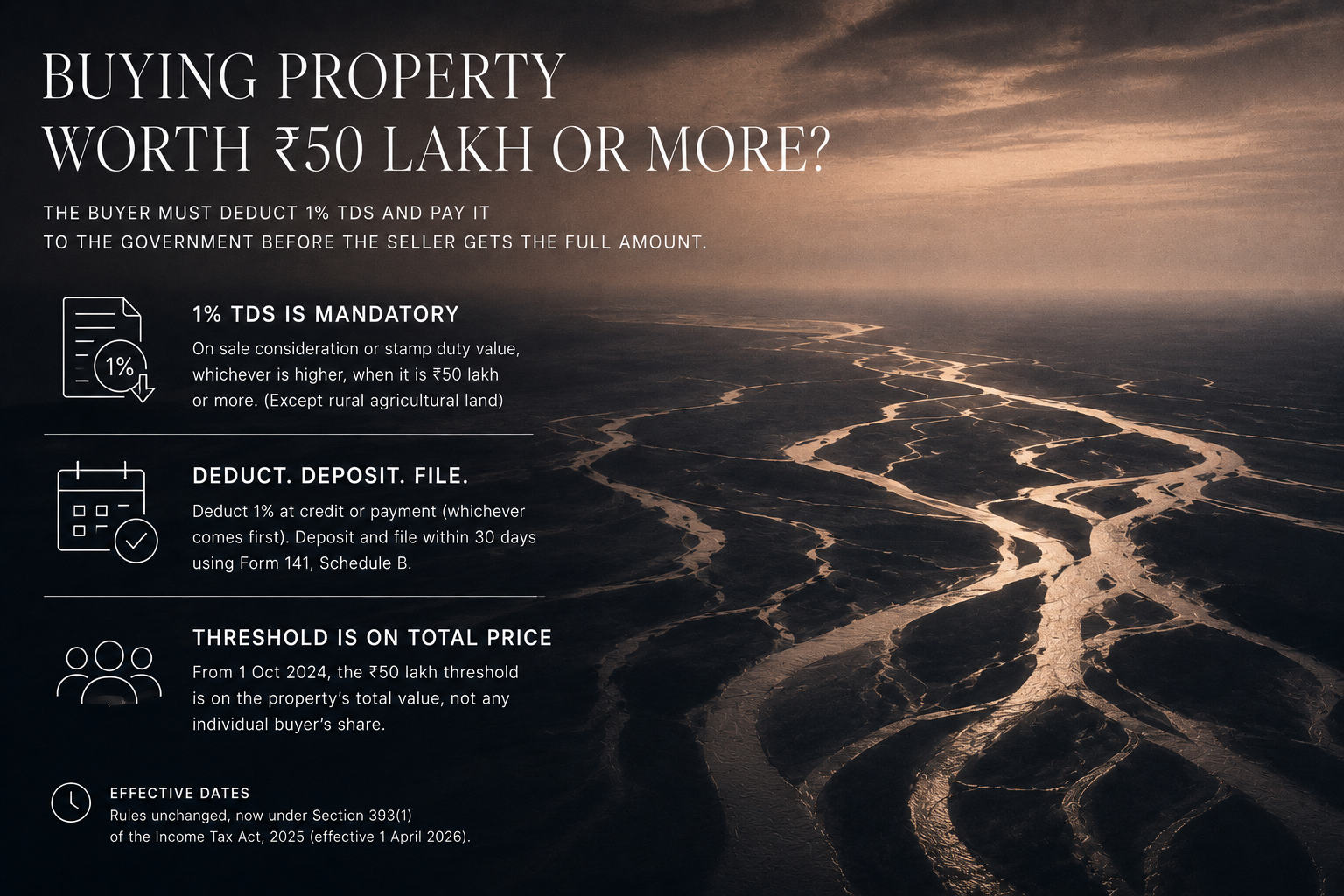
Buy a property in India worth 50 lakh rupees or more from a resident seller, and the law makes the buyer responsible for withholding 1% of the price and paying it to the government before the seller ever sees the full amount. This is not the seller's tax to file, it is the buyer's tax to deduct, and getting it wrong, missing the threshold, deducting on the wrong base, filing late, creates a real compliance problem for the buyer specifically, not the seller.
The rule itself, and what changed on 1 April 2026
Section 194-IA of the Income Tax Act, 1961 required a 1% deduction on the sale consideration or the stamp duty value, whichever is higher, whenever that figure reached 50 lakh rupees or more, for any immovable property other than rural agricultural land. That threshold and rate are unchanged under the Income Tax Act, 2025, which took effect 1 April 2026: the same obligation now sits under Section 393(1) of the new Act. The substance of the rule has not moved, only its address, and a buyer working from an older guide is very likely reading the correct rate under the wrong section number.
The bigger change: one form replaces four
The more consequential shift for 2026 is procedural rather than substantive. Form 26QB, the challan-cum-statement buyers have filed under Section 194-IA for years, is being replaced by Form 141, Schedule B, which consolidates what used to be four separate forms, 26QB, 26QC, 26QD and 26QE, covering different categories of TDS, into one. A buyer who has done this before and expects to file the familiar 26QB will find it is no longer the correct form under the new Act.
What the buyer actually has to do, step by step
Confirm the transaction value, sale consideration or stamp duty value, whichever is higher, against the 50 lakh rupee threshold before assuming the obligation applies at all. If it does, deduct 1% at the time of credit to the seller's account or at the time of payment, whichever comes first, rather than waiting until the full transaction closes. File the deduction and pay it over within 30 days of the deduction, using Form 141 Schedule B for a transaction after 1 April 2026, and issue the seller a certificate confirming the tax deducted, since the seller needs this to claim credit for it in their own return. Missing the 30-day window carries interest and penalty exposure for the buyer, not the seller, which is the detail most likely to be missed by someone doing this for the first time.
Joint buyers used to have a loophole here, and it closed
A 2018 ruling from the Delhi bench of the Income Tax Appellate Tribunal held that joint buyers were not liable for TDS under Section 194-IA if each individual's own share of the purchase price fell below 50 lakh rupees, even when the combined property value exceeded it. That reading no longer holds. From 1 October 2024, the threshold is computed on the property's total sale consideration, aggregated across all buyers and sellers, not on any individual buyer's share, closing the gap the 2018 ruling had opened. Two buyers splitting a 70 lakh rupee property 50-50, each contributing 35 lakh, still trigger the obligation on the full 70 lakh figure, with each buyer responsible for deducting and depositing TDS proportionate to their own share of that total. A joint purchase structured specifically to keep each buyer's individual contribution under 50 lakh no longer avoids the obligation, and anyone still relying on the 2018 position is relying on a rule that has since been superseded.
A worked example, with the numbers shown
Take a hypothetical flat priced at 65 lakh rupees, with a stamp duty value of 68 lakh rupees, a gap that exists because the two figures rarely match exactly. The rule uses whichever figure is higher, so the deduction is calculated on 68 lakh rupees, not 65 lakh, giving a TDS of 68,000 rupees at 1%. That 68,000 rupees is deposited within 30 days of deduction, and the seller receives 67,32,000 rupees net of the deduction plus the certificate confirming it, which the seller then uses to claim credit for that amount against their own eventual tax liability. A buyer who deducts against the lower sale price rather than the higher stamp duty value has under-deducted, and that shortfall is a liability that falls on the buyer to correct, not something the seller's own filing can quietly absorb.
The exemption that catches people who assume every land purchase qualifies
Rural agricultural land is specifically excluded from this obligation, since it is not treated as a capital asset under the Income Tax Act at all, and no TDS therefore applies to its transfer. The exemption depends on the land genuinely meeting the statutory definition of rural agricultural land, distance from a municipality, population thresholds and land-use classification among the relevant factors, rather than on how a specific plot is marketed or how the buyer assumes it should be classified. The Maharashtra Land Revenue Code: A Buyer's Guide covers how one state's own land classification interacts with this kind of national exemption, and getting the classification wrong before relying on the exemption is a real risk, not a formality.
How this interacts with a seller who happens to be an NRI
The 1% rate under Section 393(1) applies to a resident seller. A non-resident seller is a different case entirely, governed by the withholding provision now sitting under Section 393(2), Table Serial No. 17, previously Section 195, which runs at a materially higher rate calculated on capital gains rather than a flat 1% on the transaction value. Capital Gains Tax on Selling Land in India: The Complete Guide covers that withholding regime and the lower deduction certificate that mitigates it, and a buyer needs to know which regime applies before assuming the familiar 1% rate is the only obligation in play, since buying from an NRI seller triggers a genuinely different set of rules.
What Avacasa recommends
Check the seller's residential status and the property's classification before assuming the standard 1% rule applies, since both the NRI exception and the rural agricultural land exemption change the calculation entirely rather than adjusting it. File under Form 141 Schedule B for any transaction after 1 April 2026 rather than the now-retired Form 26QB, and treat the 30-day filing window as a firm deadline rather than a guideline, since the compliance exposure for missing it falls on the buyer alone.
Effective dates and sources
Section 194-IA's threshold, rate and agricultural land exemption remain unchanged in substance. The Income Tax Act, 2025, including the renumbering to Section 393(1) and the consolidation into Form 141 Schedule B, took effect 1 April 2026 and applies to transactions occurring on or after that date.
Due Diligence When Buying Property in Another Country and Financing a Property Purchase Abroad are worth reading for a buyer weighing an Indian purchase against options elsewhere, and Selling Indian Property as an NRI: The End-to-End Process covers the same transaction from the seller's side of the table. Currency Risk When Buying and Holding Property Abroad is relevant for an NRI buyer funding an Indian purchase from abroad, and Residency and Visa Routes Tied to Property Ownership covers a related question for the same buyer profile. Can Foreigners Own Property Abroad? Freehold, Leasehold and Use Rights is worth reading for an NRI buyer weighing an Indian purchase against a market with a genuinely different ownership structure.
Whatever the state, Goa, Karjat and Rishikesh each sit under this same national TDS obligation regardless of local land classification rules layered on top of it.
Sources
- Section 194-IA renumbered to Section 393(1) under the Income Tax Act 2025, effective 1 April 2026, rate and threshold unchanged
- Form 26QB replaced by Form 141 Schedule B, consolidating four TDS forms into one
- Rural agricultural land excluded from the TDS obligation, since it is not a capital asset
- The 50 lakh threshold aggregated across joint buyers and sellers from 1 October 2024, superseding the 2018 individual-share ruling
Ready to find your next holiday home?
Browse our curated collection of vacation homes and managed farmland across India and beyond.