Due Diligence When Buying Property in Another Country
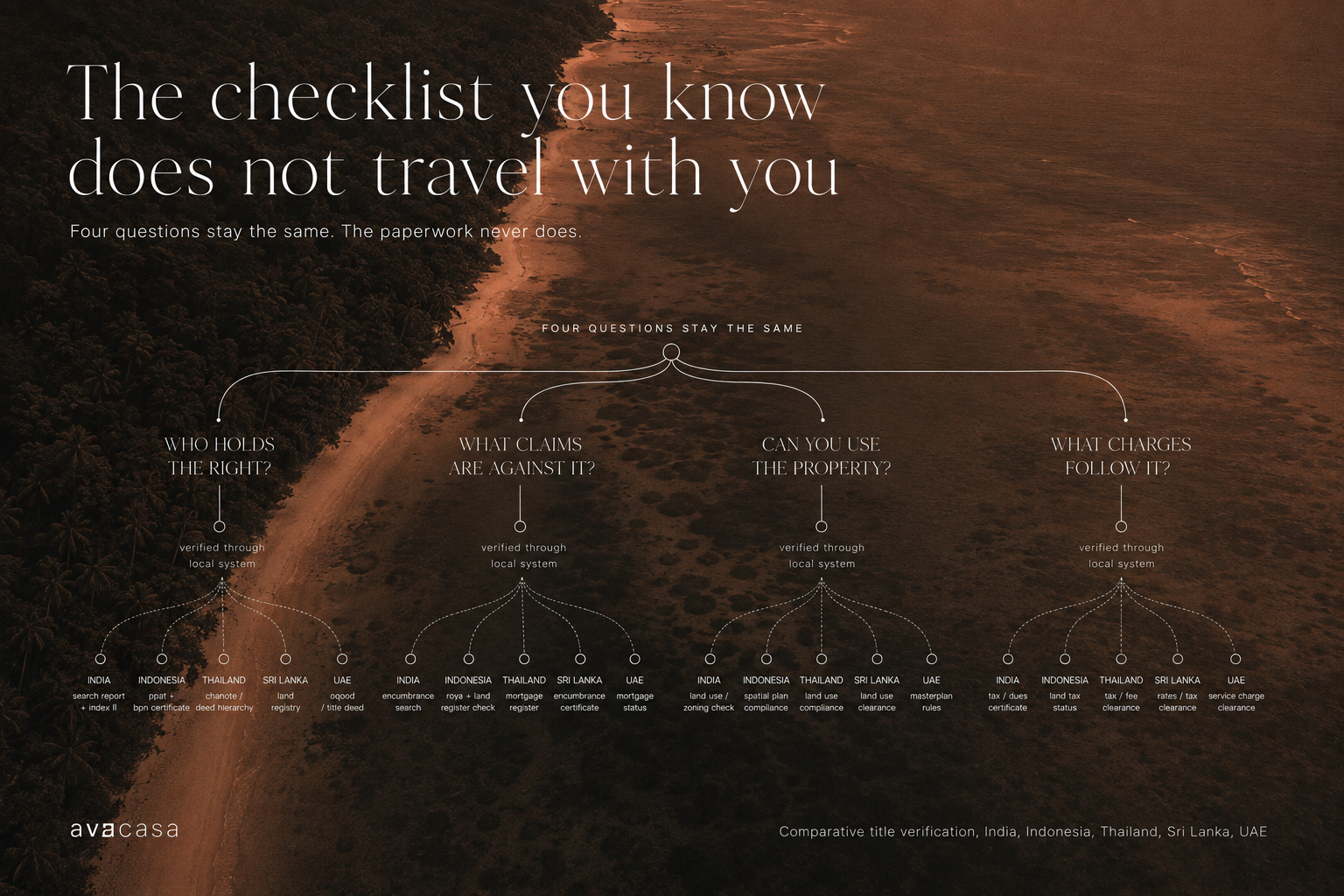
Due diligence fails abroad in a specific, predictable way: a buyer applies the checklist they already know from home, built around their own country's title system and registration process, to a country that runs on a completely different one, and misses the equivalent step because it does not look like the version they recognise. There is no universal document that proves clean title everywhere. There is a short list of things every legitimate system verifies, whatever the local paperwork happens to be called.
What every system actually verifies, under whatever name
This is a separate question from what kind of right is even on offer; Can Foreigners Own Property Abroad? Freehold, Leasehold and Use Rights covers that first decision, and everything below assumes it has already been answered. Four questions sit underneath every property purchase, anywhere. Is the seller actually the legal holder of the right being sold, and does that right mean what the buyer thinks it means. Is the title free of registered claims against it, a lien, a mortgage, a dispute. Does the intended use of the property, residential, rental, commercial, actually match what local zoning or land-use rules permit on that specific parcel. And are there taxes, fees or charges already attached to the property that transfer with it rather than staying with the seller. Every country answers these four questions through its own institutions and its own vocabulary, and the due diligence that actually protects a buyer is asking all four in the local terms, not assuming the local terms map neatly onto a system from home.
A buyer used to a single land registry producing one authoritative certificate can walk into a market where the equivalent confirmation is split across two separate offices, one confirming the underlying right and a different one confirming the specific registration step just completed, and see only the first document, treating it as the whole answer because that is what a single-document system trained them to expect. The mistake is rarely a failure to check anything at all; it is checking the thing that looked most familiar and stopping there.
Title verification looks completely different by country
In India, the equivalent document is a search report and Index II from the sub-registrar's records. In Indonesia, it runs through a PPAT, a specifically licensed notary who pulls a certified copy of the land certificate from the local BPN office and checks it against the seller's copy, a process Checking a Certificate at BPN Before You Sign and The Role of the Notaris and PPAT in an Indonesian Purchase cover in full. Thailand records land through a hierarchy of title deeds, with a Chanote sitting at the top as full, surveyed ownership and several lesser deed types carrying real limitations that a buyer can easily mistake for equivalent security. Sri Lanka verifies through its own land registry system entirely separate from all three, and property in Bali or elsewhere in Thailand runs on the two systems described above, neither resembling the other. None of these four processes resemble each other, and a buyer who has only ever done the version from one of them is not equipped to recognise whether the version in front of them now is actually thorough or just unfamiliar. Title Search in Maharashtra: Search Report and Index II, Chanote and Lesser Title Deeds in Thailand and Title Verification and the Sri Lankan Land Registry each cover one system in the depth a hub post cannot.
Off-plan purchases need a different check entirely
Buying a completed building and buying one that does not exist yet are not the same due diligence problem, and the second is where buyers most often confuse a preliminary document for a title they do not yet hold. In Dubai, an Oqood is the interim registration an off-plan buyer actually holds before a completed unit converts to a full title deed, and understanding exactly what rights that interim document does and does not carry is the whole exercise, not a footnote to it. Oqood and Off-Plan Title in Dubai: What You Actually Hold covers what that specific gap actually means in practice.
Confirming who actually has the authority to sell
A clean title is not the same question as whether the person or entity presenting it is legally entitled to transact on it. A Power of Attorney used to sell on an absent owner's behalf needs its own verification, since a forged or improperly executed one is a different failure mode from a defective title and just as capable of unwinding a purchase later. Power of Attorney for Overseas Buyers, Done Safely covers how to verify one rather than simply accept its existence. A nominee arrangement, where the name on the title and the actual controlling party are deliberately different people, is a related but distinct failure, and Nominee Ownership Structures and Why They Fail covers why that specific structure collapses in remarkably similar ways across otherwise unrelated legal systems.
What to hire locally, rather than assume
The person most motivated to tell a buyer a title is clean is usually the agent being paid when the sale closes, which is not the same as the person qualified to actually verify it. Every market covered here has its own version of an independent legal or notarial professional whose job is specifically to check the four questions above rather than to close the deal, and paying for that person separately from the agent is not an optional precaution in any of these systems, it is the mechanism by which the verification actually happens rather than being merely asserted.
Sources
- Comparative land registration and title verification practice across India, Indonesia, Thailand, Sri Lanka and the UAE, as covered in the country- and state-level guides linked above
Ready to find your next holiday home?
Browse our curated collection of vacation homes and managed farmland across India and beyond.