Title Verification and the Sri Lankan Land Registry

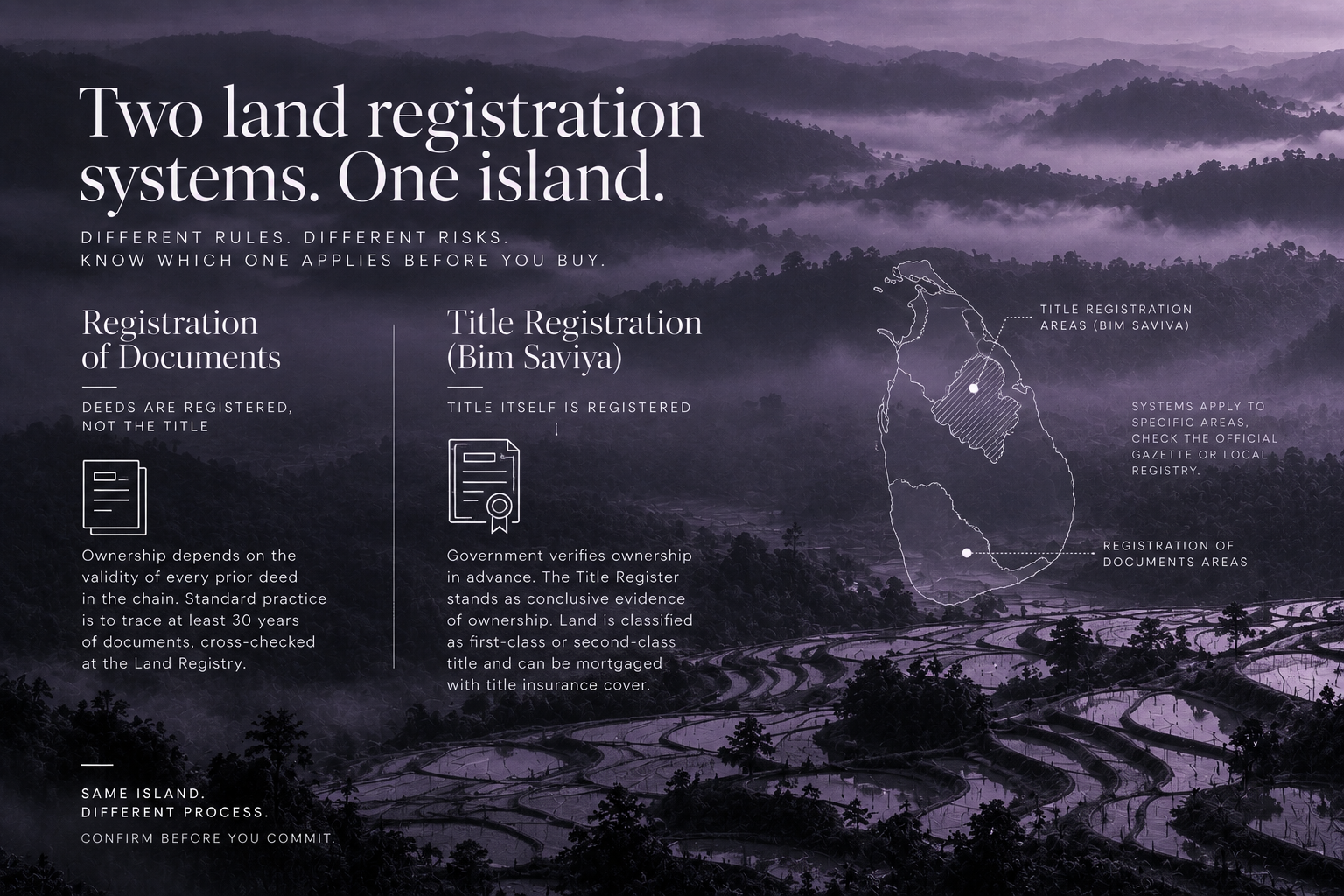
Two properties in Sri Lanka, sitting a few kilometres apart, can require entirely different title verification processes, and a buyer who does not know which system applies to a specific parcel is at real risk of applying the wrong checklist entirely. Sri Lanka runs two parallel land registration systems side by side, not one national standard, and confirming which one governs a given property comes before any other verification step.
The two systems, and why they are not interchangeable
The Registration of Documents system, the older and still more widespread of the two, registers the instruments, the deeds themselves, rather than the underlying title, which means ownership genuinely depends on the validity of every prior deed in the chain, not on the fact of registration alone. The Title Registration system, known as Bim Saviya and built on Torrens principles, instead registers the title itself: once land is brought into this system, the government has already investigated ownership through the Commissioner of Title Settlement, and the resulting entry in the Title Register stands as conclusive evidence of ownership, not simply one more document in a chain a buyer still has to independently verify.
How to actually find out which system applies
Title Registration operates only in specific, designated areas published in official government gazettes, which means a buyer cannot assume either system applies by default and has to confirm the specific parcel's status directly, either through the relevant government gazette notification or by checking with land registry officials in the district the property sits in. A buyer who assumes every Sri Lankan property sits under the more protective Bim Saviya system, simply because it exists and sounds more reassuring, may in fact be looking at a Registration of Documents property that requires the considerably more involved deeds-chain verification described below.
What verification actually looks like under the deeds system
Where the older Registration of Documents system applies, the standard, lawyer-recommended practice is tracing the chain of ownership back at least 30 years through prior deeds and survey plans, cross-checked directly against the Land Registry's own records rather than accepted from copies the seller provides. This is a genuinely more labour-intensive process than a single title check, since a break or defect anywhere in that 30-year chain, a disputed prior transfer, an unresolved inheritance, an improperly executed deed, can undermine the current owner's title regardless of how straightforward the immediate transaction looks. A buyer treating this as a formality to rush through, rather than the substantive legal work it actually is, is taking on exactly the risk this system's own structure makes possible.
Why a Title Registration property is a genuinely different proposition
Where Bim Saviya applies, land is classified as either first-class or second-class title, and the government's own prior investigation replaces most of what a deeds-system buyer would otherwise have to verify independently. A first-class title carries close to the strongest ownership certainty the Sri Lankan system offers, and land under this system can also be mortgaged with title insurance cover, an option not equally available in the same form under the older system. This does not eliminate the value of independent legal advice, but it does mean the actual verification burden, and the specific risks a buyer's lawyer should be checking for, are materially different from a deeds-system property a few kilometres away.
What Avacasa recommends
Confirm which of the two systems governs a specific property before assuming any particular verification process applies, checking the relevant government gazette notification or the district land registry office directly rather than the seller's own characterisation of the title. Where the deeds system applies, insist on the full 30-year chain being traced and cross-checked at the registry, not simply reviewed from copies supplied by the seller, and treat any gap or inconsistency in that chain as a reason to pause rather than a technicality to work around. Can Foreigners Own Land in Sri Lanka? The Current Position and The 99-Year Lease Route in Sri Lanka cover the ownership structures this title verification sits underneath, regardless of which registration system applies.
Before you commit
Owning Property in Sri Lanka as a Foreigner: The Complete Guide covers the wider ownership framework, and Sri Lankan Property Taxes and Transfer Costs for Foreigners covers the cost side of a transaction this verification work sits alongside. How to Read a 7/12 Extract Before You Buy covers a structurally similar verification habit in a different country, worth reading for the parallel it draws, and Due Diligence When Buying Property in Another Country covers the broader discipline this specific check is one part of. Hak Milik, Hak Pakai and HGB: The Three Titles That Matter is worth reading for a similarly structured verification question in a different Asian market, and 10 Questions to Ask Before Signing Anything covers the same discipline applied domestically.
Whatever the destination inside the country, Sri Lanka covers a wide enough range of markets that both registration systems appear across different districts, and confirming which one applies to a specific plot is never safe to assume from the destination alone, and the same holds across Thailand and Dubai, where a different national framework applies just as uniformly within each country.
Sources
- Sri Lanka's two parallel land registration systems: Registration of Documents and the Torrens-based Bim Saviya Title Registration system
- The standard 30-year deeds-chain verification practice under the Registration of Documents system
Ready to find your next holiday home?
Browse our curated collection of vacation homes and managed farmland across India and beyond.