Sri Lankan Property Taxes and Transfer Costs for Foreigners
A foreign buyer pricing a Sri Lankan property purely on its asking price is missing the single largest line item in the entire transaction, and it is not a small one. The taxes and transfer costs that apply specifically to foreign ownership here run considerably higher than the standard local buyer would pay, and understanding the current framework, and how much it has already changed over the past two decades, matters before any price comparison against a local buyer's equivalent purchase is taken at face value.
Stamp duty applies to everyone, and is the smaller piece
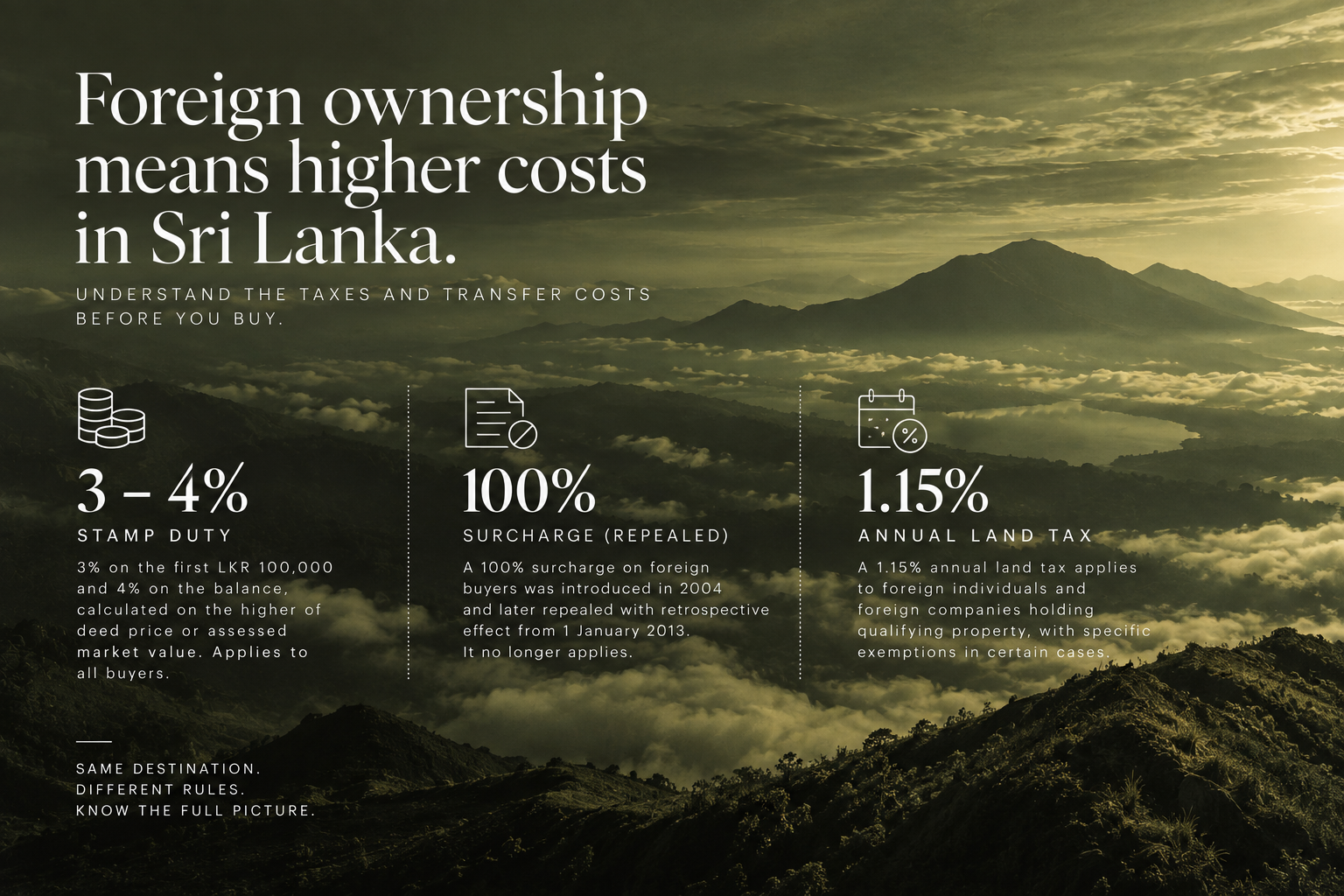
Stamp duty on a property transfer in Sri Lanka is charged at 3 percent on the first 100,000 rupees of the property's value and 4 percent on the remaining balance, calculated on whichever is higher, the price stated on the deed or the market value assessed by the relevant Provincial Department of Revenue. This is paid by the buyer, customarily, to the Provincial Council where the property sits, before the deed can be registered at the Land Registry, and it applies to any buyer, foreign or Sri Lankan, in the same way.
The foreign-buyer surcharge history is genuinely complicated, and worth getting right
A 2004 amendment to Sri Lanka's Finance Act imposed a surcharge equivalent to the full value of the property, effectively doubling the cost, on any acquisition of immovable property by a non-citizen. This provision was subsequently repealed, with retrospective effect from 1 January 2013, removing that specific 100 percent surcharge from the framework entirely. In its place, the Land (Restrictions on Alienation) Act No. 38 of 2014 introduced a different mechanism: a general prohibition on transferring land in Sri Lanka to foreigners and foreign-owned companies, with specific exceptions, alongside a separate, considerably smaller annual land tax applying to foreign individuals and foreign companies that do hold qualifying property. Can Foreigners Own Land in Sri Lanka? The Current Position covers what those exceptions actually are and how the 99-year lease route factors into current foreign ownership structures.
The land tax that applies today
A 1.15 percent annual land tax applies to foreign individuals and foreign companies holding qualifying Sri Lankan property, a genuinely modest figure compared with the repealed 100 percent surcharge, though specific exemptions exist for leases approved under Strategic Development Projects or for foreign companies relocating international or regional operations to Sri Lanka. A buyer assuming the historical 100 percent surcharge still applies is working from outdated information, and a buyer assuming no foreign-specific cost applies at all is equally mistaken, since the 1.15 percent annual tax is real and ongoing rather than a one-time transfer cost.
Why the specific structure a buyer uses changes the tax picture
The 99-Year Lease Route in Sri Lanka covers the leasehold structure many foreign buyers use given the direct freehold restrictions on land, and the tax treatment differs meaningfully depending on whether a foreign buyer holds a qualifying lease, a condominium unit under the specific exceptions that permit foreign condominium ownership, or a structure involving a Sri Lankan company. Confirming which structure actually applies to a specific purchase, before assuming a single uniform tax rate covers every foreign ownership arrangement, is a necessary step rather than a formality.
What actually needs verifying before signing
The specific property's classification under the current framework, whether it falls under a permitted exception to the 2014 restriction, whether the 1.15 percent annual land tax applies to the specific ownership structure being used, and the correct stamp duty calculation based on the higher of deed price or assessed market value, all need independent confirmation from a Sri Lankan lawyer rather than assumed from a general online guide, since the framework has changed substantially over the past two decades and continues to carry real nuance by structure and property type.
What Avacasa recommends
Budget for stamp duty at 3 to 4 percent of the assessed or declared value as a baseline transaction cost applying to any buyer, and separately confirm whether the 1.15 percent annual land tax applies to the specific foreign ownership structure being used. Do not rely on outdated information about the repealed 100 percent surcharge, and do not assume the reverse, that no foreign-specific cost exists at all. Title Verification and the Sri Lankan Land Registry covers the parallel verification question for confirming the underlying title itself is clean.
Before you commit
Due Diligence When Buying Property in Another Country covers the wider verification discipline this tax question sits inside, and How to Verify a Developer's Track Record is relevant where a developer-led project rather than an individual seller is involved. 10 Questions to Ask Before Signing Anything rounds out the practical checklist, and Chanote and Lesser Title Deeds in Thailand and Checking a Certificate at BPN Before You Sign cover structurally similar verification questions in two other Asian markets, worth reading for the parallels each draws.
Whatever the destination inside the country, Sri Lanka, Thailand and Indonesia each run their own distinct tax and transfer framework for foreign buyers, and Sri Lanka's specific history described above, repealed surcharge, current restriction and annual land tax, does not carry over to either of the other two markets.
Sources
- Stamp duty rates on Sri Lankan property transfers: 3 percent on the first 100,000 rupees, 4 percent on the balance
- The repeal of the 100 percent foreign-buyer surcharge, the 2014 Land Restrictions on Alienation Act, and the current 1.15 percent annual land tax on foreign holders
Ready to find your next holiday home?
Browse our curated collection of vacation homes and managed farmland across India and beyond.