Chanote and Lesser Title Deeds in Thailand

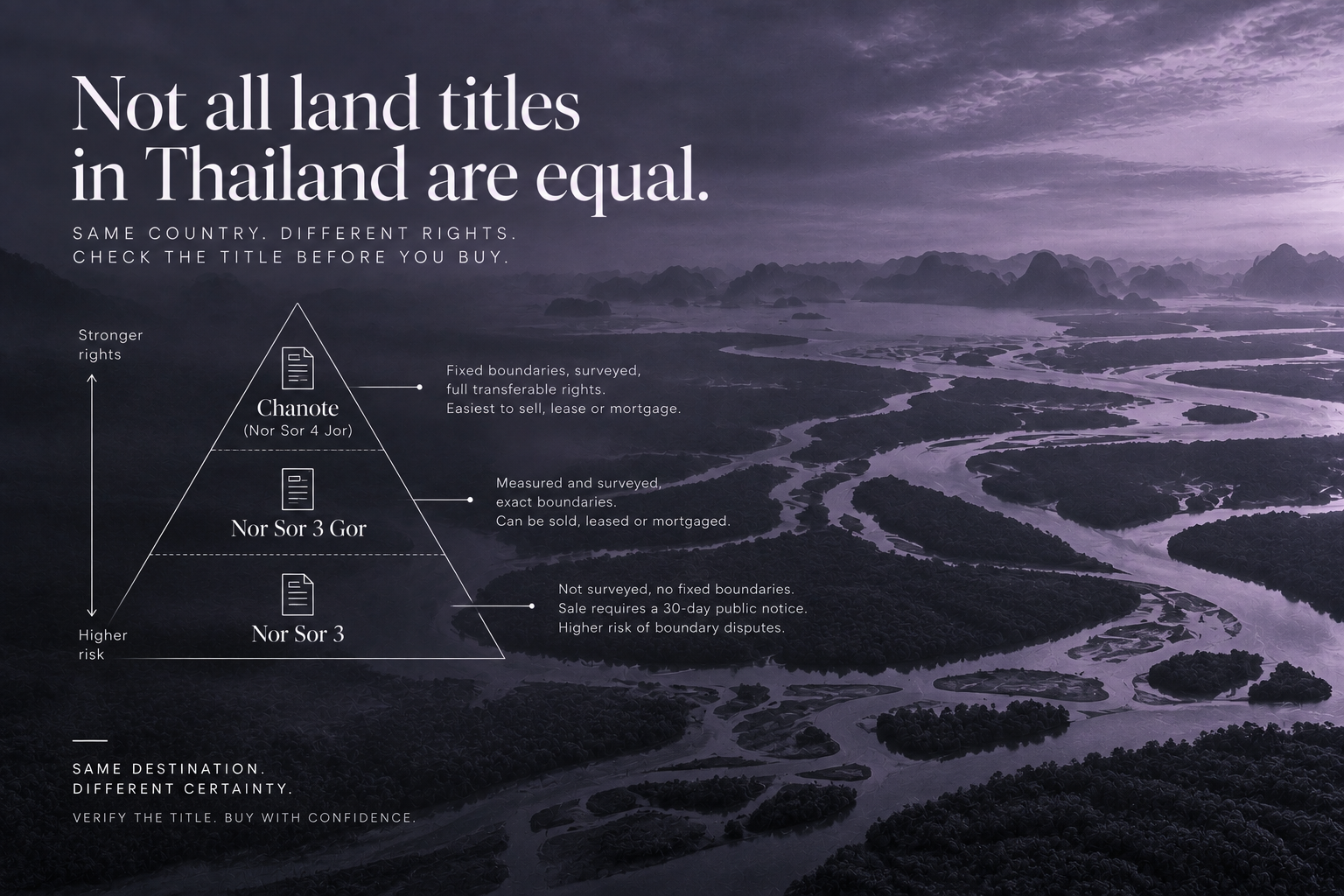
Not every piece of paper called a title deed in Thailand carries the same legal weight, and the gap between the strongest and weakest versions is large enough to decide whether a bank will lend against the land at all. A foreign buyer who has already worked through the structural question of how to hold Thai property, Owning Property in Thailand as a Foreigner: The Complete Guide covers that groundwork, still needs to confirm which specific title the land itself carries before any of those structures matter.
Chanote is the only title that behaves like freehold elsewhere
The Chanote, formally Nor Sor 4 Jor, is the strongest land title Thailand issues. Its boundaries are fixed by satellite survey against the national land grid and marked on the ground with numbered concrete posts that match the deed, and it carries full, transferable rights of possession comparable to freehold ownership in most Western property systems. This precision is not a formality: it is what makes a Chanote plot straightforward to sell, lease, mortgage or subdivide without a separate boundary dispute process first.
The titles beneath it, and what actually separates them
A Nor Sor 3 Gor sits one step below Chanote: the land has been measured and surveyed by the Land Department and has exact, fixed boundaries, and it can be sold, transferred, leased, used as usufruct or mortgaged in essentially the same way as a Chanote property. A plain Nor Sor 3, by contrast, has never been measured by the Land Department, meaning the land has no exact fixed boundaries at all. It can still be sold, but the sale requires a 30-day public notice period first, and the absence of surveyed boundaries carries a real, ongoing risk of a boundary dispute with an adjoining owner that a Chanote or Nor Sor 3 Gor title does not carry. Weaker titles still exist below this tier, generally reflecting land that has not been through any formal survey process, and these carry correspondingly weaker transfer rights and correspondingly higher risk.
Why banks treat this hierarchy as more than paperwork
Fewer than a third of titled land nationwide is full Chanote, which is part of why it commands a genuine price premium over otherwise comparable Nor Sor 3 Gor or Nor Sor 3 land in the same area. Thai banks lend against Chanote-titled land far more readily than against lesser titles, since the fixed, surveyed boundaries remove the collateral-valuation uncertainty a lender would otherwise be exposed to. A buyer planning to finance a purchase, or simply wanting maximum resale liquidity later, should treat title tier as a primary filter on which land to consider, not a secondary detail confirmed after the price is agreed.
What this means for a foreign buyer specifically
The title tier question sits alongside, not instead of, the ownership structure questions that already apply to any foreign purchase in Thailand. The Condominium Quota: The One Freehold Route for Foreigners in Thailand and Thai Land Leases: The 30-Year Rule and Its Limits cover how a foreigner can actually hold an interest in Thai land or a unit regardless of its title tier, but a lease or a condominium unit built on Nor Sor 3 land inherits that land's boundary uncertainty even though the foreign buyer's own legal structure is otherwise sound. Checking the underlying title tier is a separate, necessary step from confirming the ownership structure is itself legal.
What actually needs verifying before signing
The title document itself states which tier applies, but a buyer should independently confirm this at the local Land Department office rather than relying on the seller's or agent's characterisation, since the difference between a Nor Sor 3 and a Nor Sor 3 Gor is not always obvious from a quick look at the paperwork. Where the land is Nor Sor 3, factor the 30-day public notice requirement into the transaction timeline, and treat any boundary dispute risk the seller mentions, or fails to mention, as a reason for an independent survey before proceeding.
What Avacasa recommends
Confirm the exact title tier at the Land Department directly before agreeing a price, since a Nor Sor 3 property carries genuine boundary-dispute risk and a longer transfer process that a Chanote or Nor Sor 3 Gor property does not. Where financing is part of the plan, treat Chanote status as close to a precondition rather than a preference, given how much more readily Thai banks lend against it. Thai Company Ownership of Land and Why It Is Risky is worth reading alongside this, since a risky ownership structure and a weak title tier are separate problems that can compound each other.
Before you commit
Due Diligence When Buying Property in Another Country covers the wider verification discipline this title check is one part of, and 10 Questions to Ask Before Signing Anything rounds out the practical checklist before any Thai purchase closes. How to Verify a Developer's Track Record is relevant where a developer, rather than an individual seller, holds the underlying title. Title Verification and the Sri Lankan Land Registry covers a structurally similar tiered-title question in a different market, worth reading for the parallel it draws. Phuket Through the Year: Monsoon, High Season and the Rate Curve is relevant for a buyer weighing rental income against a title tier's effect on resale liquidity.
Whatever the destination inside the country, Thailand, Indonesia and Sri Lanka each run their own distinct title or land-registration hierarchy, and confirming the specific tier for a specific plot is never safe to assume from the country name alone.
Sources
- The Chanote, Nor Sor 3 Gor and Nor Sor 3 title hierarchy, survey status and transfer rights
- Comparative transfer rights and the 30-day public notice requirement for Nor Sor 3 land sales
Ready to find your next holiday home?
Browse our curated collection of vacation homes and managed farmland across India and beyond.