Condominium Quota: The One Freehold Route for Foreigners in Thailand
A condominium building in Thailand can simply stop selling to foreigners, with no warning printed anywhere on the listing. Once foreign ownership reaches 49% of a building's total registered floor area, the registrar rejects any further foreign freehold application outright, and a buyer who assumed availability based on price and location alone can find out only at the point of registration that the quota is already gone.
The 49% rule, measured in area, not units
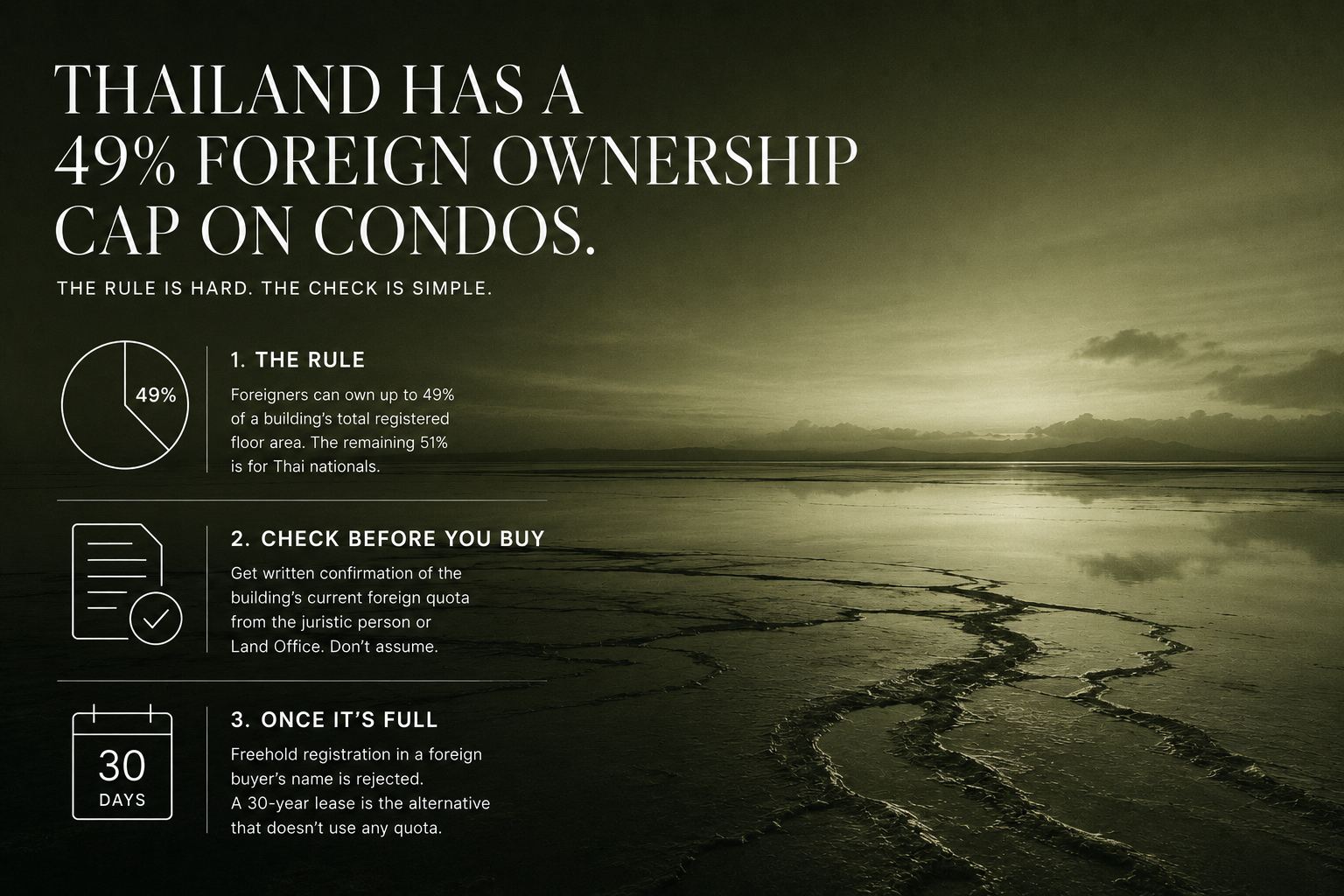
Under the Condominium Act B.E. 2522 (1979), foreign nationals may collectively hold freehold title to no more than 49% of a building's total registered floor area, with the remaining 51% reserved for Thai nationals. The quota is measured in floor area, not in the number of units, so a handful of large foreign-owned units can consume as much of the available space as many small ones. A building where 40% of total floor area is already foreign-owned has 9 percentage points of headroom left, and a single large penthouse can absorb most of that remaining space on its own, regardless of how many individual apartments that leaves technically unsold. Owning Property in Thailand as a Foreigner: The Complete Guide covers this route inside the wider ownership picture; this piece goes further into the quota mechanic specifically.
How to actually check the number, rather than trust a listing
The juristic person, the condominium's own management entity, is legally required to maintain the foreign-ownership register and can provide a written statement of the building's current standing on request. The local Land Office holds the same information and can confirm it independently, though that route typically takes longer to process than asking the juristic person directly. Neither of these is optional due diligence for a foreign buyer specifically: confirming the actual remaining quota, in writing, before signing anything, is the one step that prevents discovering the shortfall only at the registration desk.
What happens once the quota is exhausted
When a building's foreign quota is full, freehold registration in a foreign buyer's name is not merely discouraged, it is rejected outright by the system at the point of registration. This is not a soft cap subject to negotiation with the developer or the juristic person; it is a hard administrative limit enforced at the moment title actually changes hands. A buyer who has already paid a deposit on a unit in a fully subscribed building is relying entirely on whatever refund or alternative-structure terms the sale contract happens to include, which makes confirming the quota before signing a deposit agreement, not just before the final transfer, the more useful sequencing.
Off-plan is where this actually goes wrong most often
The quota is not reserved for a specific buyer the moment a reservation deposit is paid. It is locked only at the point of title registration at the Land Office, which for an off-plan purchase can be a year or more after the reservation itself. A developer can, and in practice sometimes does, sell more foreign-quota units than the building will ultimately have space for, on the assumption that some buyers will fall away before completion, an assumption that does not always hold. A buyer who reserved a unit early, in good faith, on a building that appeared to have plenty of quota remaining at the time, can still find that quota exhausted by other foreign buyers, some who reserved later but registered sooner, by the time their own unit is ready to transfer. Written confirmation from the juristic person is worth re-checking close to the actual completion date, not just at reservation, and worth insisting the confirmation be dated within roughly a week of the inquiry, since a stale confirmation from months earlier says nothing about the building's current standing.
The lease option that sidesteps the quota entirely
A registered 30-year lease on a condominium unit does not consume any part of the 49% foreign quota, because a lease is not a freehold interest and the Condominium Act's ownership cap applies only to freehold title held in a foreign name. This makes a lease a genuine option in a building where the freehold quota is already exhausted, though it is a materially different asset from freehold ownership: a lease expires, freehold does not, and the value proposition of the two is not simply the same property at a discount. Thai Land Leases: The 30-Year Rule and Its Limits covers what a lease of this length actually secures and what a buyer can rely on at renewal.
The reform that has been proposed but is not law
A proposal to raise the foreign ownership quota from 49% to 75% has been studied and discussed, but as of 2026 no draft legislation raising it has been formally submitted to parliament, and the 49% limit remains the current, enforceable rule. A buyer relying on marketing material that describes a higher quota as though it were already in effect is relying on a proposal, not a law, and the distinction matters directly at the point of registration, since the registrar applies the rule that is actually in force rather than the one under discussion.
What this means in practice
Request the juristic person's written confirmation of the building's current foreign-ownership percentage before signing a deposit agreement, not just before final transfer, and treat any verbal assurance that "quota isn't an issue here" as unconfirmed until it is in writing. Where a building's quota is exhausted or close to it, weigh a 30-year lease seriously as an alternative rather than assuming freehold is the only real option, and price that lease as the different asset it actually is rather than as a freehold substitute at a discount. Due Diligence When Buying Property in Another Country covers the wider verification process this quota check sits inside.
Before you commit
Chanote and Lesser Title Deeds in Thailand and Thai Company Ownership of Land and Why It Is Risky cover two other pieces of the same ownership picture, title quality and the workaround structure that fails for the same underlying reason quota exhaustion cannot be sidestepped either. Can Foreigners Own Property Abroad? Freehold, Leasehold and Use Rights covers how Thailand's quota-plus-lease structure compares to the different approaches taken in Owning Property in Sri Lanka as a Foreigner: The Complete Guide and Hak Milik, Hak Pakai and HGB: The Three Titles That Matter, two markets that solve the same foreign-ownership problem in genuinely different ways worth reading side by side rather than assuming one country's rule generalises to the region.
Whatever the specific building, Thailand, Bangkok and Phuket each carry the same national 49% cap, and a quota that is exhausted in one popular building says nothing about the next one down the street.
Sources
- The 49% foreign quota under the Condominium Act B.E. 2522, measured by floor area
- Confirming remaining quota through the juristic person or the local Land Office
- The proposed 75% quota reform remains under study with no draft legislation submitted as of 2026, and a 30-year lease does not consume foreign quota
- Off-plan foreign quota risk: quota is locked at registration, not at reservation, and a developer can oversell it
Ready to find your next holiday home?
Browse our curated collection of vacation homes and managed farmland across India and beyond.