Thai Company Ownership of Land and Why It Is Risky
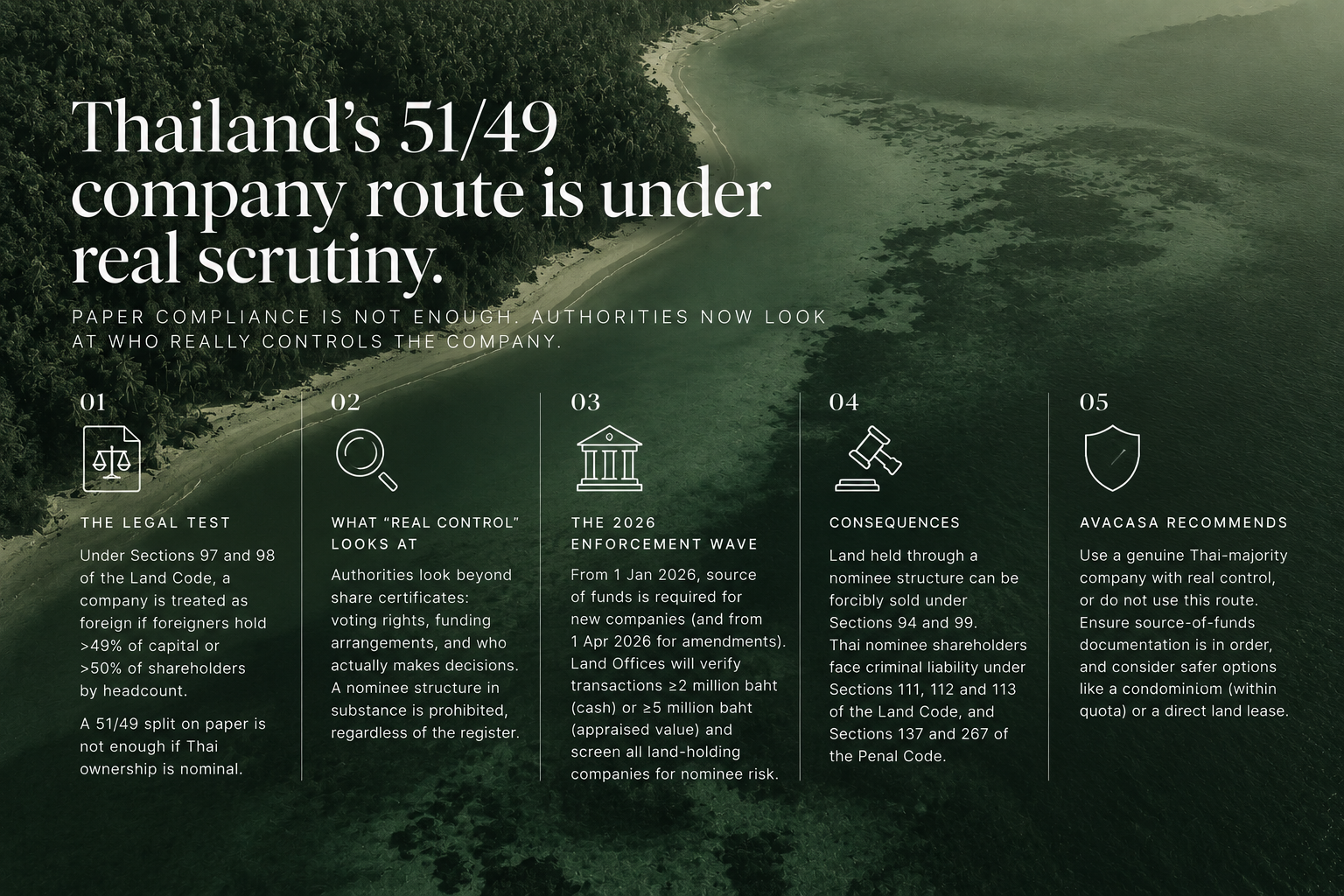
The classic workaround for Thailand's foreign land ban, a Thai company with Thai nationals holding 51% on paper while a foreign buyer actually controls it, has been quietly discussed as an option for decades. As of 2026, Thai authorities have made clear, through a coordinated wave of enforcement rather than any new law, that the paper split has never been the point. What matters, and what is now being actively checked, is who really controls the company, and getting that wrong carries consequences that go well beyond losing the land.
The legal test: Sections 97 and 98, and why the 51/49 split was never the whole answer
Under Sections 97 and 98 of Thailand's Land Code, a limited company is treated as foreign for land-holding purposes if foreigners hold more than 49% of its registered capital, or if foreign shareholders exceed half the company's shareholders by headcount, whichever test the company fails first. A company structured at the standard 51% Thai, 49% foreign split clears this test on paper. It does not clear the test that actually matters if the Thai majority shareholding is nominal, funded by, controlled by, or operated for the benefit of a foreign national in substance, an arrangement Thai law treats as land held on behalf of a foreigner and prohibits outright, regardless of what the shareholder register says.
What "real control" actually looks at
Authorities examining a company's genuine control look past the share certificate to the mechanics underneath it: disproportionate voting rights that hand a minority foreign shareholder practical decision-making power, loan agreements from the foreign party to the Thai shareholders that function as disguised payment for their nominal shares, or a foreign national acting as the sole signatory on the company's bank accounts and contracts despite holding a minority stake. Any one of these can convert an on-paper-compliant structure into a nominee arrangement in substance, and the enforcement environment as of 2026 is built specifically to look for exactly this pattern rather than stop at the shareholder register.
The 2026 enforcement wave, and why it changes the risk calculation
Thailand's Department of Business Development began requiring documentary proof of source of funds for every newly incorporated Thai company from 1 January 2026, and extended the same requirement to all company amendment filings from 1 April 2026. Between 15 and 25 May 2026, the Department of Lands issued three consecutive "Most Urgent" circulars to every provincial Land Office in the country, directing enhanced source-of-funds verification for land transactions involving cash payments of 2 million baht or more, or an appraised value of 5 million baht or more, and requiring every provincial office to build and maintain a database of all juristic persons currently holding land, screened monthly for nominee risk and reported quarterly. None of this reflects a new law. It reflects existing rules being enforced with a consistency and documentation standard that did not previously exist, which is precisely why a structure that went unchallenged for years can now attract scrutiny it never faced before.
What actually happens to land found to be held through a nominee structure
Land identified as held on behalf of a foreign national through a non-compliant company structure is subject to compulsory disposal under Sections 94 and 99 of the Land Code, forcing a sale within a prescribed period rather than allowing the arrangement to continue. The Thai nominee shareholders themselves face potential criminal liability under Sections 111, 112 and 113 of the Land Code, alongside Sections 137 and 267 of the Thai Penal Code, exposure that falls on the Thai individuals who agreed to hold the shares, not only on the foreign beneficiary who arranged the structure. This is a materially different risk profile from simply losing an investment: it is a criminal exposure for people who may have agreed to the arrangement as a favour or for a modest fee, without necessarily appreciating what they were exposed to.
Why this changes the calculation even for structures set up years ago
A structure incorporated a decade ago, before any of this enforcement existed, is not grandfathered out of the current scrutiny simply because it predates it. The provincial database requirement directs every Land Office to catalogue all juristic persons currently holding land and screen the existing register for nominee risk on an ongoing monthly basis, which means a long-standing structure faces the same fresh review as one incorporated last week. A foreign buyer who set up a company structure years ago on the advice that this was standard practice at the time should treat 2026 as the point at which that advice needs revisiting, not assume that age alone provides any protection.
What Avacasa recommends
Treat a Thai company structure as a genuine business vehicle, with real Thai shareholders exercising real decision-making, or do not use it as a route to controlling land at all; there is no version of a nominee arrangement that has become safer under the current enforcement environment. Where a company genuinely qualifies as Thai-majority in substance, ensure the source-of-funds documentation now required at incorporation and amendment stages is in order well before it is requested, since the enhanced verification applies to routine filings, not just to transactions already under suspicion. Condominium Quota: The One Freehold Route for Foreigners in Thailand and Thai Land Leases: The 30-Year Rule and Its Limits cover the two routes that do not carry this exposure, buying a condominium outright within the foreign quota, or leasing land directly rather than attempting to hold it through a company.
Before you commit
Owning Property in Thailand as a Foreigner: The Complete Guide covers where this company route sits inside the wider ownership picture, and Chanote and Lesser Title Deeds in Thailand is relevant for confirming the underlying land title independent of whichever structure is used to hold it. Nominee Ownership Structures and Why They Fail covers this same pattern of foreign control layered under local paper ownership across the other markets this site tracks, and Due Diligence When Buying Property in Another Country covers the verification habits worth applying before relying on any ownership structure at all. Can Foreigners Own Property Abroad? Freehold, Leasehold and Use Rights covers how Thailand's structure compares to Can Foreigners Own Land in Sri Lanka? The Current Position, a market that permits genuine minority-shareholding company ownership under a materially different threshold from Thailand's own.
Whatever the destination inside the country, Thailand, Bangkok and Phuket each carry this same national enforcement regime, and a company structure that seemed workable in one province is not exempt because a different province's Land Office happens to be less active.
Sources
- Sections 97 and 98 of the Land Code: the foreign-company test and why real control, not the paper shareholding split, is what is examined
- The 2026 enforcement timeline: DBD source-of-funds requirements from 1 January and 1 April 2026, and the Department of Lands' May 2026 circulars with specific transaction thresholds
- Compulsory land disposal under Sections 94 and 99, and criminal liability for nominee shareholders under Sections 111 to 113 of the Land Code and the Penal Code
Ready to find your next holiday home?
Browse our curated collection of vacation homes and managed farmland across India and beyond.