Owning Property in Thailand as a Foreigner: The Complete Guide
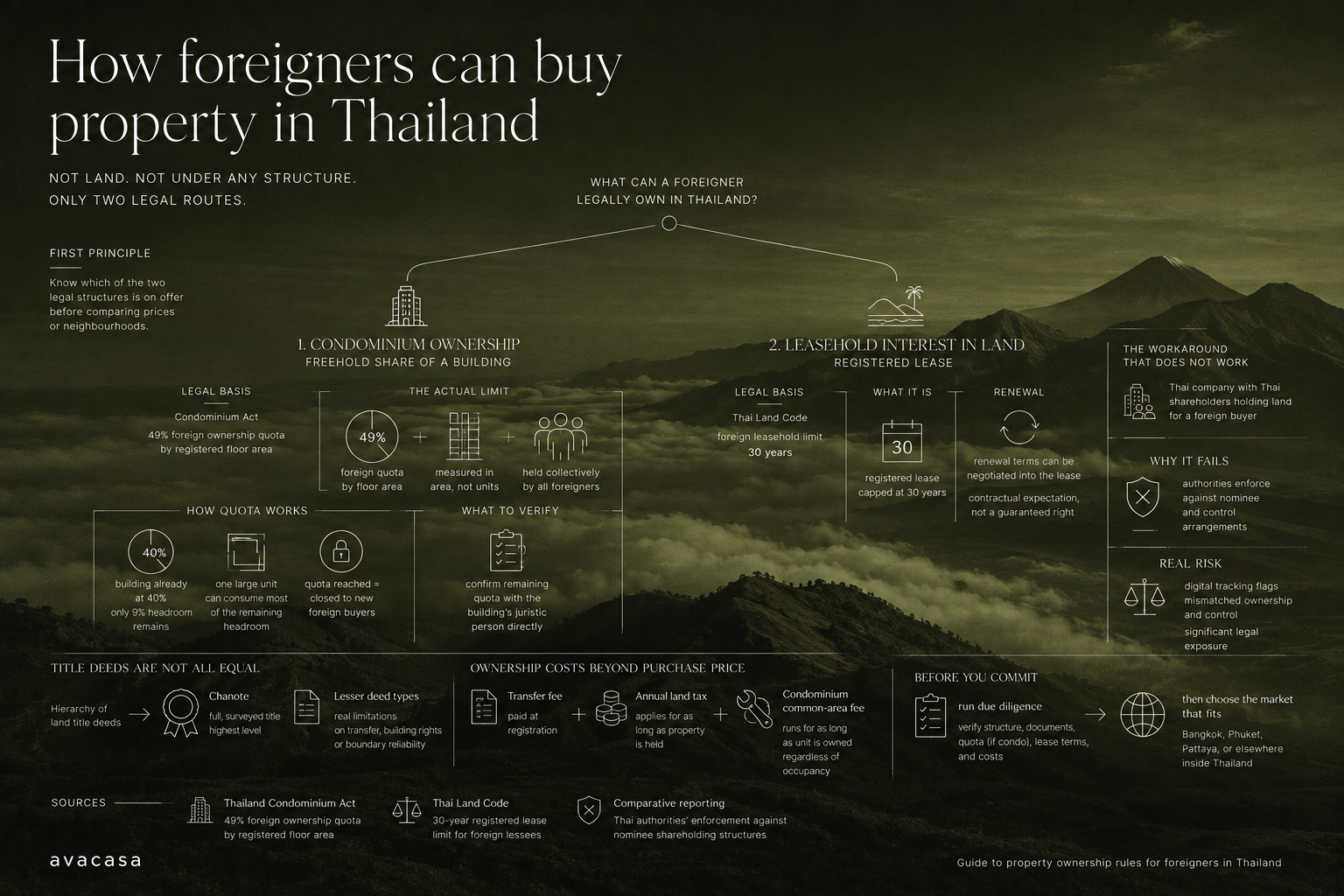
Can a foreigner buy property in Thailand outright? Not land, not under any structure, not at any price, however the listing describes it. What a foreigner can buy is a freehold share of a condominium building, capped by law, and a leasehold interest in land itself, capped at 30 years. Understanding which of those two very different things is actually on offer, before comparing prices or neighbourhoods, is the single rule everything else in this guide sits on top of.
The one freehold route: condominium ownership, and its actual limit
The Condominium Act caps foreign ownership at 49% of a building's total registered floor area, held collectively across all foreign owners in that building. This is measured in area, not units, so a handful of large foreign-owned units can consume the quota as fully as many small ones, and a popular building can simply close to new foreign buyers once that 49% is reached, regardless of how much a later buyer is willing to pay. A building with 40% of its floor area already foreign-owned has only 9 percentage points of headroom left regardless of how many individual units that represents, and a large unit can consume most of that remaining space on its own. This is the one route to holding property outright in Thailand as a foreigner, and it is worth confirming a specific building's remaining quota directly with the juristic person managing it before treating a listing as available, rather than relying on an agent's assurance that space exists. Condominium Quota: The One Freehold Route for Foreigners in Thailand covers how to check this directly rather than take an agent's word for it.
Land itself: a 30-year lease, not a purchase
Foreigners cannot own land in Thailand under any ordinary circumstance, condominium or otherwise. What is available instead is a registered lease, capped at 30 years, with the possibility of renewal terms negotiated into the original agreement, though a renewal promised in a lease is a contractual expectation rather than a guaranteed right under the same statute that caps the initial term. Thai Land Leases: The 30-Year Rule and Its Limits covers what a buyer can and cannot rely on in a renewal clause before signing.
The workaround that keeps reappearing, and why it does not work
A Thai limited company structure, with Thai nationals holding the majority shareholding on paper while a foreign buyer retains actual control through side arrangements such as disproportionate loan agreements or voting rights that do not match the ownership split, is the most persistent version of a foreign buyer trying to hold land as if it were owned outright. Thai authorities have significantly tightened enforcement against exactly this pattern, including digital tracking that flags land held by companies whose registered shareholding does not match their real beneficial ownership. Thai Company Ownership of Land and Why It Is Risky covers why this specific structure is a live legal exposure rather than a shortcut, and Nominee Ownership Structures and Why They Fail covers the same underlying pattern across other countries that fail it in remarkably similar ways.
Title deeds are not all equal
Thailand records land ownership through a hierarchy of deed types, with the Chanote sitting at the top as full, surveyed title, and several lesser deed types below it carrying real limitations on what the holder can actually do with the land, restrictions on transfer, on building rights, or on the reliability of the parcel's own boundaries. A buyer moving from a single-document system elsewhere can easily mistake a lesser deed for equivalent security because it looks like the same kind of paper, stamped and official, without registering that it confers a materially weaker right. Chanote and Lesser Title Deeds in Thailand explains what each deed type actually confirms.
What ownership costs beyond the purchase price
A transfer fee applies at registration, and an annual land tax applies on top for as long as the property is held, separate from any condominium common-area fee, which itself runs for as long as the unit is owned regardless of occupancy. Thai Property Transfer Fees and Annual Land Tax has the current rates, since building a purchase budget around the sale price alone misses a real ongoing cost that does not go away simply because the buyer only visits occasionally.
Before you commit
Can Foreigners Own Property Abroad? Freehold, Leasehold and Use Rights covers how Thailand's condominium-quota-plus-leasehold structure compares to the very different approaches taken elsewhere, and Due Diligence When Buying Property in Another Country covers the verification steps worth running before any purchase closes, regardless of which of these two structures applies.
Whatever the destination inside the country, Thailand covers a wide enough range of markets that the real decision after this eligibility question is settled is which one actually fits, from a condo in an established building in Bangkok to land held on a long lease in Phuket or Pattaya. Each of those markets applies the same national framework above identically; what differs between them is supply, price and how contested the foreign quota already is in the specific buildings a buyer is actually looking at.
Sources
- Thailand Department of Lands: Condominium Act quota and Land Code lease provisions for foreign buyers
- Reporting on Thai authorities' enforcement against nominee shareholding structures holding land for foreign beneficial owners
Ready to find your next holiday home?
Browse our curated collection of vacation homes and managed farmland across India and beyond.