Thai Land Leases: The 30-Year Rule and Its Limits
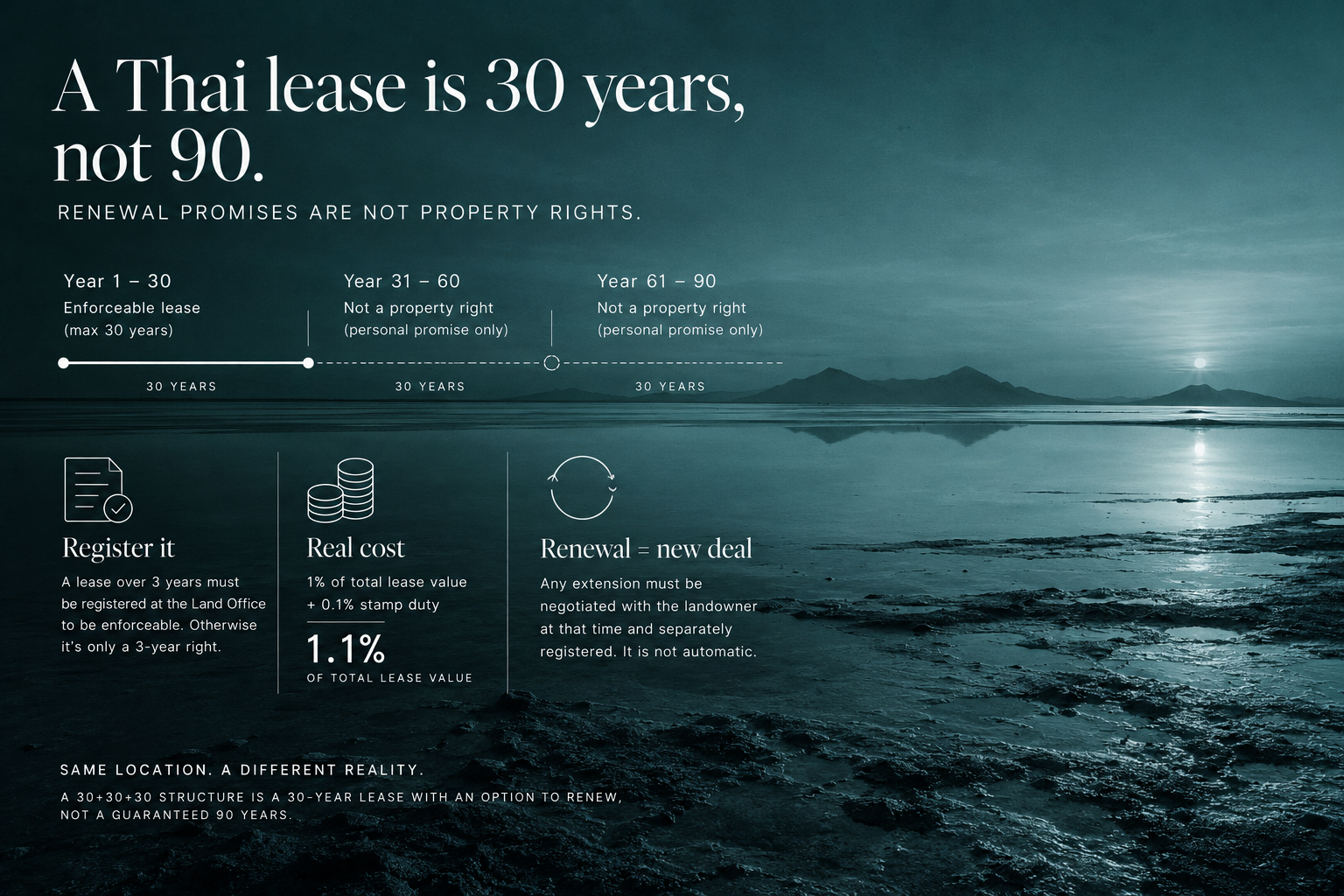
A Thai lease contract promising "30 years, renewable for 30 more, renewable again" reads like a 90-year commitment. As of a 2025 Supreme Court ruling, it is not one. The initial 30 years is real and enforceable. The renewal promises stacked on top of it are not property rights at all, they are a personal promise from whoever signed the original lease, and a buyer relying on that structure to plan for decades ahead is relying on something the courts have now said does not bind anyone but the original landlord.
The 30-year cap itself is not negotiable
Thai law fixes the maximum term for a lease on immovable property at 30 years, full stop. A contract that specifies a longer initial term is not void, it is simply capped: the excess is cut off by operation of law and the lease reads as 30 years regardless of what number the document states. This ceiling has been settled law for a long time and is not the part of this picture that recently changed.
Registration is what actually makes a lease worth anything
A lease exceeding three years has to be registered at the local Land Office to be enforceable against anyone other than the original landlord, most importantly a buyer who later purchases the property. An unregistered lease, whatever term the private contract states, reverts to a maximum enforceable term of three years the moment the underlying property changes hands, since only a registered lease survives a change in ownership. A foreign lessee who never registered the lease has, in practical terms, a three-year right, not the thirty years the paperwork describes, and this is true regardless of how detailed or professionally drafted the unregistered contract itself is.
What actually changed: the 30+30+30 promise no longer means what people thought it meant
The structure most commonly marketed to foreign buyers pairs an initial 30-year registered lease with a pre-signed promise of two further 30-year renewals, often described as a 90-year arrangement. A 2025 Thai Supreme Court ruling, Judgment 4655/2566, held that this stacked renewal promise is not a real property right attached to the land at all. It is a personal contractual obligation binding only the specific landlord who signed it, and it does not transfer automatically to a successor owner if the land is sold. A buyer relying on the renewal clauses to plan sixty additional years past the initial term is relying on a promise that a new owner, should the land ever be sold, has no legal obligation to honour.
What this means for a lease already in place
An existing 30+30+30 lease is not void because of this ruling, the initial 30-year registered term remains exactly as enforceable as it always was. What the ruling removes is the certainty that the second and third 30-year periods will actually happen as originally promised, particularly if the underlying land changes hands before either renewal is exercised and separately registered. A lessee partway through the initial term, with renewals still years away, should treat those future renewals as something to be renegotiated and registered fresh when the time comes, not as an automatic right already secured by the original paperwork.
What registration actually costs, and why skipping it to save a small fee is a bad trade
Registering a lease at the Land Office costs 1% of the total lease value, calculated as the annual rent multiplied across the full lease term, plus stamp duty of a further 0.1%, a combined 1.1% of the lease's total value. On a lease valued at 10 million baht over its term, that works out to roughly 100,000 baht in registration fees and 10,000 baht in stamp duty, a real but modest cost against what is at stake: an unregistered lease is a three-year right dressed up as a thirty-year one. Custom generally has the lessee bear this cost, though it is negotiable between the parties, and treating it as an optional expense to save on is treating the difference between an enforceable thirty-year lease and an unenforceable three-year one as a minor line item rather than the entire point of the transaction.
What actually needs to happen for a renewal to be real
A renewal only becomes an enforceable property right once it is negotiated afresh with whoever owns the land at that time and separately registered at the Land Office, exactly as the original 30-year term was. There is no mechanism in Thai law to lock in that future negotiation in advance, no matter how the original contract is worded. A lessee approaching the end of an initial term should treat the renewal as a new transaction requiring the landowner's actual, current cooperation, not the exercise of a right already guaranteed by a clause signed decades earlier.
What Avacasa recommends
Confirm any lease exceeding three years is actually registered at the Land Office, not simply signed, since an unregistered lease is a three-year right in practical terms regardless of its stated length. Price a 30+30+30 structure as a genuine 30-year lease with an option to attempt renewal, not as a de facto 90-year term, when weighing it against a purchase price or comparing it to freehold alternatives elsewhere. Condominium Quota: The One Freehold Route for Foreigners in Thailand covers the one route to genuine outright ownership this lease structure sits alongside, for a buyer weighing whether a condominium purchase is a better fit than a long-term land lease.
Before you commit
Owning Property in Thailand as a Foreigner: The Complete Guide covers where this lease structure fits inside the wider ownership picture, and Thai Company Ownership of Land and Why It Is Risky covers a different structure entirely that some buyers consider as an alternative to leasing, one that carries its own distinct legal exposure. Chanote and Lesser Title Deeds in Thailand is relevant for confirming the underlying land itself carries a title capable of supporting a registered lease in the first place, and Due Diligence When Buying Property in Another Country covers the verification habits worth applying to any lease before signing. Can Foreigners Own Property Abroad? Freehold, Leasehold and Use Rights covers how Thailand's lease-based approach compares to Owning Property in Sri Lanka as a Foreigner: The Complete Guide and Hak Milik, Hak Pakai and HGB: The Three Titles That Matter, two markets that solve the same foreign-land problem through a shareholding threshold and a use-right title rather than a lease term.
Whatever the destination inside the country, Thailand, Bangkok and Phuket each carry the same national lease framework, and the 2025 ruling applies uniformly across all three regardless of how a specific development markets its own lease structure.
Sources
- Thailand's 30-year maximum lease term and the registration requirement for enforceability beyond three years
- Thai Supreme Court Judgment 4655/2566: the 30+30+30 renewal structure is a personal promise, not a real property right, and does not bind a successor owner
- What is required for a lease renewal to actually become enforceable: fresh negotiation and separate registration
- Lease registration costs: 1% registration fee plus 0.1% stamp duty on the total lease value
Ready to find your next holiday home?
Browse our curated collection of vacation homes and managed farmland across India and beyond.