Hak Milik, Hak Pakai and HGB: The Three Titles That Matter
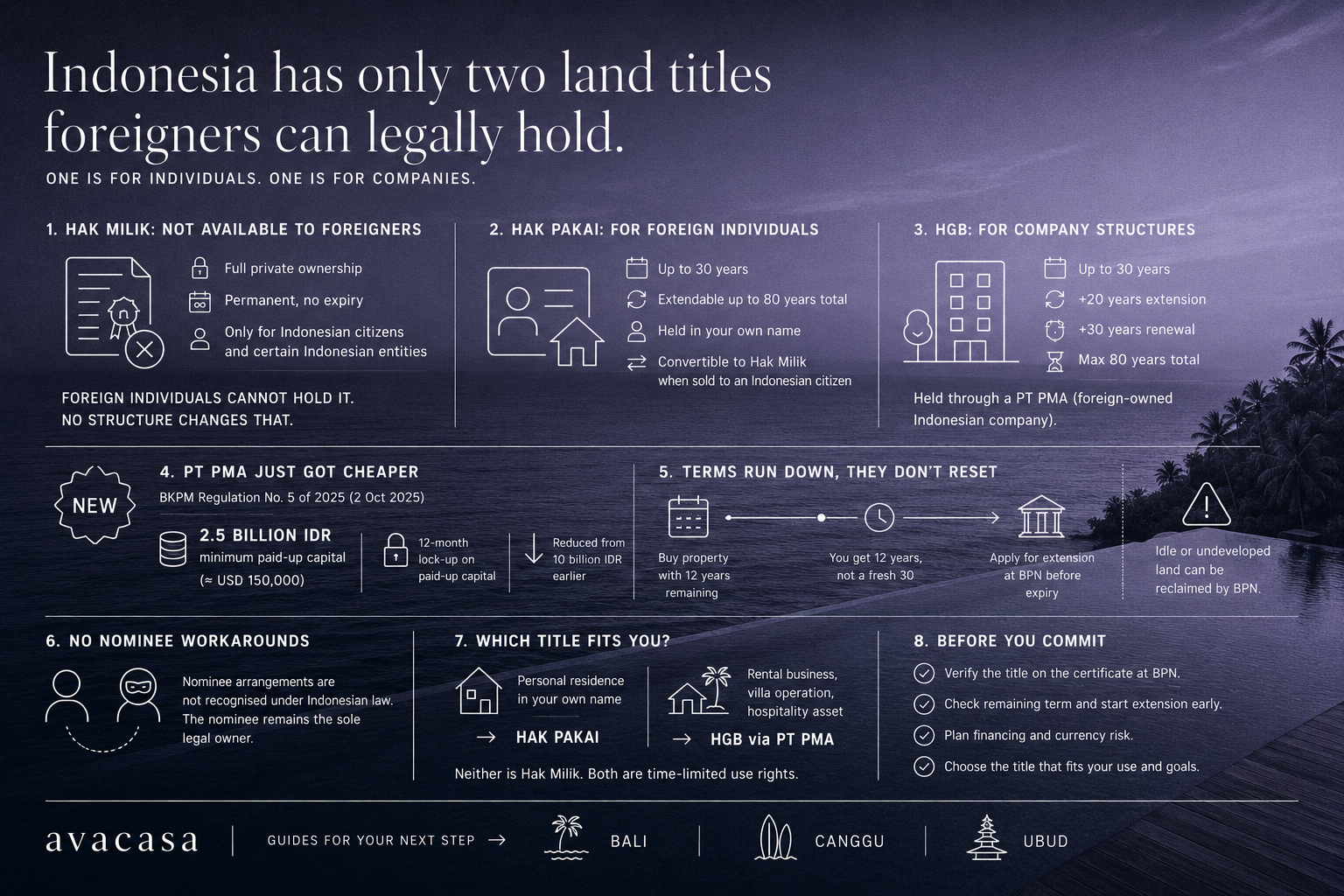
A listing in Indonesia that simply says "freehold" is describing a title a foreign buyer cannot actually hold. Indonesia's Agrarian Law recognises several distinct land rights, and exactly one of them, Hak Milik, is full private ownership, and it is reserved for Indonesian citizens. Understanding which of the other titles, Hak Pakai or Hak Guna Bangunan, actually applies to a specific property is the real question a foreign buyer needs answered before comparing listings on price.
Hak Milik: the one title foreigners cannot hold, under any structure
Hak Milik is Indonesia's closest equivalent to freehold ownership: it does not expire and does not need periodic renewal. It is also, without exception, restricted to Indonesian citizens and certain Indonesian legal entities. A foreign individual cannot hold Hak Milik directly, and no company structure converts a foreigner into someone eligible to hold it. Any arrangement claiming otherwise is describing a workaround, not a legal title.
Hak Pakai: the direct route available to a foreign individual
Hak Pakai, right of use, is the title a foreign individual can hold directly in their own name, for a specific and limited purpose. It runs for up to 30 years, extendable to a combined total of up to 80 years across its renewal terms. It is a registered right, not an informal arrangement, and when sold to an Indonesian citizen it is capable of being converted into Hak Milik in that buyer's hands, though the reverse conversion is not available to a foreign holder. For a foreign individual buying a personal residence rather than operating a business through it, Hak Pakai is generally the more direct route of the two available titles, since it does not require setting up a company first.
HGB: the route built for a company structure
Hak Guna Bangunan, right to build, grants the right to construct and use a building on land the holder does not own outright, since the underlying land remains under state or third-party title. HGB follows the same term structure as Hak Pakai in practice, an initial period of up to 30 years, an extension of up to 20 years, and a further renewal of up to 30 years, for a potential total of 80 years, and the term does not reset when the property changes hands: a buyer purchasing an HGB property inherits whatever remains of the current term rather than starting a fresh 30 years. A foreign individual cannot hold HGB directly. It is held through a PT PMA, a foreign-owned Indonesian limited liability company established under Indonesia's investment law, which is why HGB is the structure most commonly used for a foreign-owned villa operated as a business, a rental property or a hospitality asset, rather than a purely personal residence.
The PT PMA route just became meaningfully cheaper
Setting up a PT PMA to hold HGB land has historically required a substantial minimum paid-up capital commitment, which kept the structure out of reach for smaller individual purchases. BKPM Regulation No. 5 of 2025, issued 2 October 2025, cut that minimum from 10 billion rupiah to 2.5 billion rupiah, roughly USD 150,000, to be fully paid up at establishment, alongside a new 12-month lock-up period on that capital to ensure it actually funds the business rather than being withdrawn immediately after registration. This is a recent enough change that older guides to Indonesian company structures are very likely describing the old, higher threshold. Owning Property in Indonesia as a Foreigner: The Complete Guide covers the ownership framework this capital requirement sits inside.
What happens as the term runs down, and why this is a due-diligence question, not a formality
Neither Hak Pakai nor HGB resets its clock when a property changes hands. A buyer purchasing a villa with, say, 12 years left on its current HGB term is buying 12 years, not a fresh 30, and the listing price should reflect that difference even when the marketing does not draw attention to it. Confirming the actual remaining term means checking the certificate's validity date directly with the local BPN, Indonesia's National Land Agency, office rather than trusting a seller's verbal assurance that renewal is routine. Extension has to be applied for at BPN before the current term lapses, and starting that process well ahead of expiry is standard advice for exactly this reason: a certificate that has already expired requires a different, slower process than a straightforward extension applied for in time. A further, less commonly discussed risk sits alongside the expiry question: Indonesian land administration rules allow BPN to reclaim HGB or Hak Pakai land that has sat deliberately undeveloped or unmaintained for an extended period after the right was granted, which is one more reason an idle plot bought under either title is a genuinely different risk profile from one already built on and in active use.
The workaround that keeps reappearing, and why it fails the same way it does elsewhere
A nominee structure, an Indonesian citizen holding Hak Milik on paper while a foreign buyer controls the property through a side agreement, is not a recognised ownership structure under Indonesian law and carries real legal exposure for both parties, since the nominee remains the sole legal owner regardless of what the private agreement says. Nominee Ownership Structures and Why They Fail covers this same pattern of foreign control layered under local paper ownership across the other markets this site tracks, and the underlying failure mode, that the law recognises only the registered holder rather than the private side agreement, is consistent across every one of them.
Which title actually fits which buyer
A foreign buyer wanting a personal residence, held in their own name without operating a business through it, is generally looking at Hak Pakai. A foreign buyer planning to run the property as a rental business, a villa operation or any other commercial use is generally looking at HGB through a PT PMA, now a meaningfully cheaper structure to set up than it was before October 2025. Neither route is a substitute for Hak Milik, and neither should be marketed or understood as full ownership, since both are, by design, time-limited rights over land the holder does not own outright.
Before you commit
Can Foreigners Own Property Abroad? Freehold, Leasehold and Use Rights covers how Indonesia's use-right system compares to the freehold and leasehold approaches taken elsewhere, and Due Diligence When Buying Property in Another Country covers the verification steps worth running before any purchase closes, regardless of which of these two titles applies. Financing a Property Purchase Abroad and Currency Risk When Buying and Holding Property Abroad are relevant for the same purchase, since a PT PMA's capital requirement is itself a cross-border transfer with its own currency exposure. Where to Buy in Bali: A Micro-Market Map and Is Bali a Good Investment in 2026? An Honest Take cover the destination most buyers actually have in mind when this question comes up.
Whatever the destination inside the country, Bali, Canggu and Ubud each carry the same national title framework, and it is worth reading Owning Property in Thailand as a Foreigner: The Complete Guide alongside this one, since Thailand solves the same foreign-land problem with a genuinely different structure, a straight leasehold rather than a use-right title layered under a local company.
Sources
- Indonesia's Agrarian Law (UU No. 5 of 1960) and the distinction between Hak Milik, Hak Pakai and HGB
- Hak Pakai and HGB term structures, up to 30 years extendable to a total of 80
- BKPM Regulation No. 5 of 2025 cutting PT PMA minimum paid-up capital from IDR 10 billion to IDR 2.5 billion, effective 2 October 2025
- HGB term extension process through BPN, and the risk of reclamation for undeveloped land
Ready to find your next holiday home?
Browse our curated collection of vacation homes and managed farmland across India and beyond.