Financing a Property Purchase Abroad
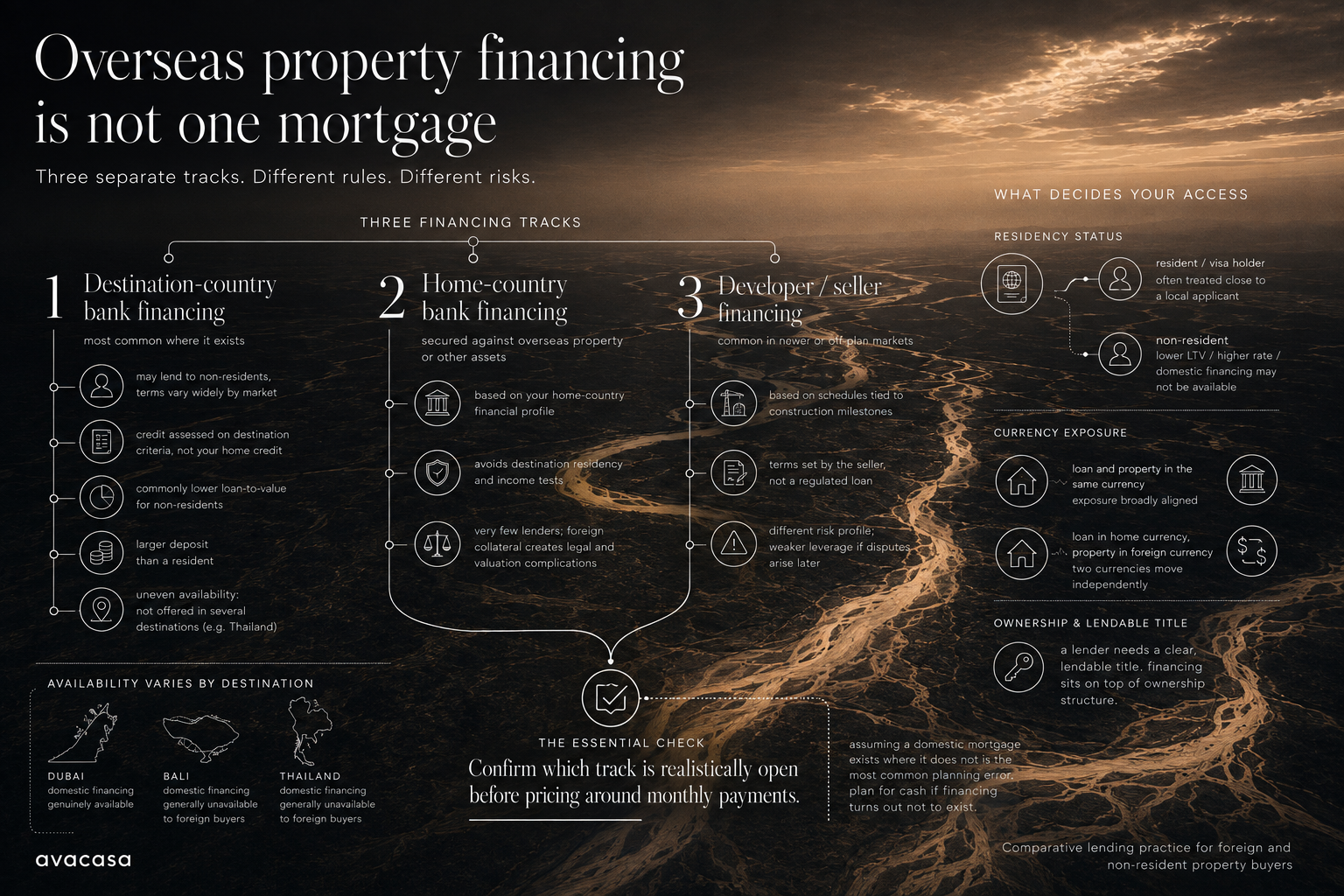
Financing a property purchase abroad rarely works the way a buyer's own bank at home does. Most people assume a mortgage for overseas property is simply their usual bank loan applied to a different address, and it is not: foreign-buyer financing runs on three genuinely separate tracks, and picking the wrong one is how a purchase timeline loses months rather than weeks.
The three tracks, and why they are not interchangeable
The first is a mortgage from a bank in the destination country itself. This is the most common route where it exists at all, but it exists unevenly: some markets lend to non-resident foreign buyers on close to the same terms as a resident, others cap the loan-to-value ratio well below what a local buyer would get, and several of the destinations covered on this site, Thailand among them, do not offer this kind of domestic mortgage to foreign buyers in any ordinary case. Where it is available, it typically asks for income documentation, a credit assessment run on the destination country's own criteria rather than the buyer's home-country credit history, and a larger deposit than a resident would need to put down. A non-resident buyer commonly sees a meaningfully lower loan-to-value ratio than a local buyer applying for the same property, so a purchase priced around a resident's typical financing terms can require a materially larger cash contribution once the actual non-resident terms are quoted.
The second is financing arranged through a bank in the buyer's own home country, secured against the overseas property or against other assets. Very few lenders do this at all, since taking a foreign property as collateral raises legal and valuation questions most domestic mortgage departments are not set up to answer, but where it exists it avoids the destination country's residency and income tests entirely, replacing them with the buyer's home-country financial profile.
The third is financing arranged through the developer or seller directly, common in newer or off-plan markets where an institutional mortgage is not yet the norm. This carries a different risk profile from either bank route: the terms are whatever the seller offers rather than a regulated lending product, and the buyer's leverage to negotiate or dispute those terms later is correspondingly weaker. A payment plan tied to construction milestones on an off-plan purchase is the most common version of this in practice, and it is worth reading such a schedule as a financing arrangement in its own right, with its own default consequences, rather than as a convenience feature of the sale.
What actually decides which track is open to you
Residency status is the single biggest variable, more than nationality itself. A buyer who already holds a residency permit or visa in the destination country is often treated close to a local applicant by that country's banks, while the identical buyer without that status is pushed toward a lower loan-to-value ratio, a higher rate, or excluded from domestic financing altogether. Residency and Visa Routes Tied to Property Ownership covers how a residency route can change this calculation before financing is even discussed, and Can Foreigners Own Property Abroad? Freehold, Leasehold and Use Rights covers the ownership-structure question a mortgage always sits on top of, since a lender needs a lendable title before anything else. A nominee or proxy arrangement will not solve a financing gap either; Nominee Ownership Structures and Why They Fail covers why that specific workaround collapses regardless of which financing track a buyer was hoping to avoid by using it.
Currency risk does not stay separate from the financing decision
A loan taken in the destination country's currency, secured against a property valued in that same currency, keeps the currency exposure on one side of the ledger: the property and the debt move together. A loan taken in the buyer's home currency against a property valued abroad splits that exposure across two currencies that do not move together, and a shift in the exchange rate can change the effective cost of the loan independently of anything happening to the property itself. Currency Risk When Buying and Holding Property Abroad goes through this in more detail than a financing overview can, but it belongs in the financing decision, not as an afterthought once a loan is already signed.
What to actually check before assuming a mortgage is available
Confirm which of the three tracks is realistically open in the specific destination before pricing a purchase around monthly payments rather than the full cash price, since assuming a domestic mortgage exists where it does not is the single most common planning error here. Mortgages for Non-Resident Buyers in Dubai covers one market where domestic financing genuinely is available and on what terms, which is worth reading precisely because it is the exception rather than the rule across the destinations this site covers, from Dubai itself to Bali and Thailand, where it is not. Where no institutional mortgage exists, the realistic options are a home-country loan against other collateral, if a lender can be found, or a cash purchase, and building a purchase timeline around financing that turns out not to exist is a worse outcome than planning for cash from the outset. Due Diligence When Buying Property in Another Country covers the verification steps that sit alongside this decision regardless of how the purchase is funded, and You Keep Going Back to Dubai. Should You Own There? works through a full financing-versus-cash comparison for one specific market rather than in the abstract. Rental Management and Yields in Foreign Holiday Markets is worth reading before financing a purchase you intend to rent out, since a loan's monthly cost has to be weighed against realistic rather than headline occupancy figures.
Sources
- Comparative loan-to-value ratios and down payment requirements for non-resident and foreign national mortgage buyers, by country
- International and foreign national mortgage financing practice across markets
Ready to find your next holiday home?
Browse our curated collection of vacation homes and managed farmland across India and beyond.