Mortgages for Non-Resident Buyers in Dubai

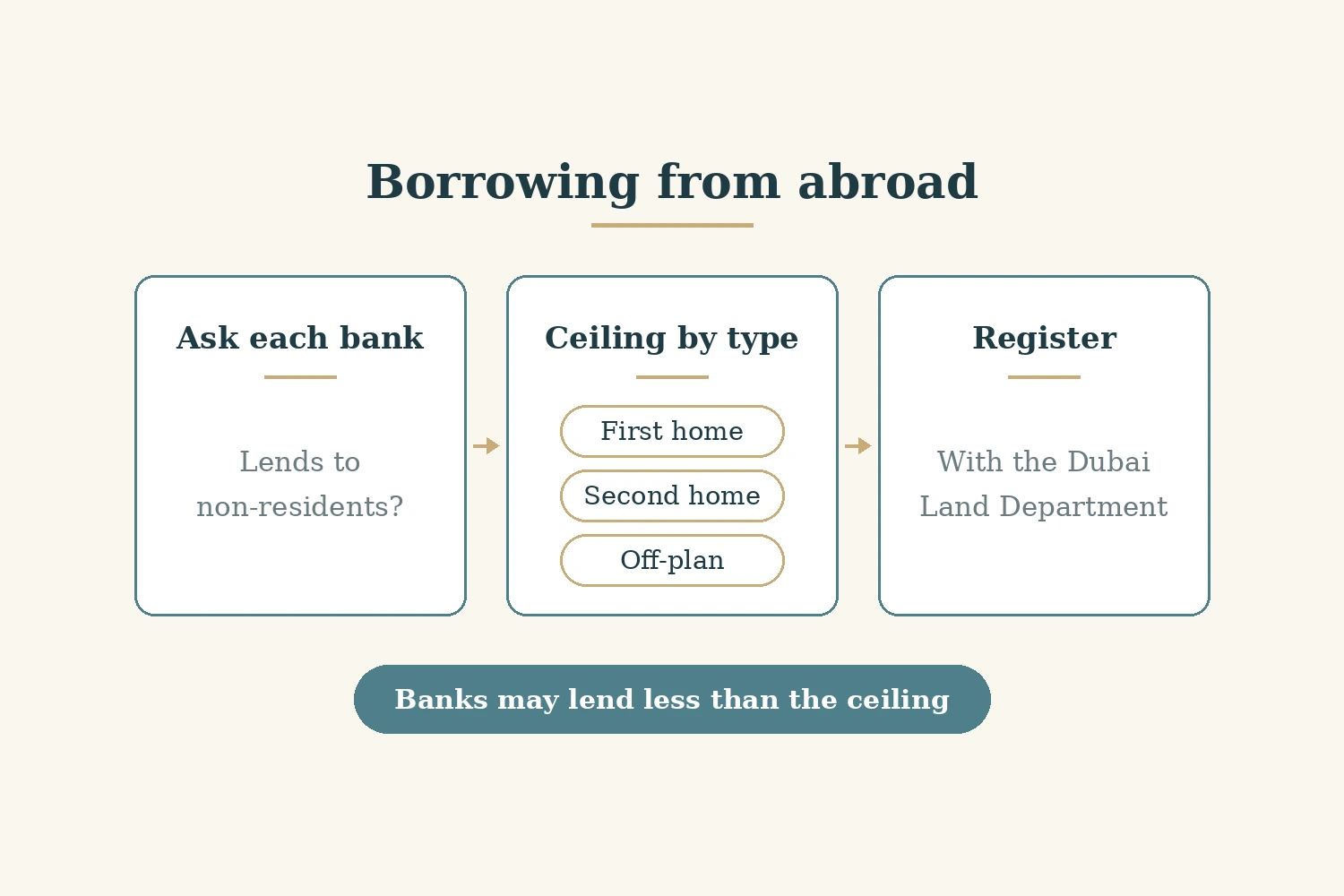
If you live in India and want to buy a home in Dubai with part bank finance, the first thing to know is that the mortgage rules of the United Arab Emirates (UAE) do not have a separate category for you. The Central Bank of the UAE (CBUAE) sorts borrowers into UAE nationals and expatriates, not residents and non-residents. So a non-resident Indian (NRI) buyer sits under the same legal ceilings as an expatriate living in Dubai. What makes borrowing harder from abroad is each bank's own policy, which the rules allow to be stricter. This guide sets out the ceilings, the fees the Central Bank caps, the cost of registering a mortgage with the Dubai Land Department (DLD), and how to plan the cash before you apply. It gives no interest rates and is not financial advice.
The short version: what the rulebook caps
The CBUAE Regulations Regarding Mortgage Loans were issued as Circular 31/2013, effective from 28 December 2013, and amended by Board Resolutions 96/2019 and 31/2/2020 (CBUAE Rulebook, read 4 November 2026). For an expatriate borrower, they set these ceilings:
- Loan to value (LTV), first home: up to 80% for a property worth up to AED (UAE dirham) 5 million, and 70% above that.
- LTV, second home or investment property: 60%, whatever the value.
- LTV, off-plan property: 50%, for every buyer and purpose.
- Debt burden ratio (DBR): repayments of all debts no more than 50% of gross salary and regular income.
- Total financing: no more than seven years' annual income.
- Term: no longer than 25 years.
These are ceilings, not offers. A bank may lend less, and many will to a borrower living outside the UAE. Our Dubai guide and UAE guide describe the market more broadly.
Non-resident is not a category in the regulation
The regulation's introduction says it covers mortgage lending to UAE nationals, nationals of the Gulf Cooperation Council (GCC) states and expatriates, and it distinguishes owner-occupiers from investors (CBUAE, read 4 November 2026). The LTV article uses only three groups: UAE nationals, expatriates and all categories. An India-based buyer is an expatriate for these purposes.
The regulation is a floor, not a promise of credit. Its application section says it sets minimum standards and that nothing in it prevents lenders from adopting more conservative limits where they see fit (CBUAE, read 4 November 2026). That is where non-residents lose ground: in bank policy, not law. Which UAE banks lend to non-residents, and on what terms, we could not confirm from an official source as of 4 November 2026, so the practical step is to ask each bank directly. For comparison, UAE nationals get higher ceilings: 85% on a first home up to AED 5 million, 75% above, and 65% on a second or investment home.
Our guides to foreign ownership by emirate and Dubai's freehold and leasehold zones cover where a foreign buyer can own in the first place.
Loan to value: first home, second home and off-plan
The 80% band was set by Resolution 31/2/2020, effective 8 April 2020, which applies it to an expatriate's first home worth less than or equal to AED 5 million (CBUAE, read 4 November 2026). Each borrower can claim only one property as a first home. A second home or an investment property is capped at 60%.
As a worked example, take a completed villa in DAMAC Hills 2, Dubai, listed from AED 1,200,000, as listed on avacasa.life, 4 November 2026. As a first home, 80% of 1,200,000 is AED 960,000, so the most a bank could lend is AED 960,000 and the buyer needs at least AED 240,000. As a second or investment home, 60% of 1,200,000 is AED 720,000, leaving at least AED 480,000 to find.
Off-plan is capped harder. Article 3 sets the maximum LTV for property bought off plan at 50%, regardless of purpose, value or category of purchaser, citing the higher risk to completion (CBUAE, read 4 November 2026). Take an apartment under construction in Meydan, Dubai, listed at AED 1,690,000, as listed on avacasa.life, 4 November 2026: 50% of 1,690,000 is AED 845,000, so the buyer needs at least the other AED 845,000. How banks fund off-plan purchases in practice, including any stage of construction they wait for, we could not confirm from an official source as of 4 November 2026. Our guides to Dubai's Oqood off-plan title and escrow protection on off-plan homes cover the off-plan side.
How much you can borrow, and for how long
Two tests limit the loan as well as the LTV. The DBR caps total debt repayments at 50% of gross salary and regular income, and the regulation says lenders should not apply the maximum automatically. They must also stress test the loan at 2 to 4 percentage points above the current rate, and where repayments run past expected retirement, the balance then must be serviceable at a DBR of 50% of post-retirement income (CBUAE, read 4 November 2026). On top of that, an expatriate may borrow no more than seven years' annual income; UAE nationals may borrow eight.
The maximum term is 25 years, and the lender sets the maximum age at the last repayment. Repayments must come from salary or verifiable business income, among other sources; an end-of-service benefit cannot be used. Repayments are on a reducing balance, at least quarterly. Loans with an interest-only period are allowed only for investment property, and principal cannot be deferred for more than five years from the first drawdown (CBUAE, read 4 November 2026). The same article requires a first-class mortgage in the lender's name on every financed property, which is why registration with the DLD, covered below, is part of every loan.
Fees the Central Bank caps, and registering with the DLD
The CBUAE's Regulation 29/2011 on bank loans to individual customers caps some home loan fees (CBUAE, read 4 November 2026):
- Early or partial settlement: no more than 1% of the outstanding balance or AED 10,000, whichever is less.
- Late payment: no more than AED 700.
- Liability letter: AED 85.
The same cap of 1% or AED 10,000 applies to the early payment fee when a loan is moved to another UAE bank. A Central Bank cap on a mortgage processing or arrangement fee we could not confirm from an official source as of 4 November 2026.
A mortgage must also be registered with the DLD. Its mortgage registration service lists the fees as 0.25% of the mortgage value, AED 250 for each title deed issued, AED 10 knowledge and AED 10 innovation fees for each drawing, and a service partner fee of AED 4,000 plus value added tax (VAT), or AED 5,000 plus VAT for a provisional (Oqood) off-plan unit (DLD, read 4 November 2026). For an off-plan unit, the developer must issue an electronic no-objection certificate. For non-resident foreigners, the document list asks for a copy of the passport in place of an Emirates ID.
On the villa example above, with a first-home loan of AED 960,000, 0.25% of 960,000 is AED 2,400. Add AED 250 for the title deed, AED 20 for the AED 10 knowledge fee and AED 10 innovation fee on one drawing and AED 4,000 for the service partner, and the total before VAT is AED 6,670.
A cash plan before you apply
Start with the regulation's numbers, then assume a bank may offer less. For a ready first home up to AED 5 million, plan for at least 20% down; for a second home, at least 40%; for off-plan, at least 50%. Add the DLD mortgage fees, and keep a margin in case the bank's own LTV is lower or its valuation comes in below the price.
Many developers advertise payment plans, including plans that continue after handover. Those are the developer's statements and contract terms, not a bank mortgage, and the CBUAE ceilings above do not describe them. Read the plan as a schedule of payments to the developer, and ask what happens if you miss one.
Before you apply, it helps to ask each bank the same short list of questions:
- Do you lend to borrowers who live and earn outside the UAE, and on what LTV?
- Which income documents do you accept from India, and how do you verify them?
- What is the maximum age at the final repayment?
- Do you lend on off-plan units, and at what stage?
- What processing, valuation and other fees apply, in writing?
Comparing the answers side by side shows quickly where each bank sits against the regulation's ceilings. Our guides to booking amounts and refunds and buyer protection for under-construction homes cover that side.
For money leaving India, the Liberalised Remittance Scheme (LRS) sets the route and its limits; our guides to the LRS for buying abroad and the LRS limit explain them. We have no exchange rate for these figures, so we have not converted them.
Who this is not for
This is not for anyone looking for an interest rate or a lender recommendation; we give neither. It does not cover UAE nationals, or Islamic finance products, in detail. It is not financial or legal advice. What Resolution 96/2019 changed in the regulation we could not confirm from an official source as of 4 November 2026. It makes no claim about what a property might earn.
Where that leaves you
As a buyer living in India, you are an expatriate under the CBUAE rules: 80% on a first home up to AED 5 million, 70% above, 60% on a second home, 50% on anything off plan, within a 50% DBR, seven years' income and 25 years. Plan the cash on those numbers, then expect a bank to be stricter. Our guides to cross-border due diligence and buying in the UK, Singapore and the Gulf, plus our Business Bay guide and Dubai Marina guide, cover the rest.
Sources
- CBUAE Rulebook: Regulations Regarding Mortgage Loans (Circular 31/2013)
- CBUAE Rulebook: Application
- CBUAE Rulebook: Article 3, Important Ratios
- CBUAE Rulebook: Resolution 31/2/2020 amending Circular 31/2013
- CBUAE Rulebook: Regulation 29/2011 on bank loans to individual customers
- Dubai Land Department: Request for Mortgage Registration
Ready to find your next holiday home?
Browse our curated collection of vacation homes and managed farmland across India and beyond.