UK, Singapore and Gulf Residents: Reporting and Financing

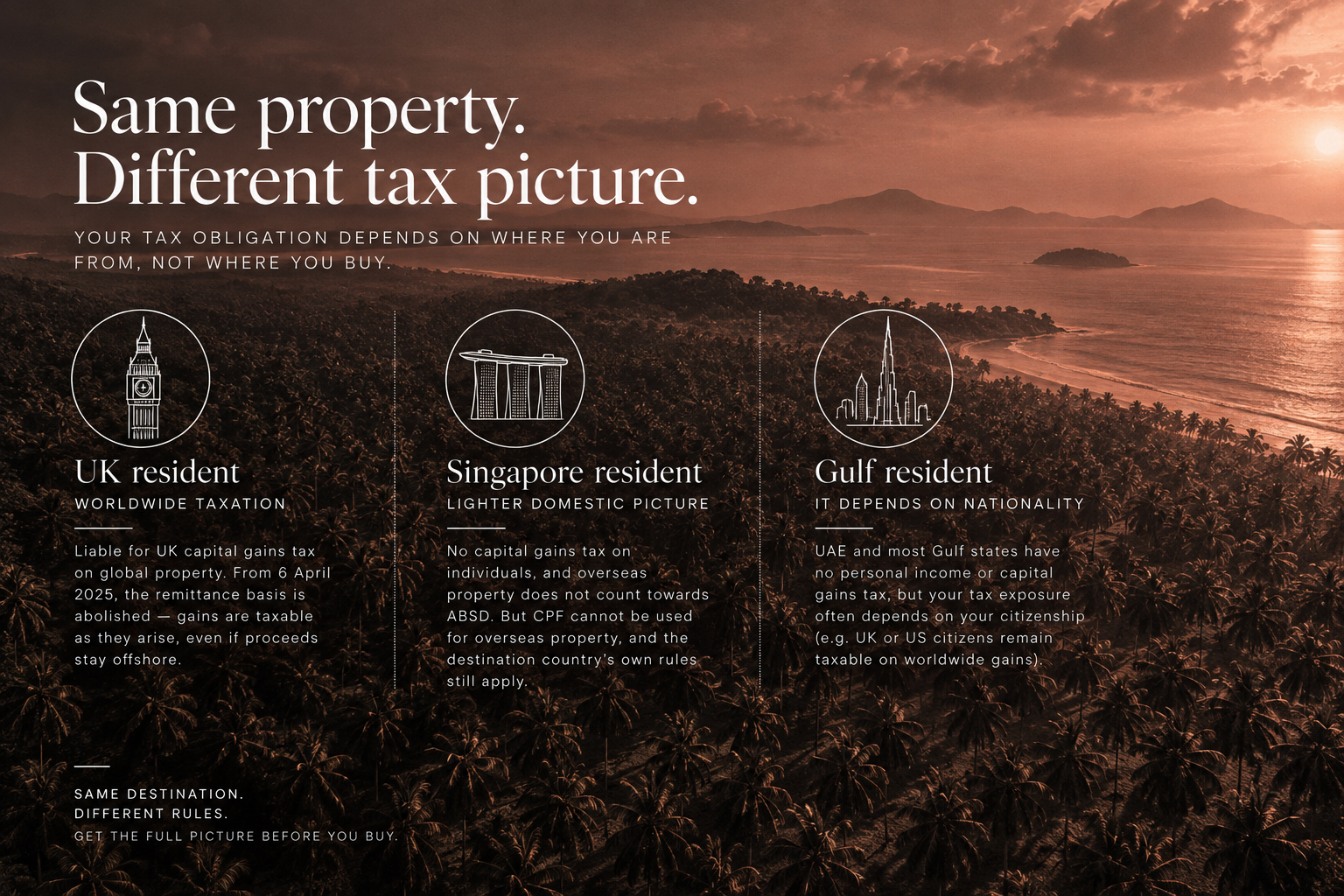
A UK resident, a Singapore resident and a Gulf-based resident can buy the identical overseas property and walk away with three genuinely different tax pictures, and the deciding factor is rarely the property itself. It is where each buyer's own tax obligation actually originates, and for one of these three groups specifically, that turns out to depend more on nationality than on where they currently live.
The UK: worldwide taxation, and a recent change that closed a real gap
UK tax residents are liable for UK capital gains tax on worldwide assets, including property held entirely overseas, and the location of the property does not remove the UK charge. The gain itself is measured in pounds sterling, converted at the exchange rates applicable on the purchase and sale dates, which means a foreign-currency property can produce a real taxable UK gain even where its price barely moved in its local currency. A meaningful recent change matters here specifically: from 6 April 2025, the remittance basis that previously let some UK residents defer tax on foreign gains until the money was brought into the UK was abolished, and most UK residents are now taxed on the arising basis, meaning the gain is taxable in the UK as it arises, regardless of whether the proceeds ever enter a UK account. A UK resident buyer who assumes leaving proceeds offshore avoids the tax bill is working from a rule that no longer applies.
Singapore: a genuinely lighter domestic picture, but not a free pass
Singapore's Buyer's Stamp Duty and Additional Buyer's Stamp Duty apply only to property physically located in Singapore, and an overseas property does not count toward a Singapore resident's ABSD property count at all. Singapore does not levy capital gains tax on individuals in the way the UK or Australia do, which means a Singapore resident's domestic tax exposure to an overseas property purchase is considerably lighter than the other two profiles covered here. This is not the same as no exposure at all: CPF savings cannot be used to purchase or service a loan on property located outside Singapore, which affects financing specifically rather than tax, and the destination country's own purchase, ownership and capital gains rules apply regardless of how light Singapore's own domestic treatment is.
Gulf residents: the UAE itself is not the question that matters
The UAE and most Gulf states levy no personal income tax, capital gains tax or inheritance tax on residents, which leads many Gulf-based buyers to assume an overseas property purchase carries no tax exposure at all. This is true only with respect to the Gulf state's own rules, and it is the least reliable assumption of the three covered here, because a Gulf-based buyer's actual tax exposure depends overwhelmingly on their citizenship rather than their residence. A UK citizen resident in Dubai remains subject to UK tax rules depending on their specific UK tax residency status, which is a separate test from where they currently live, and a US citizen resident anywhere in the Gulf is taxed by the United States on worldwide income and gains regardless of residence, since US tax obligation is based on citizenship, not residency, and does not disappear simply because the individual lives in a zero-tax jurisdiction.
Why nationality, not residence, is the real starting question for a Gulf-based buyer
A Gulf-based buyer evaluating an overseas purchase needs to identify which country, if any, still taxes them by citizenship rather than by residence, and confirm their actual tax residency status in any country they hold ties to, before assuming the UAE's own zero-tax environment settles the question. This is the single most consequential difference between the three profiles covered here: a UK or Singapore resident's tax exposure is governed primarily by where they live, while a Gulf resident's exposure is governed primarily by who they are a citizen of, a distinction that changes the entire due-diligence process before a purchase.
Financing an overseas purchase from each of these three positions
Financing follows a similarly uneven pattern across the three profiles. A UK resident can often arrange financing through international private banking arms of UK-based lenders, though rates and loan-to-value ratios for overseas property are typically less favourable than for a UK property, reflecting the lender's own higher perceived risk on a foreign asset. A Singapore resident's CPF savings are explicitly unavailable for an overseas purchase, which means financing has to come from cash savings or a separate loan facility, often arranged directly with a bank in the destination country rather than through a Singapore lender. A Gulf-based resident, benefiting from generally strong income documentation and often higher relative savings given the zero-tax environment, frequently finds financing more straightforward in practice, though the destination country's own lending rules for foreign buyers still apply regardless of how strong the buyer's underlying financial position is.
Why getting independent advice in the home jurisdiction matters as much as advice in the destination country
A buyer from any of these three profiles who takes advice only from the destination country's agents and lawyers, without separately confirming the home-jurisdiction tax and financing picture, is working with half the information needed to make an informed decision. The destination country's professionals are rarely positioned to advise accurately on UK arising-basis taxation, Singapore's CPF restrictions, or the citizenship-based exposure a Gulf resident might carry, since these are questions about the buyer's home jurisdiction rather than the property itself.
What Avacasa recommends
Identify which of these three pictures actually applies before assuming any one of them by default. A UK resident should plan for worldwide arising-basis taxation and keep currency-converted records from day one. A Singapore resident should confirm financing cannot rely on CPF and should still verify the destination country's own rules carefully, given how light Singapore's own domestic exposure is. A Gulf-based buyer should identify their citizenship-based tax exposure specifically, rather than assuming UAE residence itself determines the outcome.
Before you commit
Can Foreigners Own Property Abroad? Freehold, Leasehold and Use Rights covers the ownership structures this tax question sits on top of, and Due Diligence When Buying Property in Another Country covers the wider verification discipline before any offshore purchase. Australians Buying Abroad: CGT and Foreign Income Reporting covers a structurally similar worldwide-taxation picture for a fourth buyer profile, worth reading for the parallel it draws with the UK case above. How to Verify a Developer's Track Record, How to Negotiate Land Price Like a Pro and 10 Questions to Ask Before Signing Anything round out the practical checklist regardless of the buyer's home jurisdiction. Chanote and Lesser Title Deeds in Thailand and Checking a Certificate at BPN Before You Sign are relevant for a buyer specifically considering those two markets.
Whatever the destination, Thailand, Indonesia and Dubai each carry their own local rules, and the home-jurisdiction tax obligation described above applies on top of every one of them regardless of which destination is chosen.
Sources
- The UK's move to arising-basis taxation on foreign gains from 6 April 2025, ending the remittance basis for most residents
- Singapore's BSD/ABSD applying only to domestic property and the CPF restriction on overseas property financing
Ready to find your next holiday home?
Browse our curated collection of vacation homes and managed farmland across India and beyond.