How to Verify a Developer's Track Record
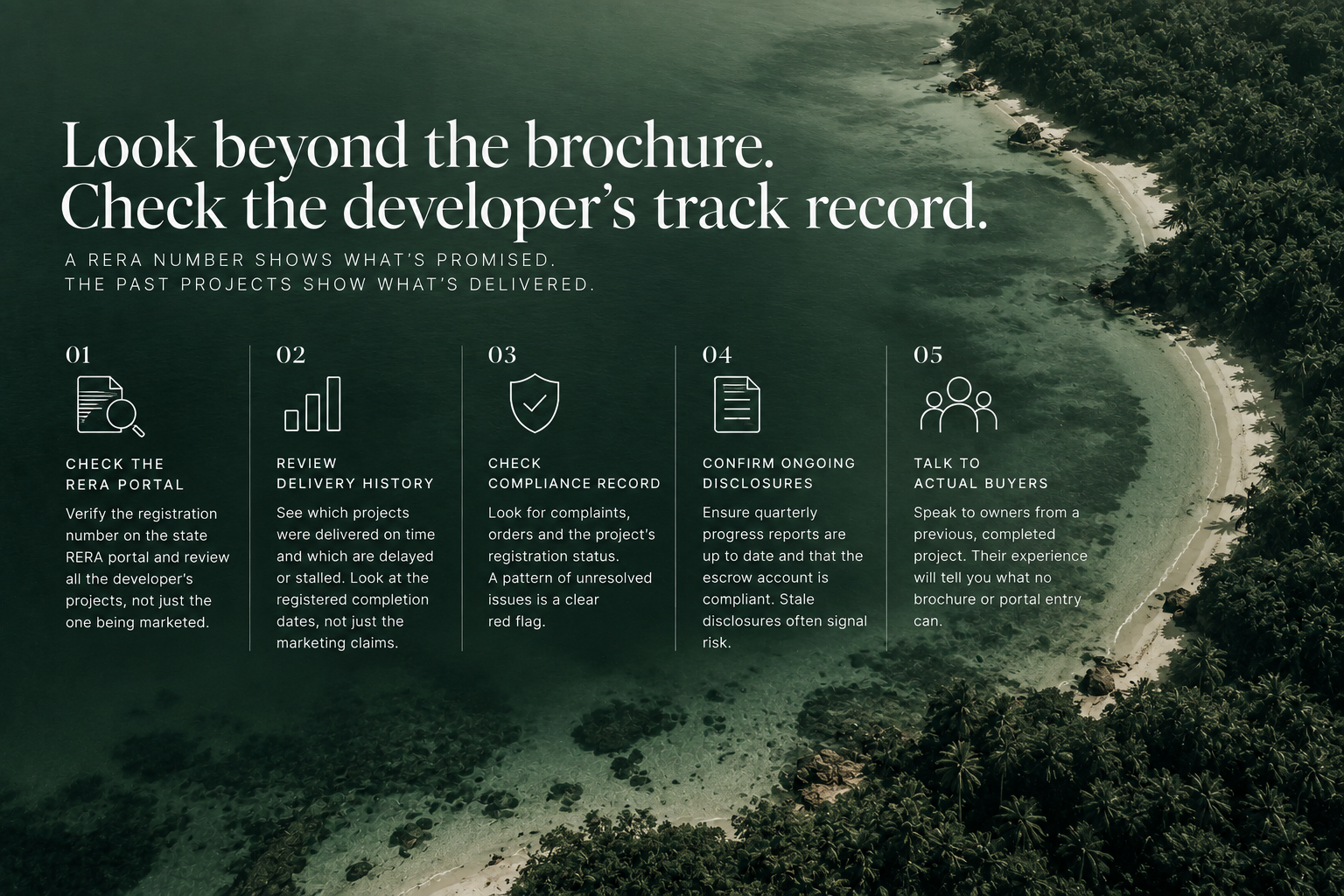
A glossy brochure and a RERA registration number tell a buyer what a developer is promising for this project. Neither one tells a buyer what that same developer actually delivered on the last one, and that gap, between the pitch for the current project and the record on the previous three, is exactly where most bad purchases originate.
Start with the state RERA portal, not the developer's own website
Every state runs its own Real Estate Regulatory Authority portal, and searching a developer's name there, rather than trusting the registration number printed on a brochure, is the first real check. Confirm the number on the brochure actually matches what the portal shows, since a mismatched or fabricated number is a serious red flag on its own. Beyond the current project, the same portal typically surfaces a developer's other registered projects, letting a buyer see the full pattern rather than one carefully chosen example.
What "delivery history" actually means, and how to check it
A developer's genuine track record is the ratio of projects completed on or near their registered timeline against those still delayed or stalled, viewed across every project they have registered, not just the ones currently being marketed. A developer happy to show a buyer their best-performing project while staying vague about two others still years behind schedule is not lying exactly, but is presenting a curated version of a record a buyer needs to see in full. The RERA portal's registration status field, active, lapsed, or the registered completion date itself compared against where a project actually stands today, is the objective version of this story rather than whatever narrative a sales team offers.
Reading the compliance record, not just the registration status
Beyond whether a project is registered, the same portal typically shows complaints filed against a specific project or developer, and any orders the state authority has passed as a result. A developer with a pattern of complaints resolved unfavourably, or repeat orders across multiple projects, is showing a buyer something a clean-looking brochure will not, and this compliance history is worth checking specifically rather than assuming registration alone vouches for conduct. RERA Explained: What Project Registration Actually Protects covers what the registration itself does and does not guarantee, which is the context this compliance check sits inside.
Escrow compliance and quarterly disclosures are a live signal, not a one-time check
A registered project is required to keep quarterly progress reports current on the portal and to maintain the mandated escrow account for buyer funds, and a project where these disclosures have gone stale, quarters passing with no update, is signalling something worth investigating before signing, regardless of how the sales presentation frames the construction timeline. This is a check worth repeating periodically through a purchase decision, not a box ticked once at the start, since a project's disclosure discipline can change over the months a buyer spends deciding.
Talking to actual buyers from a previous project beats any document
A RERA portal shows what a developer was legally required to disclose. It does not show what living through the actual handover process was like, whether promised amenities materialised as specified, or how responsive the developer's after-sales team has been once the sale itself closed. Contacting owners in a developer's previous, already-delivered project directly, through a residents' association where one exists, or simply by visiting the completed project and asking people on site, surfaces exactly the kind of practical detail that never appears in a compliance filing. A developer confident in their own track record generally has no objection to a prospective buyer doing this; reluctance to allow it, or an inability to name a single completed project a buyer could actually visit, is itself informative.
A worked example of what the pattern actually looks like
Take a hypothetical developer marketing a new project with three prior projects on record, two delivered within six months of their registered completion date and one still, three years later, showing an active RERA registration with a lapsed quarterly disclosure history, numbers chosen only to illustrate the pattern rather than describe any specific developer. The two on-time projects are the ones featured in the current marketing material. The third, the one that actually reveals how this developer behaves under pressure, whether from a funding shortfall, a permitting delay, or simple mismanagement, is the one a buyer has to go looking for rather than the one being shown. A pattern of two successes and one quiet failure is not necessarily disqualifying, delays happen to reputable developers too, but a buyer who never finds the third project is negotiating with half the information available.
What to actually do with all of this
Cross-reference the RERA registration number on any marketing material against the state portal directly, request the developer's full list of registered projects rather than accepting the two or three they choose to highlight, and check both the delivery timeline and the compliance history for each one. A developer with several completed, on-time projects and a clean compliance record across them is a genuinely different proposition from one with a single flagship project and several quieter, delayed ones sitting elsewhere in their portfolio, and the only way to tell the two apart is to actually look.
What Avacasa recommends
Treat the RERA portal as the primary source of truth and the developer's own marketing as a secondary, self-interested account of the same facts. Check quarterly disclosure discipline as an ongoing signal through the purchase decision, not a single upfront check, and ask directly for the developer's complete project list rather than the highlighted subset. Financing a Plot: Land Loans, LTV & Construction Loans and How to Negotiate Land Price Like a Pro cover two decisions that should follow this verification, not precede it.
Before you commit
NA Plot vs Agricultural Land: Which Should You Actually Buy? and How to Read a 7/12 Extract Before You Buy cover the underlying land verification that matters alongside developer verification for a plotted project specifically, and Land vs Apartments: The Better Long-Term Asset? is relevant for a buyer weighing a developer-built apartment against land bought independently of any developer at all. Capital Gains Tax on Selling Land in India: The Complete Guide and Due Diligence When Buying Property in Another Country round out the picture for an NRI buyer weighing this purchase from abroad.
Whatever the state, Karjat, Mulshi and Igatpuri each carry their own state RERA portal, and this same verification process applies regardless of which one a specific developer is registered under.
Sources
- Verifying a developer's RERA registration number against the state portal, and confirming registration status and completion timelines
- Checking complaints, orders and quarterly progress report discipline for a specific project or developer
Ready to find your next holiday home?
Browse our curated collection of vacation homes and managed farmland across India and beyond.