RERA Explained: What Project Registration Actually Protects
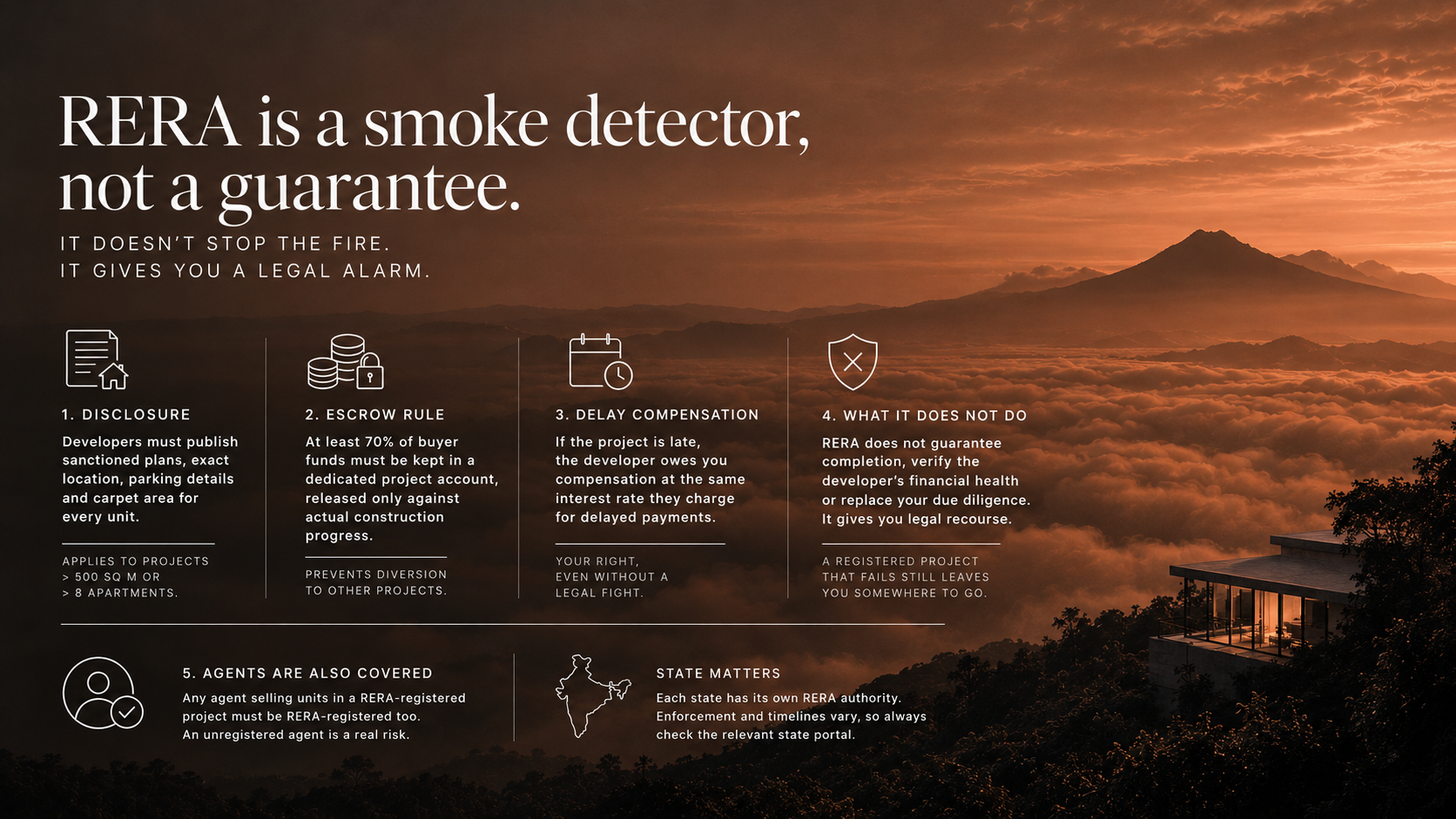
A RERA registration number on a listing gets treated as a seal of approval, proof the project is safe to buy into. What it actually is closer to is a smoke detector: it does not stop the fire, it makes sure there is a working alarm and a documented record of what was promised, so that when something goes wrong there is a specific legal mechanism to act on rather than a builder's word against a buyer's.
What registration actually requires a developer to disclose
Any residential or commercial project above 500 square metres or eight apartments has to register with the state's Real Estate Regulatory Authority before it can be marketed at all, and that registration requires the developer to publish the sanctioned layout plans, the exact project location, garage and parking specifications, and the carpet area of every unit, the usable floor area within the walls, excluding balconies, terraces and shared common areas. A project selling on super built-up area figures without a matching carpet area disclosure is not meeting this requirement properly, and a buyer comparing price per square foot across two projects needs to confirm both are quoting the same basis before the comparison means anything.
The escrow rule: where the buyer's money is actually allowed to go
At least 70% of the funds collected from buyers for a specific project has to sit in a dedicated escrow account for that project alone, released only against actual construction progress on that specific development. This is the mechanism that is supposed to prevent a developer from using one project's buyer payments to fund a different, unrelated project, a pattern that was common enough before RERA to be one of the Act's central targets. It does not guarantee the project finishes on time, but it does mean the money collected for it is legally restricted to being spent on it.
What happens when a project is late
A developer who misses the registered completion date owes the buyer compensation, calculated at the same interest rate the developer itself charges buyers for a late instalment payment, a reciprocity built into the Act specifically so the penalty is not a token amount set arbitrarily by whichever side has more leverage. This right exists whether or not the buyer had to threaten legal action to invoke it, though in practice actually collecting it usually means filing a complaint with the state authority rather than the payment arriving automatically.
What registration does not do
RERA registration does not guarantee the project will actually be delivered, it does not vet the developer's financial health beyond what the registration disclosures require, and it does not substitute for a buyer's own due diligence on the specific unit, the specific building's approvals, or the specific developer's track record on other projects. What it guarantees is legal recourse: a documented set of promises, a regulator with the power to act on non-compliance, and a five-year defect liability period after possession during which the developer is obligated to fix structural or workmanship defects at no cost to the buyer. A registered project that still fails leaves the buyer with somewhere to go; an unregistered one does not.
The protection that has nothing to do with the developer at all
RERA does not only regulate developers. Under Section 9 of the Act, any real estate agent facilitating a sale in a RERA-registered project has to be registered themselves, and an agent cannot lawfully market or sell units in a project that is required to register but has not. This is a protection buyers rarely think to check, since attention naturally goes to the project's own registration status, but an unregistered agent operating around a registered project is still a real exposure, since the accountability the Act is built around assumes the intermediary is answerable to the same regulator as the developer. Confirming an agent's own RERA registration, not just the project's, closes a gap that a buyer focused only on the building itself can miss entirely.
Why the state matters more than the Act itself
RERA is a central Act, but each state runs its own regulatory authority, and the practical experience of filing a complaint, how quickly it is heard, how consistently penalties are actually enforced, varies meaningfully by state rather than being uniform nationwide. A buyer comparing a project in Maharashtra against one in Himachal Pradesh is comparing two different enforcement environments operating under the same underlying law, not two identical systems. The Maharashtra Land Revenue Code: A Buyer's Guide covers how one state's own regulatory apparatus actually functions in practice, which is the level of detail that matters more than the Act's national text alone.
What Avacasa recommends
Check a project's RERA registration number directly on the relevant state authority's own portal rather than trusting the number printed on a brochure, and confirm the carpet area figure being quoted matches the RERA disclosure rather than a larger super built-up figure used in marketing. Treat the registration as a floor, the minimum legal protection a buyer is entitled to, not a ceiling that substitutes for checking the specific developer's actual delivery record on other projects. How to Read a 7/12 Extract Before You Buy covers a different but related verification habit worth applying alongside a RERA check, confirming the underlying land title independent of what the project's own marketing claims.
Before you commit
NA Plot vs Agricultural Land: Which Should You Actually Buy? and Financing a Plot: Land Loans, LTV & Construction Loans cover two questions that sit alongside RERA registration for any Indian property purchase, plotted or built. Capital Gains Tax on Selling Land in India: The Complete Guide and Due Diligence When Buying Property in Another Country round out the picture for an NRI buyer weighing an Indian purchase, and Residency and Visa Routes Tied to Property Ownership covers a related cross-border question for the same buyer. Can Foreigners Own Property Abroad? Freehold, Leasehold and Use Rights is worth reading for an NRI weighing an Indian project purchase against buying elsewhere.
Whatever the state, Karjat, Mulshi and Goa each carry their own state RERA authority operating under the same national Act, and confirming which one applies to a specific project is worth doing before assuming they all work identically.
Sources
- RERA's 500 sq m / 8-apartment registration threshold, carpet-area disclosure requirement, and the 70% escrow account rule
- Delay compensation calculated at the developer's own late-payment interest rate, and the 5-year post-possession defect liability period
- Mandatory RERA agent registration under Section 9, and the restriction on marketing units in an unregistered project
Ready to find your next holiday home?
Browse our curated collection of vacation homes and managed farmland across India and beyond.