Financing a Plot: Land Loans, LTV & Construction Loans
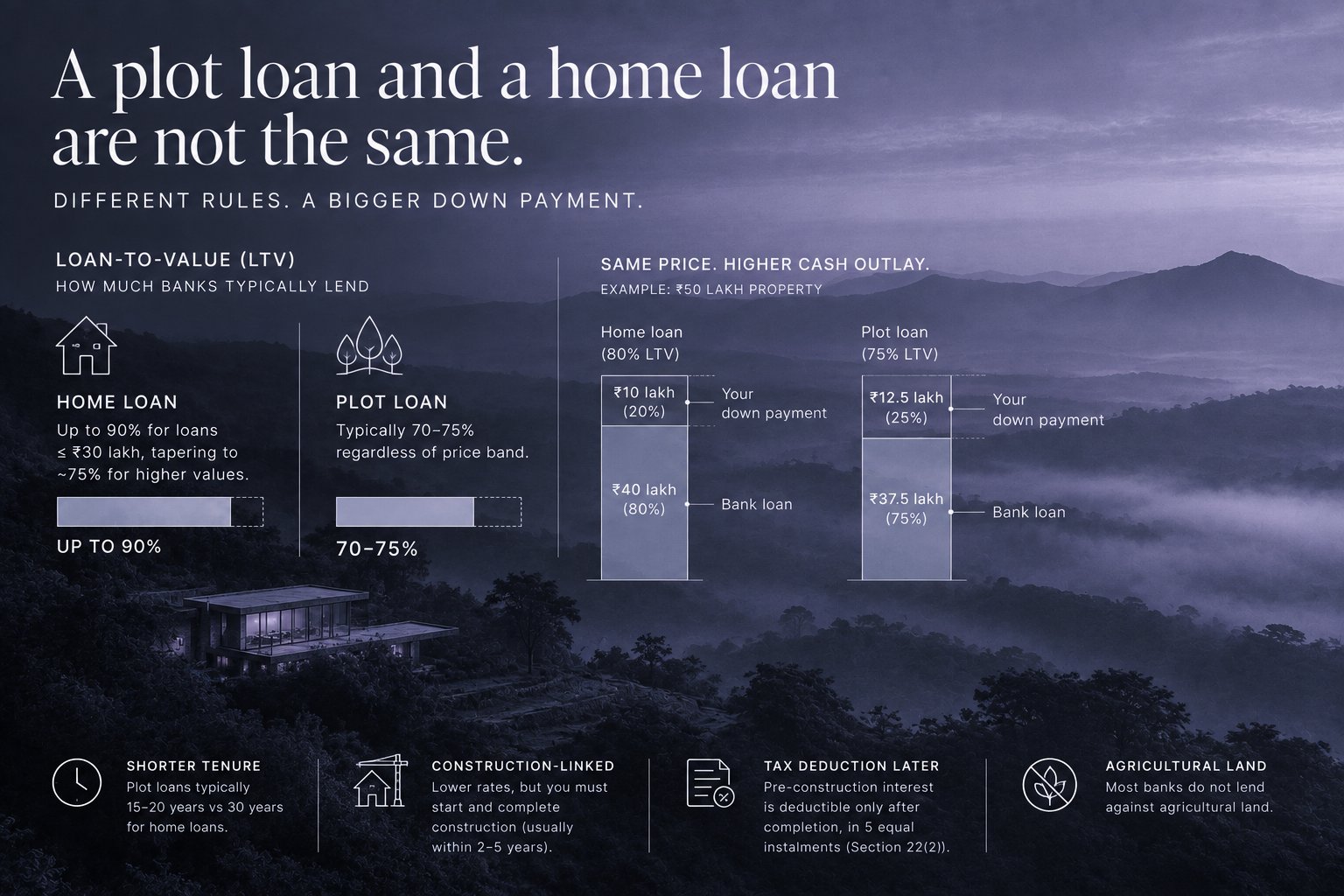
A plot loan and a home loan are not the same product priced differently, they are two different products with different rules attached, and the gap between them catches buyers who assume financing a bare piece of land works the same way as financing a flat. It does not, starting with how much of the price a bank will actually lend against it.
The loan-to-value gap, stated plainly
Home loans in India carry an RBI-linked loan-to-value ceiling that scales with the property's price: up to 90% for loans up to 30 lakh rupees, tightening to roughly 75% for properties above 75 lakh rupees. A plain plot loan, financing land alone with no construction attached, typically caps out at 70 to 75% of the plot's assessed market value regardless of price band, meaning a buyer needs to arrange 25 to 30% as a down payment rather than the smaller contribution a comparable home loan might require. This gap alone changes the cash a buyer needs on hand before a plot purchase can close, and assuming a plot loan will stretch as far as a home loan on the same budget is the first place this assumption goes wrong.
Why plot loans and construction-linked loans are not the same product either
A pure plot loan finances the land only, with no obligation to build, and tends to carry a shorter repayment tenure, typically 15 to 20 years against a home loan's ability to stretch to 30. A composite plot-and-construction loan is a different structure entirely: it finances the land purchase and the subsequent build together, disbursed in stages as construction actually progresses, and lenders commonly require construction to begin within two to three years of the plot purchase. Pricing between these two structures is genuinely inconsistent across lenders, some price a pure plot loan higher than an equivalent home loan on the assumption of weaker collateral, others price a construction-linked plot loan lower up front specifically because the eventual built structure is expected to serve as full collateral once completed, with a penalty rate applied retroactively if construction is not actually completed on schedule. A buyer comparing quotes across banks needs to confirm which of these two structures is actually being quoted, since the headline rate on its own does not say which product it belongs to.
What the LTV gap actually costs in cash, worked through
Take a hypothetical plot priced at 50 lakh rupees, a round number chosen only to make the comparison legible rather than a claim about any specific market. At a 75% loan-to-value ceiling, a plot loan covers 37.5 lakh rupees, leaving the buyer to arrange 12.5 lakh rupees upfront. A home loan on a comparably priced flat, assuming it fell into a band eligible for an 80% LTV, would cover 40 lakh rupees, leaving 10 lakh rupees to arrange. The 2.5 lakh rupee gap between these two down payments is not a rounding difference, it is real cash a plot buyer needs to have ready that a flat buyer at the identical price point would not, and a buyer who has budgeted a flat purchase's typical down payment and simply substitutes a plot at the same price is short by exactly this amount.
Agricultural land is a different problem entirely
Most mainstream banks will not lend against agricultural land at all, a restriction rooted in state-level land laws rather than bank policy alone, and the limited lenders who do offer anything in this category, mostly cooperative and regional rural banks, do so on narrower terms than a standard plot loan. A buyer whose target plot carries agricultural classification needs to confirm financing availability before assuming a plot loan applies at all, since the NA, non-agricultural, conversion question this raises is a separate hurdle from the loan itself. NA Plot vs Agricultural Land: Which Should You Actually Buy? covers that classification question directly.
The construction deadline that changes the interest rate retroactively
A construction-linked plot loan's more favourable pricing is conditional, not permanent. Lenders commonly require a completion certificate within a set window, often two to five years depending on the lender's own policy, and missing that window converts the loan to a standard, higher-rate structure, in some cases with the increased rate applied retroactively to the original disbursement date under the terms of the original agreement. A buyer treating the construction timeline as a soft target rather than a contractual deadline is exposed to a rate increase they did not budget for, applied after the fact rather than announced in advance.
The tax deduction that only shows up after construction
Interest paid during construction is not lost, but it is also not immediately usable: it accumulates as pre-construction interest and becomes deductible only once construction completes, claimed in five equal instalments starting from the year of completion, under what is now Section 22(2) of the Income Tax Act, 2025, the provision previously numbered Section 24(b), effective for the 2026-27 tax year onward with the same 2 lakh rupee cap on self-occupied property carried forward unchanged. The completion itself has to happen within five years of the end of the financial year the loan was taken in, or this deduction path narrows further. A buyer budgeting the tax benefit into their overall financing plan from year one is budgeting for a benefit that does not actually arrive until construction is done and documented.
What Avacasa recommends
Confirm which of the two structures, a pure plot loan or a construction-linked combination, a specific quote actually represents before comparing interest rates across lenders, since the two are priced on different logic and a lower headline rate on one is not automatically the better deal against a higher rate on the other. Treat any construction completion deadline as a contractual commitment rather than a target, and confirm agricultural land financing availability, or the NA conversion timeline, before assuming a plot loan is even on the table for a specific parcel. The Maharashtra Land Revenue Code: A Buyer's Guide and How to Read a 7/12 Extract Before You Buy cover the classification verification this recommendation depends on.
Effective dates and sources
The Section 24(b) to Section 22(2) renumbering under the Income Tax Act, 2025, takes effect from the 2026-27 tax year, with the deduction cap and five-year completion window carried forward unchanged from the 1961 Act.
Total Cost of Ownership: NA vs Agri Over 10 Years is worth reading alongside this for the full cost picture beyond financing alone, and Capital Gains Tax on Selling Land in India: The Complete Guide is relevant for anyone financing a plot purchase with proceeds from selling other Indian property. Due Diligence When Buying Property in Another Country has a domestic equivalent in the same verification discipline worth applying to any financed plot purchase, and Residency and Visa Routes Tied to Property Ownership covers a related cross-border question for an NRI buyer financing an Indian plot from abroad. Can Foreigners Own Property Abroad? Freehold, Leasehold and Use Rights is worth reading for the same buyer weighing this Indian plot purchase against financing a property elsewhere.
Whatever the plot, Karjat, Mulshi and Igatpuri are common destinations where this financing distinction between a plot loan and a construction-linked loan actually matters in practice.
Sources
- Plot loan loan-to-value ratios of 70-75% versus RBI-linked home loan LTV tiers
- Construction-linked plot loan completion deadlines and retroactive rate conversion for missed deadlines
- Section 24(b) renumbered to Section 22(2) under the Income Tax Act 2025, effective from Tax Year 2026-27
Ready to find your next holiday home?
Browse our curated collection of vacation homes and managed farmland across India and beyond.