The Maharashtra Land Revenue Code: A Buyer's Guide
The Maharashtra Land Revenue Code just had its biggest rewrite in decades, and most of what is written about buying land in this state still describes the version that stopped applying on 31 December 2025. If a checklist you are reading mentions a Collector's permission and an annual non-agricultural charge as the normal cost of converting farmland, it is describing a process that no longer exists for most plots in the state.
This guide is the map to the Code as it actually stands now: what decides whether land is buildable, what changed in the conversion process, what it costs, and where the Code restricts a purchase outright. Each section links to a full walkthrough where one exists; this is the overview that ties them together.
What the Code actually governs
Two things about a piece of land are set by the Maharashtra Land Revenue Code before you ever see a sale agreement: its classification, and its official record.
Classification is the line between agricultural and Non-Agricultural (NA) land, and it decides what can legally be built. Agricultural land is meant for cultivation; putting a house or a plotted development on it without converting the classification first is the single most common way buyers in this state end up owning something they cannot use as intended. It is also not a paperwork technicality that gets fixed later: a structure raised on land that is still classified agricultural has no legal basis to exist, and the fix runs through the same conversion process described below, not around it. What 'Non-Agricultural (NA)' Land Status Really Means covers the distinction in full, and NA Plot vs Agricultural Land: Which Should You Actually Buy? works through the trade-off between buying land already converted and buying agricultural land to convert yourself.
The record is the 7/12 extract (Saat Baara Utara), the document that shows who holds the land, its classification, and its area, and Index II, the registration-office record of the transaction itself. Neither is optional reading before you sign anything. How to Read a 7/12 Extract Before You Buy and Title Search in Maharashtra: Search Report and Index II go through both documents line by line.
Converting agricultural land to NA got much simpler in December 2025
This is the change that makes an old guide dangerous. The Maharashtra Land Revenue Code (Second Amendment) Act, 2025 received the Governor's assent on 31 December 2025 and rewrote Section 42, the provision that had required a landowner to apply to the Collector for permission before converting agricultural land to non-agricultural use.
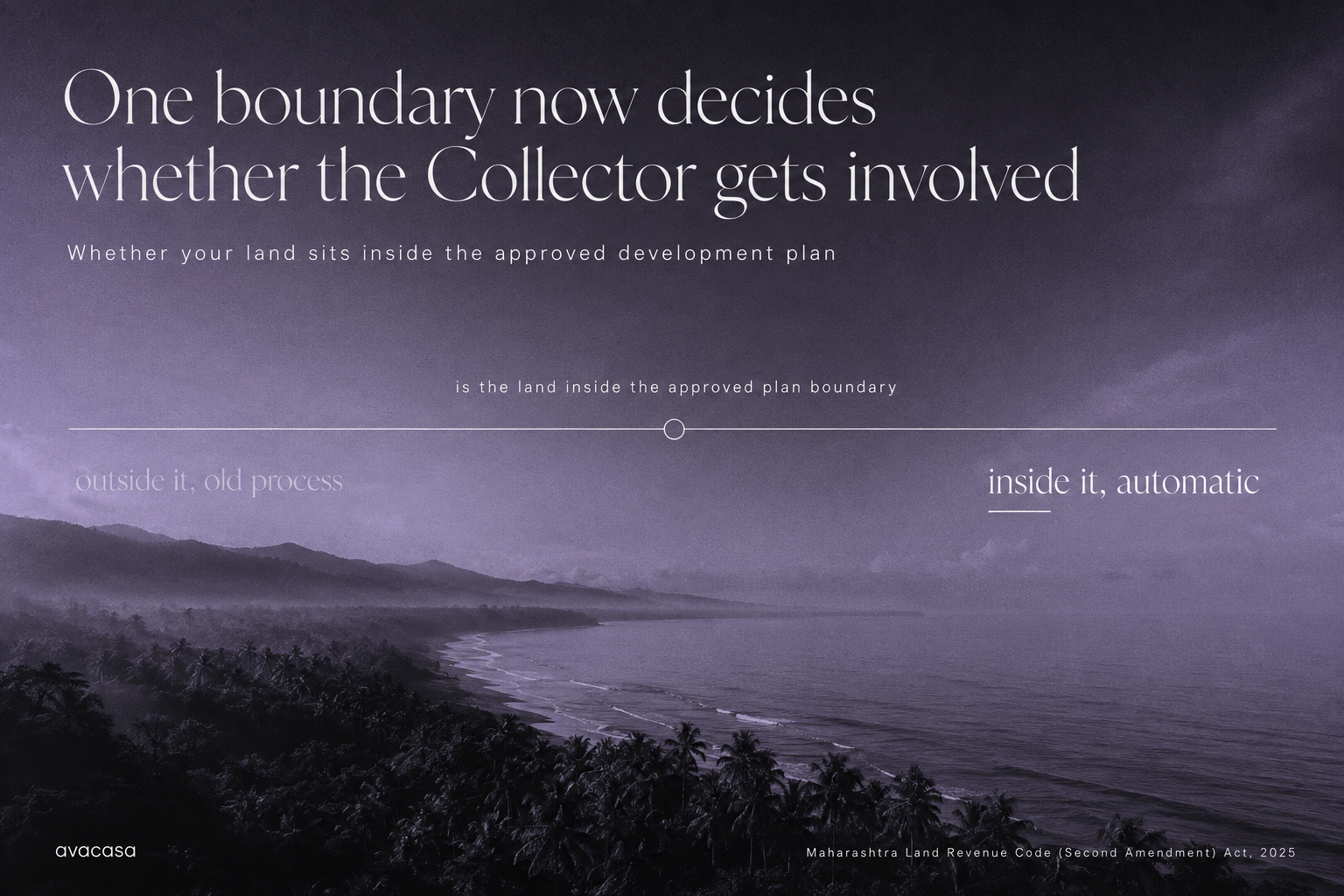
Under the new Section 42, that permission requirement is gone wherever the non-agricultural use is already permissible under the area's Development Plan or Regional Plan, made under the Maharashtra Regional and Town Planning Act, 1966. Where that condition is met, the Planning Authority approving a building plan or development permission now handles what used to be a separate revenue-department step, and the change to the land's official record follows automatically rather than waiting on a separately issued Sanad. What happens to land that falls outside an approved Development or Regional Plan has not been clarified in what has been published about the amendment so far, so treat that as an open question rather than assume the old process simply continues unchanged.
The cost side changed just as much. The recurring annual non-agricultural assessment is gone, replaced by a one-time premium under the new Section 47, calculated as a percentage of the land's market value under the Annual Statement of Rates (the Ready Reckoner), banded by area:
- up to 1,000 square metres: 0.1% of market value
- 1,001 to 4,000 square metres: 0.25% of market value
- above 4,000 square metres: 0.5% of market value
A 2,500 square metre plot valued at 4,000 rupees per square metre under the Ready Reckoner has a market value of 1,00,00,000 rupees (2,500 times 4,000), falls in the middle band, and carries a one-time premium of 25,000 rupees, 0.25% of that value. Compare that to an annual charge that ran indefinitely under the old system, and the one-time model is a real change in what owning converted land costs over time, not just in the process to get there.
Land converted between 1 January 2002 and the amendment's commencement uses the Ready Reckoner rate from the year it was actually converted, not today's rate. Land converted on or before 31 December 2001 uses 2001 rates. A Government Resolution dated 10 February 2026 filled in how this runs in practice: a single-window process centred on the Planning Authority, using existing systems such as the Building Plan Management System or AutoDCR where they exist, the premium collected before development permission or building-plan approval is granted, and the digital 7/12 extract updated automatically once that happens, rather than waiting on a separate mutation application. The same Resolution directs Collectors to notify banks and financial institutions in their jurisdiction that a Sanad is no longer the document to expect for eligible conversions. Converting Agricultural Land to NA After the 2025 Amendment walks through the full process step by step; Step-by-Step: Buying Your First NA Plot in Maharashtra applies it to an actual purchase.
If you already hold NA land, or are buying from someone who does
The transition is not only forward-looking. Landholders whose land was already converted before the amendment, and who were paying the old annual assessment, now owe the one-time premium in its place rather than continuing indefinite annual payments. That is a real, current liability sitting on plots that were converted years ago, and it will not show up on an old-format 7/12 extract pulled before the change took effect.
If you are buying land that was converted any time before this amendment, ask directly whether this one-time premium has been paid, and get that confirmed in writing rather than assumed. Nothing in what has been published states whether Maharashtra treats this as automatically the seller's responsibility to clear before transfer or something that can pass to a new owner unresolved, so this belongs in your lawyer's due diligence rather than in a general answer here. A fresh 7/12 extract pulled after the property was mutated under the new single-window process is worth more right now than one pulled before February 2026, because the automatic-update mechanism the Government Resolution describes is new enough that older printouts may not reflect it.
In practice, that due diligence has three parts. First, get written confirmation from the Planning Authority, not the seller, of whether the plot falls inside an approved Development Plan or Regional Plan boundary; that single fact decides whether the simplified route in this amendment applies to it at all. Second, ask for the premium payment receipt if the land was already converted, and if there is none, find out in writing whether it has been assessed and by whom, since an unassessed liability does not disappear because nobody has raised it yet. Third, pull the 7/12 extract yourself rather than accepting a copy the seller provides, and check its date against the property's conversion or mutation history so you know whether it reflects the current single-window process or an older record.
The other costs the Code decides
Two further figures come out of the same framework, and both use the same Ready Reckoner value that now sets your conversion premium.
Stamp duty is charged at registration on the transaction value or the Ready Reckoner value, whichever is higher, so under-declaring the agreement price to save on duty does not work: the tax authority uses whichever number is bigger. In Gram Panchayat jurisdiction, where most plotted land outside the major cities sits, the rate is 3% of that value for a male buyer and 2% for a female buyer; rates run higher inside municipal corporation and council limits. On top of that, registration itself costs 1% of the property value, capped at 30,000 rupees for anything above 30 lakh rupees.
Put the two together on the same 2,500 square metre plot from the conversion example above, valued at 1,00,00,000 rupees under the Ready Reckoner: a male buyer registering it in Gram Panchayat jurisdiction pays stamp duty of 3,00,000 rupees (3% of 1,00,00,000) plus the capped registration charge of 30,000 rupees, a combined 3,30,000 rupees before the conversion premium is even counted. That is the figure that belongs in a purchase budget, not the premium alone. Stamp Duty & Registration in Maharashtra: What You Pay at Closing has the full rate table across jurisdictions. Ready Reckoner Rates and How They Set Your Floor Price explains where those published values come from and how often they change.
Land the Code restricts outright
Not everything on the market is available to every buyer. Section 36A of the Code restricts the transfer of tribal land to non-tribal buyers in scheduled areas, and getting this wrong voids the transaction rather than merely complicating it; Tribal Land and Section 36A Restrictions in Maharashtra sets out where this applies. Gaothan, the traditional village settlement area, is recorded and trades differently from both agricultural and NA land outside it; Gaothan and Village Land: Why It Trades Differently explains the distinction. And a non-farmer's ability to buy agricultural land in this state at all is narrower than most buyers expect; Can a Non-Farmer Buy Agricultural Land in Maharashtra? covers who actually qualifies.
Before you close
Two checks sit outside the Code itself but decide whether a plotted development is worth buying into. If the land you are looking at is part of a registered project rather than a standalone plot, MahaRERA: Checking a Plotted Project's Registration explains what that registration actually verifies. And whatever the classification or the conversion history, The NRI Documentation Checklist for Buying Land is the file your lawyer will build regardless.
If you are buying specifically to build a second home rather than as a first purchase in the state, Can NRIs Buy NA Plots in India? Rules, FEMA & Repatriation and Why NRIs Can't Buy Agricultural Land - and the Workarounds cover the national rules this state-level picture sits inside. For where in Maharashtra this actually plays out on the ground, the Karjat and Alibaug destination guides, and the wider Goa market for comparison, show how these rules shape what gets built and sold in practice.
Sources
- Maharashtra Land Revenue Code (Second Amendment) Act, 2025: assented 31 December 2025, substituting Section 42 and Section 47
- Government Resolution, 10 February 2026: single-window implementation of the premium and automatic 7/12 mutation
- Legal analyses of the Amendment Act's premium slabs and transitional rates, cross-checked across independent commentary from corporate law and real estate practice publications
Ready to find your next holiday home?
Browse our curated collection of vacation homes and managed farmland across India and beyond.