The NRI Documentation Checklist for Buying Land
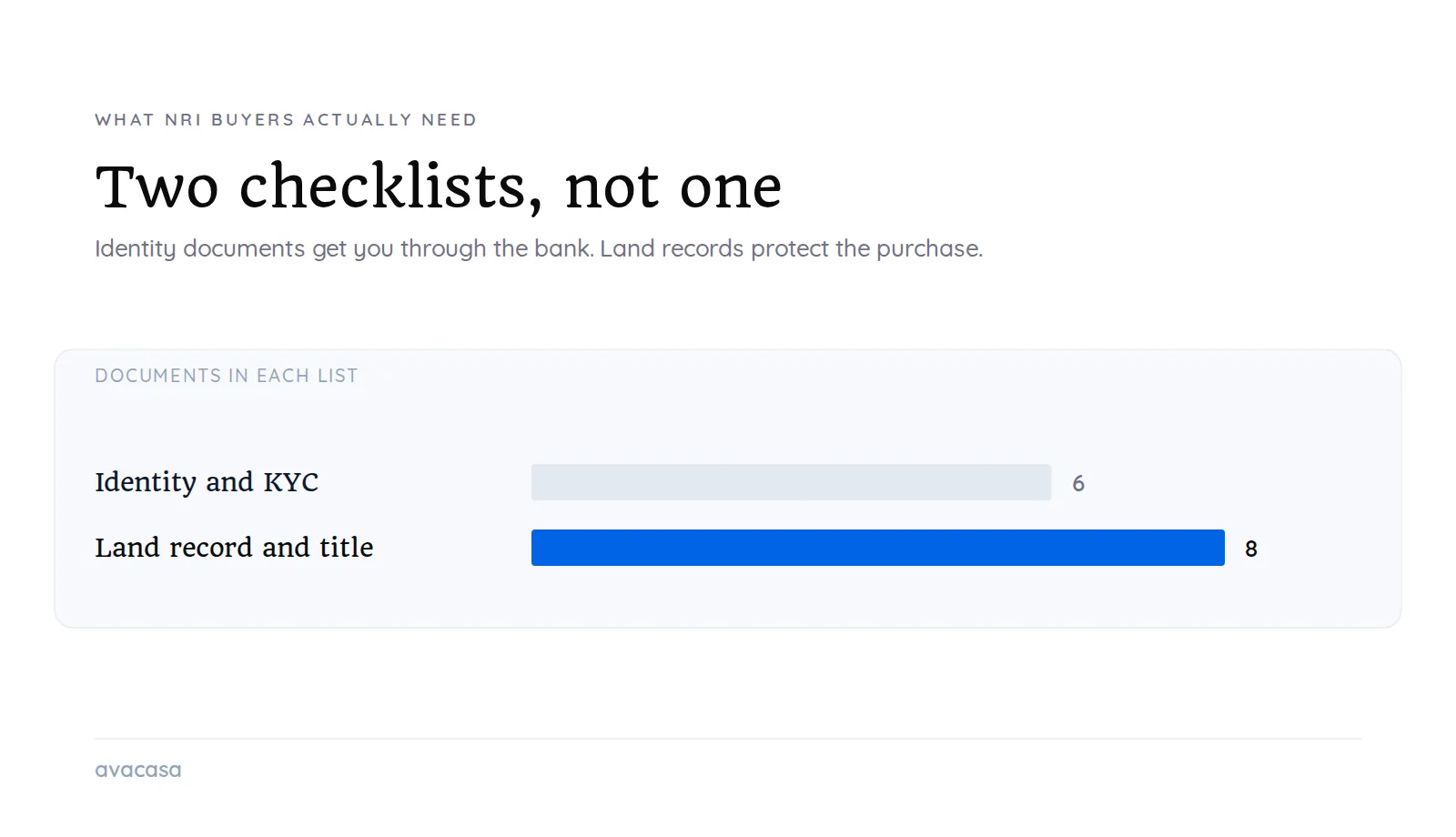
Most NRI documentation checklists are written for buying a flat. Buying a plot of land needs a different list, because the document that actually protects you on land is not your passport. It is the land record.
Two checklists, not one
Search for "NRI property documents checklist" and nearly every result gives you the same set: passport, OCI or PIO card, PAN card, overseas address proof, photographs, bank statements. That list is real and necessary, but it is a KYC (know your customer) checklist. It proves who you are to a bank, a developer, or a sub-registrar. It says nothing about whether the land itself is safe to buy.
For a built apartment in a RERA-registered project, the KYC checklist and a RERA check cover most of the risk, because the project's approvals have already been vetted at the developer level. For a standalone plot, especially one outside an established plotted development, the burden shifts almost entirely onto the buyer, and that means a second checklist: the land-record documents that establish who actually owns the parcel, whether it is legally saleable, and whether it carries hidden encumbrances.
Checklist one: who you are
Valid Indian passport, or, if you hold a foreign passport, an OCI (Overseas Citizen of India) card. The PIO (Person of Indian Origin) card scheme was merged into OCI, so if you still hold an old PIO card, confirm with your bank whether it needs to be exchanged before the transaction.
PAN card. Mandatory for any property transaction above ₹10 lakh, and effectively mandatory below that threshold too, since it is required for TDS compliance, loan applications, and filing returns if you later rent out or sell the property. Apply through NSDL or UTIITSL well before you need it; last-minute applications delay closing.
Overseas address proof. A utility bill, driving licence, or bank statement, generally not older than three months, consistent with the address on your other documents.
Recent passport-sized photographs, and visa or residency proof for your country of residence.
NRE, NRO, or FCNR account statements, since these demonstrate the funding source the sub-registrar and your bank will want to see. If you plan to route payment through an NRI home loan, add salary slips, employment verification, and your last two years of tax returns from your country of residence.
Checklist two: what you are actually buying
This is the list most generic guides skip, and it is the one that matters more for land than any personal document above.
7/12 extract (or the state equivalent land record). In Maharashtra this is the primary record of rights and shows the current registered owner, the land classification, and any recorded encumbrances or disputes. Read it yourself rather than relying on a summary from the seller or broker; our guide on reading a 7/12 extract walks through what each field means.
Title search report and Index II. A search of the sub-registrar's records covering at least the past 30 years, confirming an unbroken and undisputed chain of ownership. In Maharashtra this comes as a search report plus Index II rather than the Encumbrance Certificate used in southern states; see our note on title search and verifying ownership for the distinction.
NA (Non-Agricultural) conversion order, if the land is being sold as NA. If the seller cannot produce the actual conversion order from the collector's office, and the land still shows as agricultural in the 7/12 extract, you may be looking at unconverted agricultural land regardless of how it is marketed. NRIs cannot buy agricultural land under FEMA; see why NRIs can't buy agricultural land and the workarounds if this applies to your purchase.
RERA registration certificate, if the land is part of a plotted development above the threshold size that triggers mandatory registration. Verify the certificate number directly on the state RERA portal rather than trusting a printed copy, and check that the registration is still active and has not lapsed.
Approved layout plan, sanctioned by the relevant planning authority, showing that the plot boundaries you are buying match what has actually been approved for development.
Tax and dues clearance. Property tax receipts and a No Objection Certificate confirming no outstanding dues, loans, or liens against the land.
Power of Attorney, if you cannot be present for signing, drafted, attested, and registered correctly; see our full guide on executing a POA safely.
Why the order matters
Buyers who assemble both checklists at once, rather than personal documents first and land documents as an afterthought once a deal feels close, catch problems while they are still cheap to walk away from. A missing or defective 7/12 extract discovered before you pay a token amount costs you nothing. The same discovery after registration is a lawsuit.
A related mistake is treating the land-record checklist as a one-time check. Land records can change between your initial verification and the registration date, particularly if there is any dispute, pending litigation, or a recent inheritance in the ownership chain. Re-verify the 7/12 extract and title search within a short window before registration, not months earlier.
What a lawyer adds that a checklist cannot
A document checklist tells you what to collect. It does not tell you whether what you collected is internally consistent, whether the seller named on the 7/12 extract matches the seller signing the deed, or whether a decades-old partition among family members was ever properly recorded. That judgment is what a property lawyer is for, and for land purchases specifically, that review is not optional. Budget for it as part of the transaction cost, not as a discretionary extra.
Where to go next
Once your documents are in order, our guides on stamp duty and registration in Maharashtra and the full purchase timeline from booking to mutation cover what happens next. If you are funding the purchase from abroad, see legal channels to send money home. For the legal basics, read who counts as an NRI, OCI or PIO and checking a plotted project's MahaRERA registration. Browse our full India property guide or Maharashtra listings, and if you would like a lawyer to review your documents before you commit funds, book a consultation.
Sources
- RBI FAQs on Acquisition and Transfer of Immovable Property in India, via Ministry of External Affairs
- Documents required for NRIs to buy property in India, 2026 checklist
Ready to find your next holiday home?
Browse our curated collection of vacation homes and managed farmland across India and beyond.