Why NRIs Can't Buy Agricultural Land - and the Workarounds
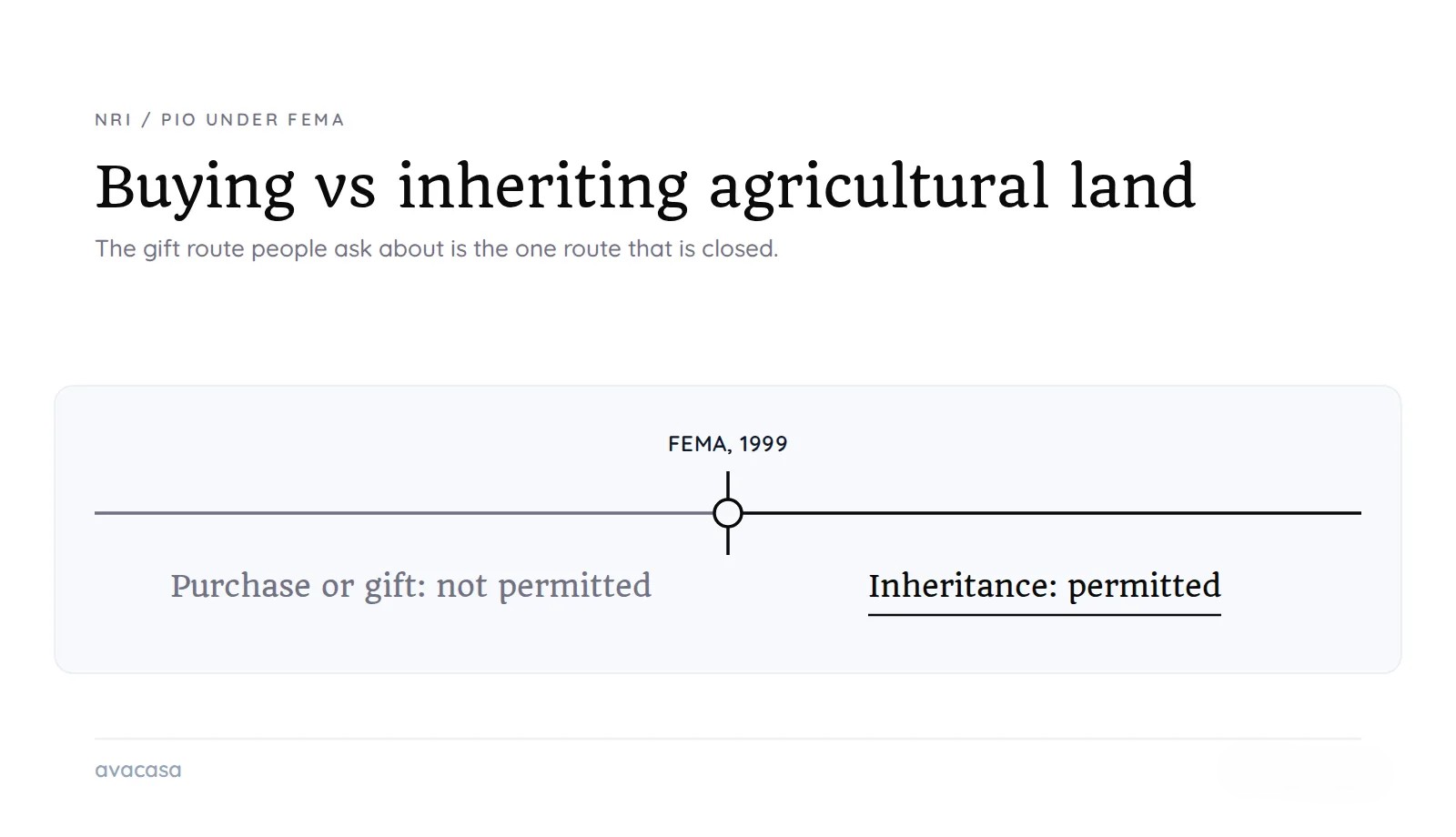
Most guides on this topic get one detail wrong, and it is the detail that actually matters: an NRI cannot receive agricultural land as a gift, even from a parent. The only door that opens without approval is inheritance.
That distinction gets blurred constantly, including on pages that otherwise cite the Foreign Exchange Management Act (FEMA) correctly. It matters because a buyer who structures a transaction around a "gift from a resident relative" is not finding a workaround. They are stepping into a contravention.
This confusion is not limited to informal advice. It shows up in professionally written explainers that get everything else right, which is exactly why it spreads. A source that correctly cites FEMA sections and RBI circulars but slips on this one exception looks credible enough that readers stop checking further.
The rule, stated precisely
Under FEMA, 1999, and the Reserve Bank of India's (RBI) regulations on acquisition and transfer of immovable property, a Non-Resident Indian (NRI) or a Person of Indian Origin (PIO) cannot purchase agricultural land, plantation property, or a farmhouse in India. This is not a documentation gap that a lawyer can close with the right paperwork. It is a blanket prohibition under the general permission scheme, and the only route around it is specific RBI approval, granted case by case in consultation with the central government. In practice, that approval is rare enough that no buyer should plan around getting it.
The prohibition applies regardless of how the money moves. Paying in rupees from an NRO account, remitting foreign exchange through normal banking channels, routing the payment through a resident relative's account: none of it changes the answer. FEMA regulates the transaction, not the currency path.
This sits apart from residential and commercial property, which NRIs and PIOs can buy freely, in any number, without RBI approval. Agricultural land is carved out specifically because Indian policy has long treated farmland as a resource reserved for resident cultivators, and FEMA inherited that stance when it replaced the older Foreign Exchange Regulation Act (FERA) in 1999.
The same restriction applies to a farmhouse and to plantation property, and all three terms get used loosely in casual property conversation. A farmhouse in the FEMA sense is not a weekend house with a garden. It generally means a dwelling built on agricultural land that has not been reclassified, which is precisely why the workaround discussed later in this piece, converting the underlying land, matters so much in practice.
Why the "gift" workaround does not work
Search results on this topic are full of advice to receive agricultural land as a gift from a parent, sibling, or other qualifying relative. The RBI's own published FAQ on this subject answers the question directly: NRIs and PIOs can freely acquire residential or commercial property by gift, from a resident, another NRI, or a PIO. Agricultural land, plantation property, and farmhouses are excluded from that permission. A gift of farmland to an NRI is not a smaller version of the residential gift rule. It falls outside it entirely.
This is worth being blunt about because the error is common enough that it has become conventional wisdom in casual conversation, and conventional wisdom is not a defense in a FEMA compounding proceeding. If you have already received agricultural land as a gift while non-resident, that transaction is a contravention regardless of intent, and it needs to be regularised, not defended.
The three routes that do work
Inheritance. An NRI or PIO can inherit agricultural land, a farmhouse, or plantation property without RBI approval, whether the person they inherit from was resident in India or was themselves a non-resident who had lawfully acquired the land. This is the cleanest and most common legitimate route, and it is why family land in a home village so often ends up in an NRI's name without anyone involved needing to apply for anything.
Retained ownership from resident days. If you bought agricultural land while you were still a resident Indian and later moved abroad and became an NRI, you keep the land. FEMA does not require you to divest it. You simply cannot add to that holding through further purchase while non-resident.
Specific RBI approval. The general permission route is closed, but Section 6 of FEMA lets the RBI approve individual proposals in consultation with the government. This exists on paper more than in practice. Buyers who go this route should expect a long, uncertain process with no guarantee of a favourable outcome, and should not treat it as a viable plan for a straightforward purchase.
A fourth option is not a workaround at all, but the honest answer for anyone determined to buy actual farmland: return to India, become resident under FEMA by spending more than 182 days here with the intent to stay, and buy on the same footing as any other Indian citizen in that state. Once residency is established, the NRI restriction no longer applies. It is a real path, just not a fast one.
The other route: change what the land is, not who is buying it
A large share of what gets marketed to NRIs as "agricultural land near a leisure destination" is not agricultural land by the time it reaches a buyer. It has been converted to Non-Agricultural (NA) status under the relevant state land revenue code, which reclassifies the parcel and removes it from FEMA's agricultural land carve-out. Once converted, an NRI can buy it the same way they would buy any residential or commercial property: freely, without RBI approval.
This is the structure behind most of the plotted developments marketed to NRIs in leisure corridors like Karjat, Alibaug, or Coorg. The developer completes the conversion before sale, and the buyer purchases NA land, not agricultural land. The distinction is not cosmetic. It changes which FEMA regime governs the purchase, and it changes what you can build, since raw agricultural land carries construction restrictions that NA land does not.
Buyers should verify conversion status directly rather than take a broker's word for it. The Maharashtra Land Revenue Code sets out how this process works and what changed after the 2025 amendment, and the distinction between NA plots and unconverted agricultural land is worth understanding before signing anything.
What happens if the rule is broken
A purchase made in violation of the FEMA prohibition is treated as a contravention, not a technicality. The Enforcement Directorate can pursue penalties of up to three times the transaction value, with additional daily penalties for continued non-compliance, and the underlying title can be challenged. Buyers who discover they have unknowingly ended up holding agricultural land, whether through an ill-advised gift structure or a benami-style arrangement using a resident relative's name, should get it regularised through a FEMA-specialist lawyer rather than wait for it to surface during a future sale or inheritance dispute.
Selling inherited or legitimately retained agricultural land also has its own rule worth knowing in advance: an NRI or PIO can only sell it to a person resident in India who is also an Indian citizen. Another NRI cannot buy it from you, even if they would otherwise qualify to inherit similar land themselves. The same restriction extends to gifting land you already hold: it can only be gifted onward to a resident Indian citizen, never to another NRI or PIO, even a close relative.
Repatriating the proceeds if you do sell inherited agricultural land follows its own path too. Sale proceeds go into an NRO account rather than moving abroad directly, and from there an NRI or PIO can remit up to USD 1 million per financial year, subject to the standard documentation and a chartered accountant's certificate. That cap applies across all NRO remittances in a given year, not per transaction, so it is worth planning around if a sale is one part of a larger year of fund movement.
The practical takeaway
If a plot is genuinely agricultural land, an NRI cannot buy it, cannot receive it as a gift, and has exactly two low-friction ways to end up owning it: inherit it, or already have owned it before becoming non-resident. Specific RBI approval exists but is not a plan. Converting the land to NA status before purchase is the route that actually explains most NRI-marketed land deals in leisure corridors, and it works because it changes the legal category of the land rather than trying to work around the rule for agricultural land itself.
Anyone structuring a purchase around family gifting agricultural land, or around a relative "holding" land on their behalf, should treat that as a red flag rather than a workaround, and get independent legal advice before money moves.
Where to go next
For related reading, see our guides on the Maharashtra Land Revenue Code, the difference between an NA plot and agricultural land, what NA status actually means, and how agricultural-to-NA conversion works after the 2025 amendment. NRIs should also read our explainer on who counts as an NRI, OCI or PIO, the NRI buying NA plots primer, the case against the myth that agricultural land is always a bad buy, how inheritance and succession works for NRIs, and our note on land versus apartments as a long-term asset. If tribal land restrictions are relevant to your target belt, see our piece on Section 36A restrictions in Maharashtra. Browse our full India property guide or Maharashtra listings, and if your situation involves inherited or gifted land that may already be non-compliant, book a consultation before you act.
Sources
- RBI FAQs on Acquisition and Transfer of Immovable Property in India, via Ministry of External Affairs
- RBI Master Direction on Acquisition and Transfer of Immovable Property under FEMA, 1999
Ready to find your next holiday home?
Browse our curated collection of vacation homes and managed farmland across India and beyond.