Power of Attorney for Overseas Buyers, Done Safely
A Power of Attorney (POA) lets someone else sign on your behalf. It does not, on its own, transfer ownership of anything. That distinction sounds obvious written down, and yet it is the single most common misunderstanding NRI buyers carry into a property transaction, and the one that has cost the most people their money.
What a POA actually does, and does not do
A Power of Attorney is an authorisation, not a conveyance. It lets a person you trust, an "attorney" in the legal sense, act in your name: sign a sale deed, appear before the sub-registrar, pay stamp duty, collect keys. What it cannot do is transfer title. Title moves only through a registered sale deed, a registered gift deed, a will, or inheritance. A seller who tries to hand over property using only a General Power of Attorney (GPA), without a subsequent registered sale deed, has not actually sold anything.
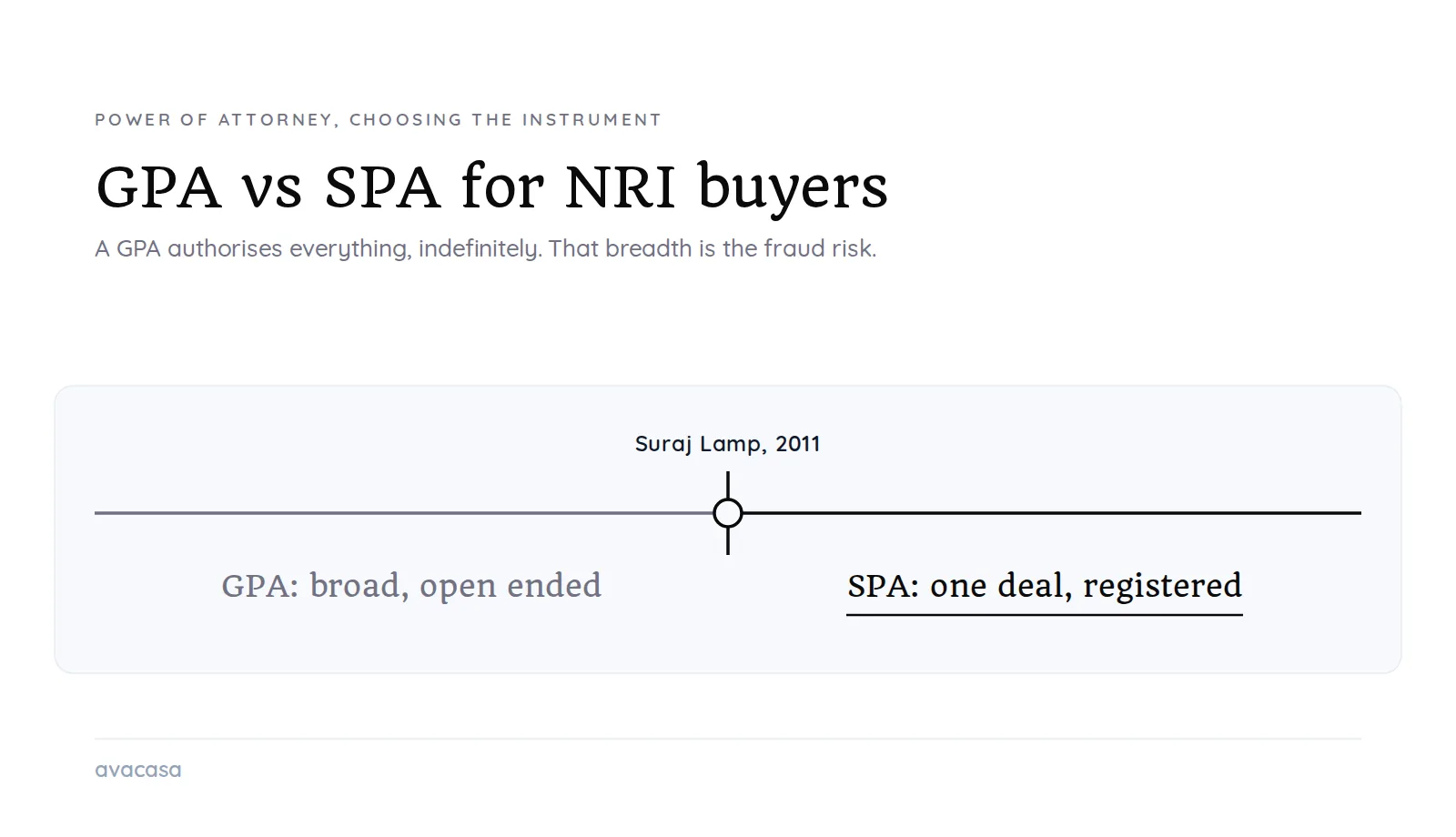
This was settled definitively by the Supreme Court in Suraj Lamp & Industries Pvt. Ltd. v. State of Haryana (2011), which held that so-called "GPA sales", where a buyer takes possession and a GPA instead of registering a proper deed, do not convey ownership and cannot be recognised as valid transfers. If you are buying, and the person selling to you proposes to complete the deal through their own POA arrangement rather than a registered deed in your name, that is not a shortcut. It is a transaction that will not hold up.
General power of attorney versus special power of attorney
The two instruments look similar and behave very differently.
A General Power of Attorney (GPA) hands your attorney sweeping authority: to manage, lease, mortgage, and sell any of your property, often without a defined end date. It is the instrument most associated with fraud. One widely cited analysis of NRI property disputes found forged or misused POAs behind a large share of ownership conflicts, with GPA-related fund misappropriation the single largest category.
A Special Power of Attorney (SPA), sometimes called a Specific Power of Attorney, authorises one clearly defined transaction: the purchase of one named property, the registration of one specific sale deed, nothing broader. If you need someone to complete a single purchase on your behalf, an SPA drafted for that transaction only is the safer instrument, and most competent Indian property lawyers will draft it that way by default rather than defaulting to a GPA out of convenience.
The practical rule: match the scope of the POA to the transaction. A GPA covering "all my property in India, indefinitely" is a standing liability. An SPA covering "this plot, this transaction, this timeframe" is a tool.
How an NRI executes a valid POA from abroad
The document has to be drafted, signed, attested, and in most states registered, in that order.
Draft it precisely. An Indian property lawyer should draft the POA naming the exact property, the exact powers granted, a validity period, and clear revocation terms. A vague, catch-all POA is the version that ends up disputed.
Sign and attest it where you live. You sign in the presence of a notary or an Indian consular officer in your country of residence. If your country is a signatory to the Hague Apostille Convention, an apostille from the relevant authority (the Secretary of State's office in the US, the FCDO in the UK, the Ministry of Foreign Affairs in the UAE or Singapore, and equivalents elsewhere) is generally sufficient and faster than consular attestation. If your country is not a Hague signatory, the document instead needs attestation by the Indian embassy or consulate.
Bring it into India and adjudicate or register it. Once the POA arrives in India, it typically needs to be stamped within a set window, and where it authorises the transfer of immovable property, most states now require it to be registered at the sub-registrar's office in the district where the property sits, not merely notarised. This registration step is what several states tightened in the last two years specifically because unregistered GPAs were the vehicle for so much fraud; treat registration as the default requirement rather than an optional extra, and confirm the current position in your specific state before assuming a notarised copy will be accepted.
Skipping any one of these steps, drafting it too broadly, signing it without attestation, or failing to register it in India, is what turns a POA from a convenience into a liability.
What the POA holder can and cannot do with your money
A POA that grants banking authority still runs into FEMA's account rules. Your attorney can typically operate your NRO account, making local payments and withdrawals on your behalf, and they can be authorised to file your income tax return. What a POA cannot do is repatriate funds from your NRE account to your foreign bank account; that instruction has to come from you directly, since NRE repatriation is treated as a personal act under the regulations, not one that can be delegated. If your transaction plan assumes your attorney can move sale proceeds abroad on your behalf without your direct involvement, revisit that assumption before you rely on it.
Choosing and limiting the attorney
The person you name matters more than the document. A close relative is the conventional choice, and several states offer reduced stamp duty for POAs executed in favour of specified close family, but a family relationship is not a substitute for scrutiny. Set an expiry date rather than an open-ended term. Limit the powers to what the transaction actually requires. Keep a signed, dated revocation ready to file if the relationship or the circumstances change, and notify the relevant sub-registrar and any bank or developer involved the moment you revoke, since a POA remains usable by a third party until the revocation is formally on record.
If the POA will also handle a home loan on your behalf, confirm with the lender in advance exactly which loan-related actions it covers. Banks vary in how much they will accept from an attorney versus requiring the NRI principal's direct signature on loan documents, and finding this out at the disbursal stage rather than the application stage causes real delays.
The bottom line
A Power of Attorney is how most NRIs complete a purchase they cannot be physically present for, and used correctly it is a routine, safe instrument. Used carelessly, drafted too broadly, left unregistered, or handed to someone whose interests are not fully aligned with yours, it becomes the single largest source of NRI property disputes on record. Draft narrow, register where required, and never treat a POA as a substitute for a properly registered sale deed in your own name.
Where to go next
Before you execute a POA, make sure you have the rest of your paperwork lined up: see our NRI documentation checklist for buying land and our note on who counts as an NRI, OCI or PIO for property purposes. If the property involves agricultural land, read why NRIs can't buy agricultural land and the workarounds first, since a POA cannot get around that restriction. For the funding side of the transaction, see legal channels to send money home. Once your attorney is in place, our guides on reading a 7/12 extract, title search in Maharashtra, and stamp duty and registration cover what happens next in the transaction. For the exit side, see selling Indian property as an NRI. Browse our full India property guide or Maharashtra listings, and if you want a lawyer to review your POA draft before you sign it, book a consultation.
Sources
- Suraj Lamp & Industries Pvt. Ltd. v. State of Haryana, Supreme Court of India (2011)
- Registration (Karnataka Amendment) Act, 2025, on compulsory POA registration for property transfer
Ready to find your next holiday home?
Browse our curated collection of vacation homes and managed farmland across India and beyond.