Checking a Certificate at BPN Before You Sign

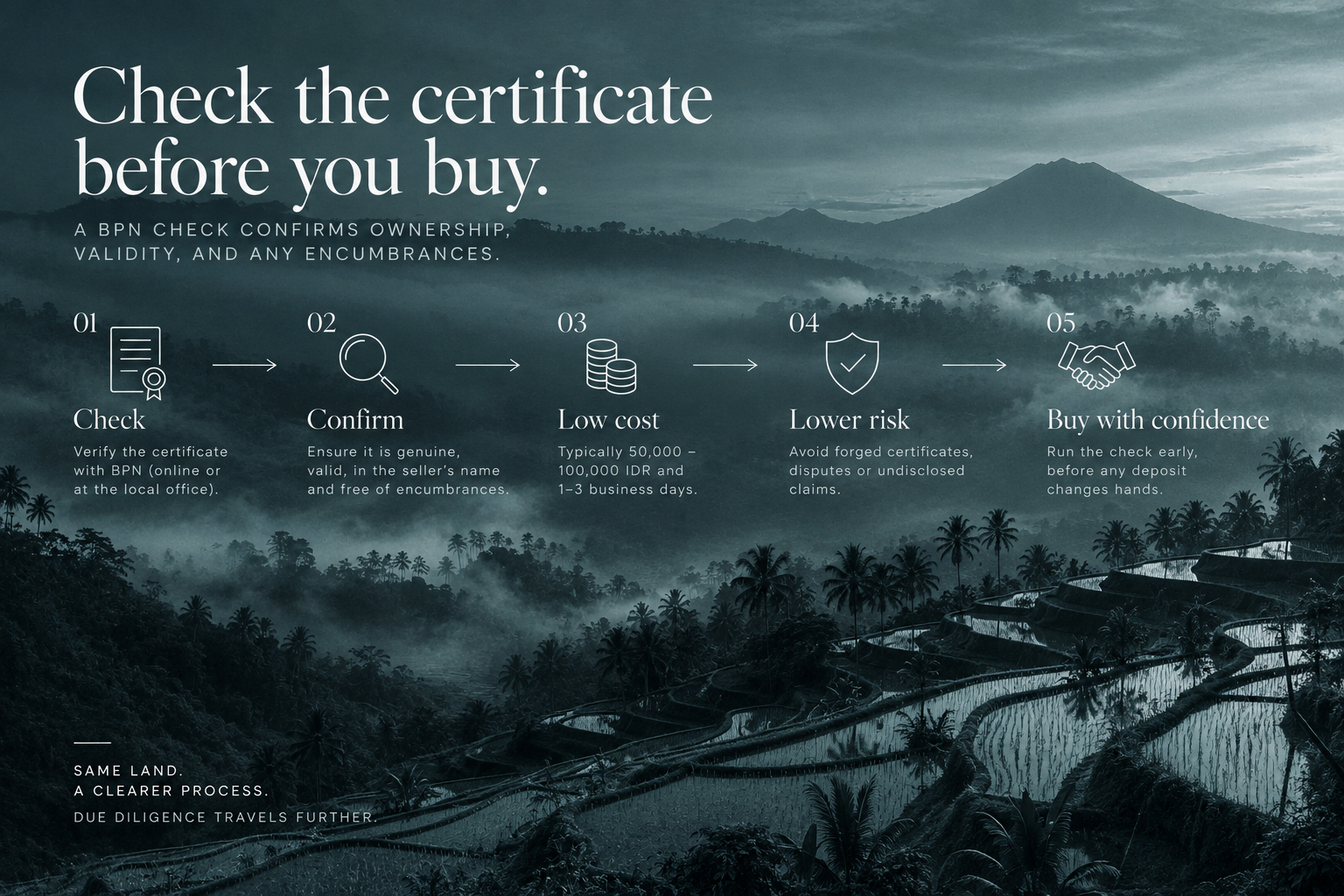
A land certificate in Indonesia is only as reliable as the last time someone actually checked it against the National Land Agency's own records, and for a foreign buyer specifically, that check is one of the cheapest, highest-value steps available before signing anything. It costs a fraction of a percent of a typical purchase price and takes a few working days, which makes skipping it one of the more avoidable mistakes a buyer can make.
What BPN actually is and why the check matters here specifically
BPN, Badan Pertanahan Nasional, is Indonesia's National Land Agency, the government body responsible for registering land and issuing certificates such as Hak Milik and the leasehold and use-right categories that apply to foreign buyers. Hak Milik, Hak Pakai and HGB: The Three Titles That Matter covers what these certificate types actually mean for ownership. Indonesia's land registration system is not fully centralised in the way a buyer from a country with a single national land registry might assume, and certificates can be forged or duplicated, which makes independent verification against BPN's own records a genuinely necessary step rather than a formality.
What a certificate check actually confirms
A formal certificate check, a pengecekan sertifikat, confirms four specific things: that the certificate is genuine and not forged, that it is currently valid and has not been cancelled, that it is registered in the name of the person or entity claiming to sell it, and that it carries no encumbrance, a mortgage or a court seizure, that would prevent a clean transfer. Any one of these failing is a reason to stop the transaction entirely, not a detail to negotiate around, since a certificate that fails even one of these checks may not represent enforceable ownership at all.
How to actually run the check
The check can be done in person at the local BPN office, typically costing in the range of 50,000 to 100,000 rupiah and taking one to three business days, or through BPN's own online tools, the Sentuh Tanahku application or the official BPN website, for electronic certificates. A buyer working through an agent or a notary should confirm this specific check has actually been run and ask to see the result directly, rather than accepting a general assurance that the property's paperwork is in order.
Why this sits alongside, not instead of, the wider due diligence process
Confirming a certificate is genuine and unencumbered answers a narrower question than a complete title verification. It does not, on its own, confirm the seller has the legal authority to transfer the specific type of certificate involved to a foreign buyer, which depends on the certificate category itself. Leasehold in Indonesia: How Long, How Renewable, How Safe and PT PMA: Setting Up a Foreign-Owned Company to Hold Property cover the structures a foreign buyer actually uses to hold an interest in Indonesian land, and the BPN certificate check is a necessary precondition for any of those structures, not a substitute for confirming the structure itself is correctly set up.
What actually goes wrong when this step is skipped
A buyer who skips the BPN check and relies solely on the seller's or agent's copy of the certificate is exposed to exactly the failure modes the check exists to catch: a certificate copy that looks legitimate but does not match BPN's current record, an encumbrance that was never disclosed, or a seller whose name no longer matches the registered owner because of an intervening, unrecorded transaction. None of these are visible from the document alone, which is the entire reason the check exists as an independent verification step rather than a paperwork review.
Timing the check within the wider transaction sequence
Running the BPN check early, before earnest money or a deposit changes hands, gives a buyer genuine leverage to walk away cleanly if the certificate fails verification. A buyer who runs the check only after a deposit is already committed has weakened their own position considerably, since unwinding a transaction after money has moved is a materially harder negotiation than simply declining to proceed. The check itself takes only a few days, which makes there being little practical reason to sequence it any later than the earliest point the certificate details are available.
What Avacasa recommends
Treat the BPN certificate check as a mandatory, non-negotiable step before signing anything, not an optional add-on to due diligence. Confirm directly, rather than through secondhand assurance, that the check has actually been performed and ask to see its result before proceeding to the next stage of the transaction. Owning Property in Indonesia as a Foreigner: The Complete Guide covers the wider framework this verification step fits inside.
Before you commit
Due Diligence When Buying Property in Another Country covers the broader verification discipline this BPN check is one part of, and How to Verify a Developer's Track Record is relevant where a developer, rather than an individual owner, is the seller. 10 Questions to Ask Before Signing Anything rounds out the practical checklist, and Title Verification and the Sri Lankan Land Registry and Chanote and Lesser Title Deeds in Thailand cover structurally similar verification questions in other Southeast and South Asian markets. Where to Eat in Bali: A Considered List and Emerging Pockets to Watch Around Bali are relevant for a buyer specifically scouting Bali once the legal groundwork is understood.
Whatever the island or destination inside the country, Indonesia, Thailand and Sri Lanka each run their own distinct land registry verification process, and confirming the specific procedure for the specific country is never safe to assume from general Southeast Asian due diligence practice alone.
Sources
- What a BPN certificate check confirms: authenticity, validity, ownership match and encumbrance status
- In-person and online methods for checking a certificate at BPN, including cost and processing time
Ready to find your next holiday home?
Browse our curated collection of vacation homes and managed farmland across India and beyond.