PT PMA: Setting Up a Foreign-Owned Company to Hold Property
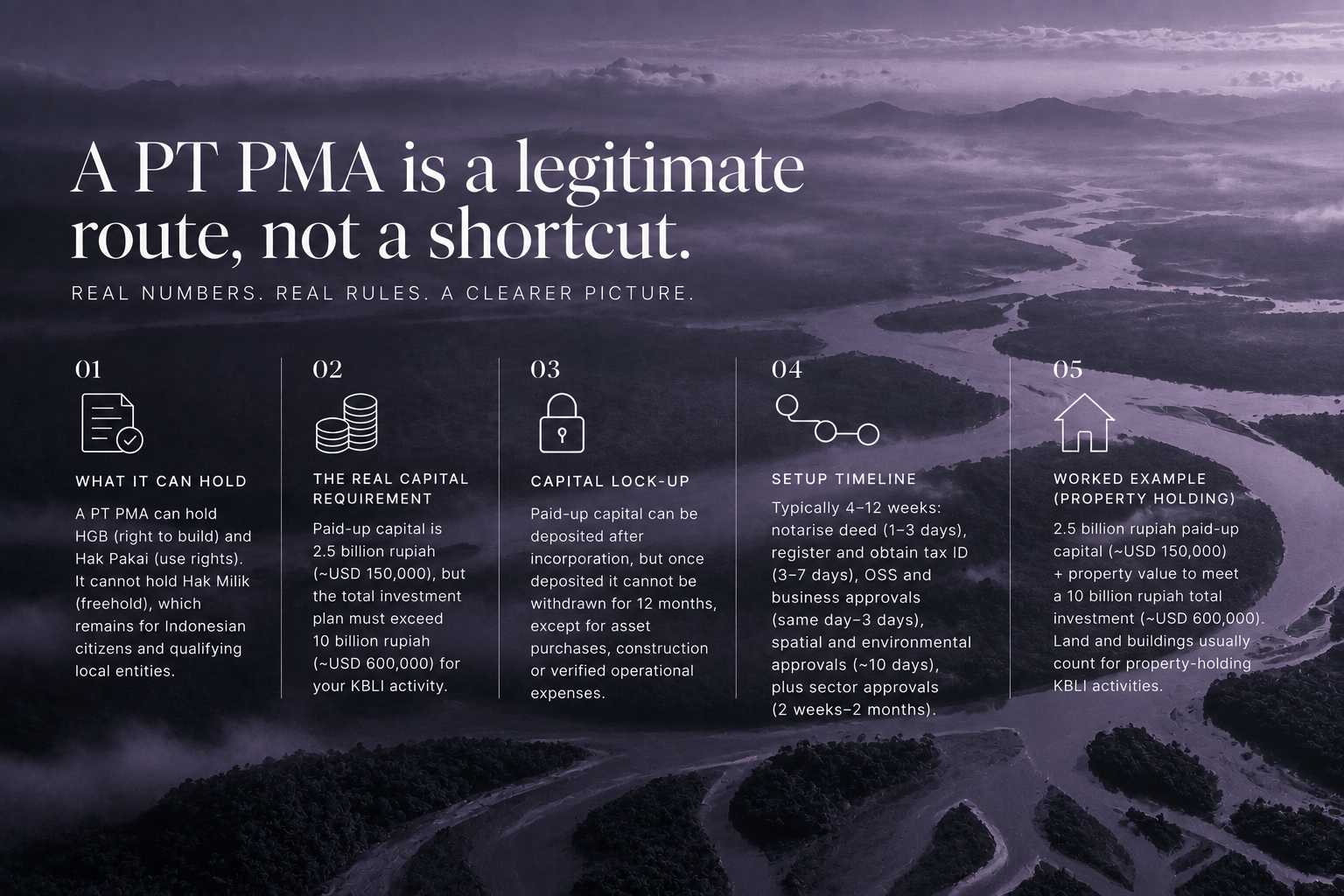
A PT PMA is not a shortcut around Indonesia's foreign land ownership rules, it is the legitimate business vehicle those rules already provide for, and the headline "2.5 billion rupiah minimum capital" figure that gets quoted everywhere is only the first number in a calculation that runs considerably higher once the full requirement is actually worked through.
What a PT PMA can hold, and what it still cannot
A PT PMA, a foreign-owned limited liability company established under Indonesia's investment law, can acquire Hak Guna Bangunan, the right to build, along with Hak Pakai or long-term lease arrangements for commercial purposes. It cannot hold Hak Milik, Indonesia's full freehold title, under any circumstance, since that title remains reserved for Indonesian citizens and qualifying local entities regardless of how the foreign company is structured. A PT PMA is consequently a route to a genuine, company-registered right to build and use land, not a workaround that converts a foreign buyer into the equivalent of a freehold owner.
The capital figure everyone quotes, and the one most guides leave out
Since BKPM Regulation No. 5 of 2025, effective October 2025, a PT PMA's minimum paid-up capital dropped from 10 billion rupiah to 2.5 billion, roughly USD 150,000, a genuinely significant reduction in the barrier to entry. What far fewer sources mention clearly: the company's total investment plan for its specific business activity, identified by its five-digit KBLI classification code, still has to exceed 10 billion rupiah per project location, with the paid-up capital forming only a portion of that larger figure. Land and buildings are generally excluded from this total investment calculation, except specifically in property development and other asset-intensive sectors, and a PT PMA set up to hold property is, in most structurings, exactly the case where land and buildings are not excluded. A buyer planning around the 2.5 billion rupiah figure alone, without checking how their specific KBLI classification treats the property itself, is planning around an incomplete number.
What happens to the capital once it is actually deposited
The paid-up capital does not need to be fully deposited at the moment of incorporation; a declaration letter suffices initially, with the actual deposit following once the company's Indonesian bank account is open. Once deposited, that capital cannot be withdrawn from the account for at least 12 months, with three specific exceptions: asset purchases, building construction, or verified operational expenses. This lock-up is not a technicality to route around, it exists specifically to ensure the declared capital actually funds real business activity rather than being withdrawn immediately after the company clears incorporation, and a structure that tries to withdraw the capital for anything outside those three exceptions within the 12-month window is not simply inconvenienced, it is non-compliant.
The setup sequence, and how long each stage actually takes
Setting up a PT PMA runs through five broad stages: notarising the company deed, typically one to three business days; registering with the Ministry of Law and Human Rights for deed ratification and a tax identification number, three to seven business days; registering through the Online Single Submission system for the company's business identification number and risk classification, same-day to three business days for lower-risk activities; obtaining spatial conformity approval, environmental documentation and standard certificates, roughly ten working days for most sectors; and, where applicable, sector-specific ministry approvals, which can add anywhere from two weeks to two months depending on the activity's risk classification. A buyer budgeting a PT PMA setup around a single, short timeline is likely underestimating it, since the full sequence, sector approvals included, can run considerably longer than the faster early stages suggest on their own.
A worked example of what the full number actually looks like
Take a hypothetical PT PMA set up specifically to hold a villa property, numbers chosen only to make the calculation concrete rather than a claim about any specific structure. The 2.5 billion rupiah paid-up capital is the first outlay, roughly USD 150,000, deposited into the company's Indonesian account and locked there for 12 months barring the three permitted exceptions. Because property holding is one of the sectors where land and buildings count toward the total investment plan rather than being excluded from it, the underlying property itself has to be valued in a way that, combined with the paid-up capital, clears the 10 billion rupiah threshold for the company's KBLI classification, roughly USD 600,000 in total. A buyer who budgeted only the 2.5 billion rupiah headline figure, expecting a villa worth a fraction of that to close the gap, has materially underestimated what the structure actually requires to be compliant for this specific use case.
What Avacasa recommends
Confirm the total investment plan requirement for the specific KBLI classification a PT PMA will operate under before finalising a budget around the 2.5 billion rupiah paid-up capital figure alone, since property-holding activities are commonly the case where land and buildings count toward the larger 10 billion rupiah threshold rather than being excluded from it. Plan the 12-month capital lock-up into cash flow from the outset, and budget the full setup sequence, sector approvals included, in weeks rather than days. Hak Milik, Hak Pakai and HGB: The Three Titles That Matter covers the ownership titles a PT PMA structure actually secures.
Before you commit
Leasehold in Indonesia: How Long, How Renewable, How Safe covers the term structure that applies to HGB held through a PT PMA in the same way it applies to Hak Pakai held directly, and Nominee Ownership Structures and Why They Fail covers the illegitimate alternative some buyers consider instead of a genuine PT PMA. Owning Property in Indonesia as a Foreigner: The Complete Guide covers where this company route sits inside the wider ownership picture, and Due Diligence When Buying Property in Another Country covers the verification habits worth applying before committing capital to any structure. Can Foreigners Own Property Abroad? Freehold, Leasehold and Use Rights covers how Indonesia's PT PMA route compares to Freehold and Leasehold Zones in Dubai: Where Foreigners Can Buy and Thai Company Ownership of Land and Why It Is Risky, two markets that structure company-based foreign ownership in materially different, and in Thailand's case materially riskier, ways.
Whatever the destination inside the country, Bali, Canggu and Ubud each see PT PMA structures used for the same purpose, holding land for a villa or hospitality business a foreign individual cannot hold directly in their own name beyond Hak Pakai's residential scope.
Sources
- BKPM Regulation No. 5 of 2025: PT PMA minimum paid-up capital reduced to IDR 2.5 billion, effective October 2025, and the separate IDR 10 billion total investment plan requirement per KBLI code
- The 12-month capital lock-up period and its three exceptions: asset purchases, building construction, and verified operational expenses
Ready to find your next holiday home?
Browse our curated collection of vacation homes and managed farmland across India and beyond.