Freehold and Leasehold Zones in Dubai: Where Foreigners Can Buy
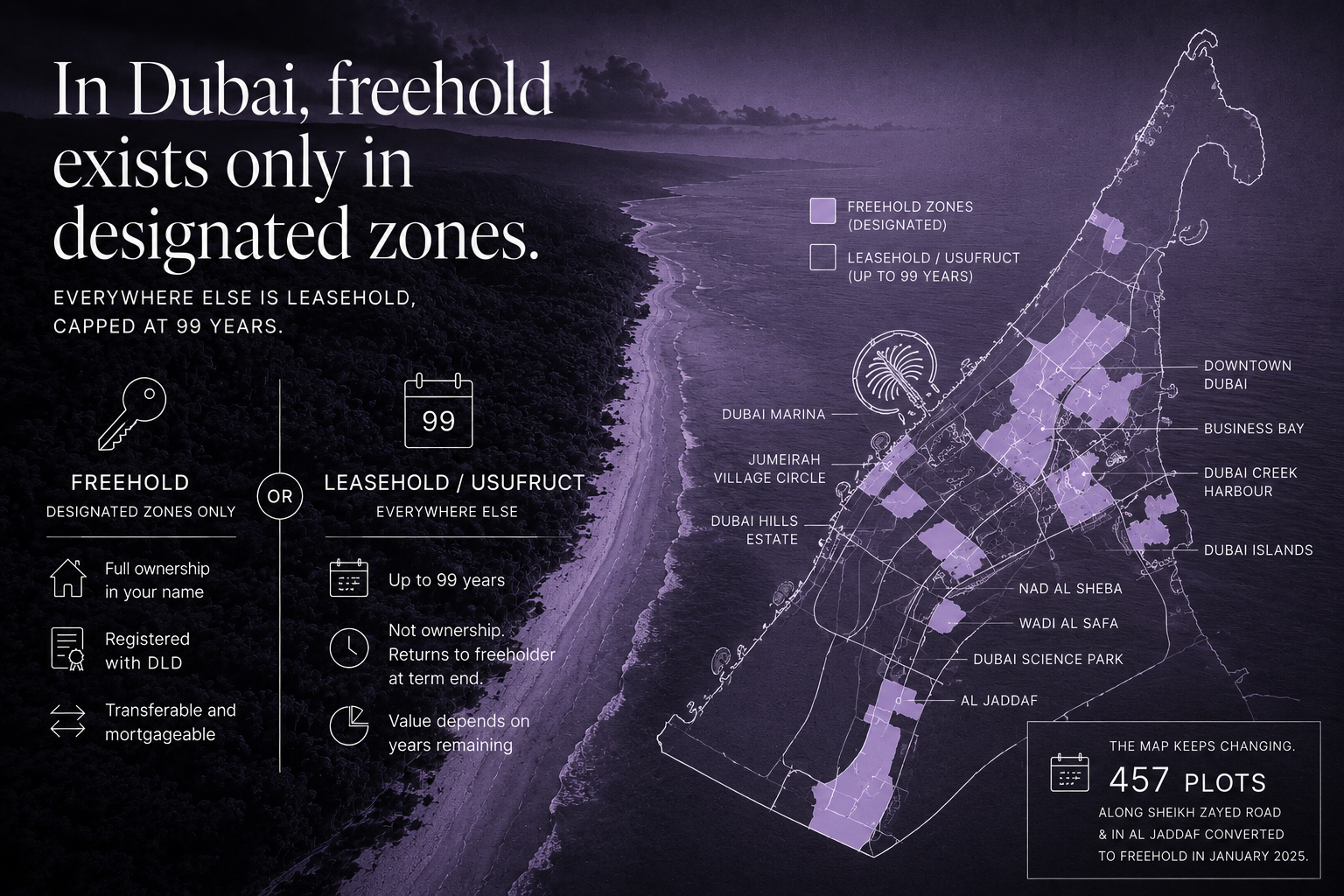
Dubai does not let a foreign buyer own property anywhere in the city. It lets a foreign buyer own property in specifically designated zones, each one created by its own decree and registered with the Dubai Land Department, and everywhere else in Dubai runs on a leasehold or usufruct basis capped at 99 years. A listing in a neighbourhood that sounds familiar is not automatically freehold just because it is popular or well established.
How a zone actually becomes freehold
Dubai first opened freehold ownership to non-GCC foreign nationals through a ruling issued in 2002, and the legal framework was formalised through subsequent legislation in 2006 that set out which areas would carry full foreign ownership rights. Since then, the list of designated freehold zones has expanded steadily through further decrees, dozens of areas as of 2026 with sources disagreeing on the precise count, since the list has genuinely kept growing and different published lists lag the most recent additions by different amounts. Each zone is created individually, by its own decree, and registered with the DLD; freehold status is not a general rule that applies across the city by default, it is a specific designation a given area either has or does not have.
The list is not static, and a recent change moved in the direction most buyers do not expect
In January 2025, the Dubai Land Department ruled that 457 plots along Sheikh Zayed Road and in the Al Jaddaf district would convert from leasehold to freehold, a genuinely significant reclassification rather than a routine addition to the map. Al Jaddaf itself, along the Dubai Creek waterfront, has since become an active freehold destination with new tower developments, and other areas added to the freehold list in the 2023-2025 window include Nad Al Sheba, Wadi Al Safa, Dubai Science Park and Dubai Islands, the redeveloped former Deira Islands waterfront. The direction of travel matters more than any single addition: this is a list that keeps expanding rather than one that was fixed once in 2006 and has stayed the same since, and a buyer relying on an older list risks missing that an area once correctly described as leasehold-only has since been reclassified.
The areas most buyers already know are freehold
Dubai Marina, Downtown Dubai, Palm Jumeirah, Business Bay, Jumeirah Village Circle, Dubai Hills Estate and Dubai Creek Harbour are among the freehold zones most familiar to foreign buyers, and each carries full title registered with the DLD, transferable and mortgageable in the same way a freehold property would be anywhere. Buying Property in Dubai as a Foreign Buyer: The Complete Guide covers the ownership process inside these zones in more detail than a zone-by-zone list can.
The areas a buyer might assume are freehold, and are not
Deira, Bur Dubai, Karama, Satwa, Al Qusais, Al Rashidiya and the older parts of Jumeirah are established, well-known Dubai neighbourhoods, and none of them are designated freehold zones. A foreign buyer can still acquire property in these areas, but only on a leasehold or usufruct basis, capped at 99 years, not outright ownership. This is precisely the gap where a buyer's prior familiarity with a neighbourhood's name can mislead: an area does not need to be obscure or newly built to sit outside the freehold list, and several of Dubai's oldest, most recognisable districts are leasehold-only for exactly this reason.
What a 99-year leasehold actually is, and is not
A leasehold or usufruct right in a non-designated area grants the holder use of the property for the term of the lease, registered and transferable in its own right, but it is not equivalent to freehold ownership and should not be priced or understood as though it were a discount version of the same asset. The property reverts to the underlying freeholder at the end of the term, and a lease bought partway through its original tenure carries less remaining value than a fresh 99-year term would, a distinction that matters when comparing two listings priced similarly but sitting on leases with different remaining durations.
Why this distinction matters more than location or price alone
A buyer comparing two properties on price per square foot without first confirming which of them is actually freehold is comparing two different categories of asset as though they were the same thing. Freehold and leasehold are not points on the same spectrum with freehold simply being the more expensive end of it; they are structurally different rights, and a leasehold property in a well-known older district can be priced attractively precisely because it is not freehold, not because it represents better value on a like-for-like basis. Confirming a specific building's status directly against the DLD's registered list, rather than assuming based on the area's reputation, is the actual first step, ahead of any comparison on price.
What Avacasa recommends
Check a property's freehold or leasehold status against the Dubai Land Department's own registration before treating price or location as the deciding factor, since the two categories are not interchangeable regardless of how similar two listings look on paper. Where a leasehold property is being considered specifically because it sits in an established, older district outside the freehold list, confirm how much of the original lease term actually remains, not just that a lease exists, since a nearly-expired lease and a fresh 99-year term are materially different purchases at the same headline price. Financing a Property Purchase Abroad is worth reading before assuming a mortgage is equally available on both categories, since lenders commonly treat freehold and leasehold Dubai property differently.
Before you commit
Mortgages for Non-Resident Buyers in Dubai covers the financing question this freehold distinction feeds directly into, and Residency and Visa Routes Tied to Property Ownership covers how Dubai's Golden Visa route, which requires a qualifying freehold purchase, is itself contingent on the property actually sitting inside a designated zone. Can Foreigners Own Property Abroad? Freehold, Leasehold and Use Rights covers how Dubai's zone-based approach compares to the different structures in Owning Property in Thailand as a Foreigner: The Complete Guide and Owning Property in Sri Lanka as a Foreigner: The Complete Guide, two markets that solve the same foreign-ownership question in genuinely different ways. Due Diligence When Buying Property in Another Country covers the verification habits worth applying before assuming any specific building's status.
Whatever the neighbourhood, Dubai, Dubai Marina and Downtown Dubai are worth checking individually against the DLD's own list rather than assumed freehold by reputation alone.
Sources
- Dozens of designated freehold zones in Dubai as of 2026, each created by Ruler's Decree and registered with the DLD
- Non-designated areas, Deira, Bur Dubai, Karama, Satwa, Al Qusais, Al Rashidiya and old Jumeirah, restricted to leasehold or usufruct rights up to 99 years
- Dubai's freehold framework opened to foreign buyers from 2002, formalised through 2006 legislation
- January 2025 DLD ruling converting 457 plots along Sheikh Zayed Road and Al Jaddaf from leasehold to freehold
Ready to find your next holiday home?
Browse our curated collection of vacation homes and managed farmland across India and beyond.