Buying Under Construction: Escrow and Buyer Protection in India, Dubai and Thailand
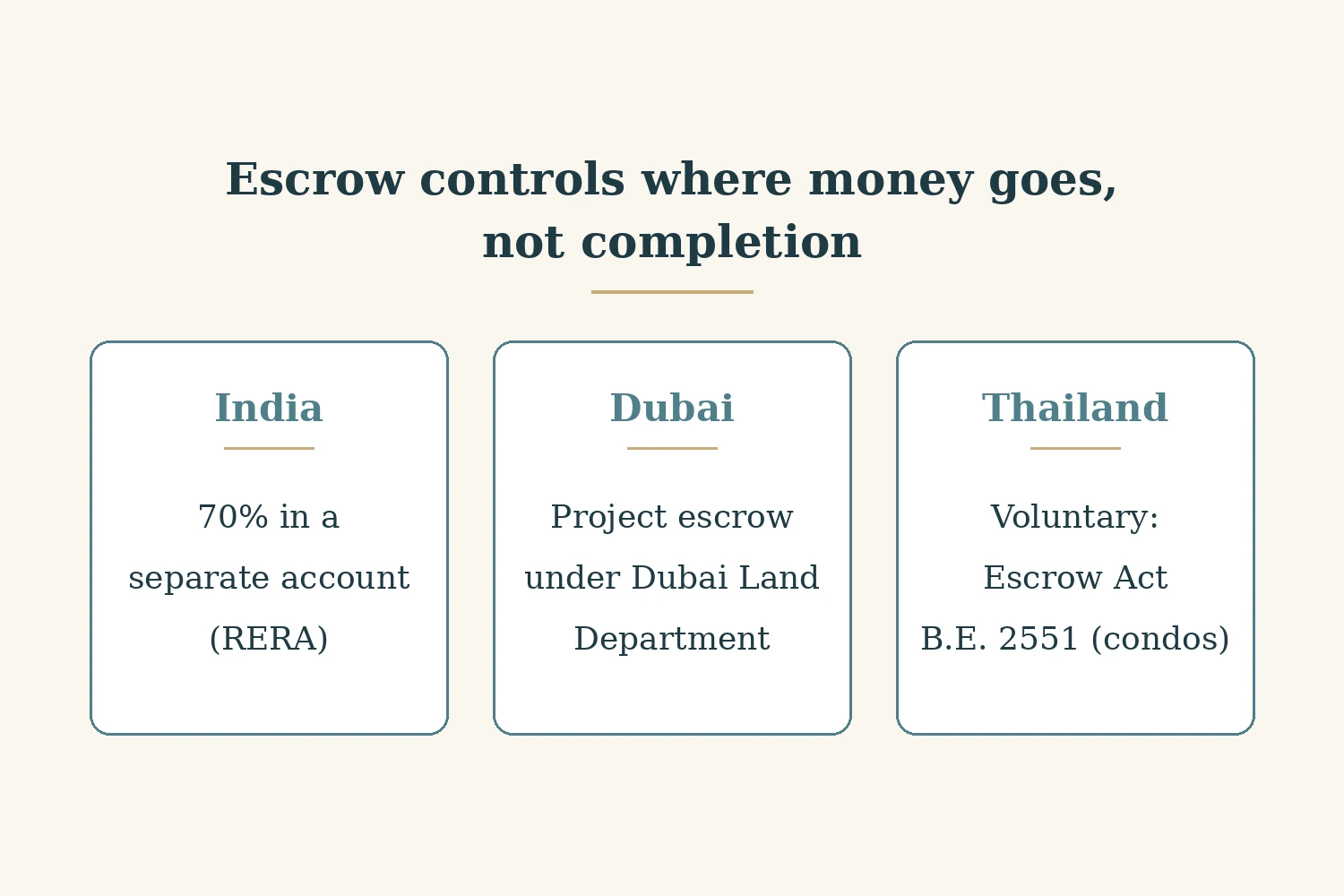
"Escrow" is one of the most reassuring words in an off-plan brochure, and one of the least consistent. In India it means a separate project account holding a share of buyers' money. In Dubai it means a supervised account in the project's name that receives buyers' instalments. In Thailand there is no general legal requirement for off-plan escrow at all; it exists only if the parties agree to it. This guide compares what the law in each market actually requires, where each protection stops, and what to check before you pay. The common thread is this: in all three, the rules control where your money goes far more than whether the building is finished on time. Statutory points below were read on 27 October 2026 unless stated, the English is our paraphrase, and this is not legal advice.
Three markets, three meanings of escrow
Before the detail, the short version:
- India: under the central Real Estate (Regulation and Development) Act, 2016 (RERA), a registered project must keep 70% of the money it collects from buyers in a separate bank account, with withdrawals tied to progress and certified by professionals.
- Dubai: buyers' instalments go into an escrow account in the project's name, managed by a bank or financial institution accredited by the Dubai Land Department (DLD), and used only for that project.
- Thailand: the Escrow Act is voluntary, so instalments for a condominium under construction usually go to the developer unless the contract says otherwise.
What each system does when a project stalls, or when a buyer stops paying, also differs. The sections below take each market in turn.
India: the 70% account and who signs off withdrawals
Section 4(2)(l)(D) of RERA requires a promoter registering a project to declare that 70% of the amounts realised from buyers will be deposited in a separate account in a scheduled bank, to cover the cost of construction and land, and used only for that purpose. Under its provisos, money may be withdrawn only in proportion to the percentage of completion, after certification by an engineer, an architect and a chartered accountant in practice, and the accounts must be audited within six months of the end of each financial year (RERA as enacted, Goa RERA copy, read 27 October 2026).
To show the scale: on an illustrative ₹1 crore collected from buyers, at least ₹70 lakh (1,00,00,000 x 70%) must sit in the separate account, and up to ₹30 lakh (1,00,00,000 minus 70,00,000) is not covered by that rule. The 70% rule is in the central Act, and state rules can add to how it works, so check your state's rules and the project's registration page for the account details.
India: the 10% advance cap and the registration exemption
Section 13(1) of RERA says a promoter may not take more than 10% of the cost of an apartment, plot or building as an advance or application fee without first entering into a written agreement for sale and registering it. On an illustrative ₹80 lakh apartment, that cap is ₹8 lakh (80,00,000 x 10%). If you are asked for more before a registered agreement exists, stop and ask why.
These protections apply to registered projects. Under section 3(2)(a), registration is not required where the land to be developed does not exceed 500 square metres, or the number of apartments does not exceed eight, including all phases. Either limit is enough for the exemption, and a state may lower the thresholds. So a small project may sit outside RERA altogether, and with it outside the 70% account. Look the project up on your state RERA portal before paying anything. Our guide to checks before you pay in Maharashtra and our questions before signing a land deal cover the wider checks.
India: where the protection stops
If a promoter fails to complete the project or give possession as the agreement for sale provides, or discontinues business, section 18(1) lets a buyer who withdraws claim back the amount paid, with interest at the prescribed rate and compensation; a buyer who stays is paid interest for each month of delay until possession. Section 18(2) adds compensation for loss caused by defective title. Separately, under section 14(3), if a structural defect or a defect in workmanship, quality or services is brought to the promoter's notice within five years of possession, the promoter must rectify it "without further charge, within thirty days", and if it does not, the buyer is entitled to compensation.
These are rights to claim, not automatic payments. Recovery runs through the regulator or the courts, and depends on the promoter being able to pay. Our India guide covers the places we list.
Dubai: one project, one account, and the cost of default
Dubai's escrow law, Law No. 8 of 2007, requires the escrow account to be opened in the project's name and used only for building that project, and protects the money in it from the developer's creditors (article 9). Loans the developer takes against the project must also be paid into the account (article 13). After the completion certificate, the escrow agent holds back 5% of the account's total value, released to the developer one year after the units are registered in buyers' names (article 14). If the project is not completed, the escrow agent, after consulting the DLD, must take measures to complete it or refund depositors (article 15). All read on the Dubai Legislation Portal, 26 October 2026.
On an illustrative escrow account holding 1,000,000 United Arab Emirates (UAE) dirhams (AED), the retention would be AED 50,000 (1,000,000 x 5%). The DLD's own guidance, in its frequently asked questions, says that payments from escrow generally go only to contractors, consultants and marketing, with marketing limited to 5% of total sales; that limit is DLD guidance, not a figure in the law (read 26 October 2026). Any sale of an off-plan unit must also be entered in the Interim Real Property Register, or it is void (Law No. 13 of 2008, article 3). Our detailed guides to Dubai escrow and off-plan protection, the Oqood register and the Dubai buying process go further, and our Dubai guide describes the city.
Escrow protects the buyer's money from the developer. It does not protect the buyer from their own default. Under article 11 of Law No. 13 of 2008, as replaced by Law No. 19 of 2017, if a buyer defaults the DLD serves 30 days' written notice before the developer can act. Where the unit is more than 80% complete, the developer may keep the contract and everything paid and claim the balance, ask the DLD to sell the unit at public auction, or terminate and keep up to 40% of the unit's contract value (read 26 October 2026). The law sets other rules for less advanced projects, which our Dubai escrow guide covers.
On an illustrative unit with a contract value of AED 1,000,000, terminating above 80% completion would let the developer keep up to AED 400,000 (1,000,000 x 40%). That is measured against the unit's value, not against what you have paid.
Thailand: no statutory off-plan escrow for condominiums
This section covers condominiums only; we have not checked the separate rules for housing estates. Thailand's Escrow Act B.E. (Buddhist Era) 2551 (2008) works on a voluntary basis. Section 5, in the English translation published by the Fiscal Policy Office (the Thai text is the authoritative version), says the parties to a contract may agree to use an escrow agent by entering into an escrow contract under the Act. Section 6 requires that contract to be in writing, signed by the parties and the escrow agent, and to set out the conditions for delivery and the rules for transferring money out of the account (Fiscal Policy Office translation, read 27 October 2026). A legal note published on the Thai Senate's website also describes the Act as voluntary, and gives instalments for off-plan housing and condominiums as an example of where it can be used (read 27 October 2026).
We found no escrow requirement in the Department of Lands' Thai text of the Condominium Act (read 25 October 2026). In practice, then, instalments go to the developer unless your contract sets up escrow. If it does not, ask for it, or accept the direct-payment risk knowingly and in writing.
Thailand: what protects a condominium buyer instead
Without escrow, the buyer's protection comes from the contract, from Thailand's consumer protection rules on certain contract terms, and from the transfer itself. We could not confirm the details of any consumer protection rule for condominium contracts from an official source, so we state none here. Ask a Thai lawyer which rules apply to your contract.
At transfer, the Condominium Act requires the Land Office to register a transfer of a unit only with the latest debt-free certificate from the condominium juristic person (section 29, Department of Lands Thai text, read 25 October 2026). Our guides to Bangkok condo common fees and the juristic person, the foreign quota for Thai condominiums, Thai property taxes and fees and owning property in Thailand as a foreigner cover the rest, and our Thailand guide and Bangkok guide describe the places.
Who this is not for
This is not for a buyer of a finished, ready property, where the transfer is the main event. It does not cover housing estates or land in Thailand, state-specific RERA rules in India, or the full set of Dubai default rules for less advanced projects. And it says nothing about any listed project's escrow status or registration: those are for you to look up.
Where that leaves you
Escrow, where it exists, answers where your money goes. It does not promise completion. Before you pay, in any of the three markets:
- India: find the project on the state RERA portal, and do not pay more than 10% before a registered agreement for sale.
- Dubai: make sure the escrow account is named in the agreement, pay only into it, and register the sale through Oqood.
- Thailand: ask whether the contract uses an escrow agent under the Escrow Act. If not, decide in writing whether you accept paying the developer directly.
- Everywhere: check the developer's record, using our guides to checking a developer's track record and cross-border due diligence.
Sources
- Goa Real Estate Regulatory Authority: Real Estate (Regulation and Development) Act, 2016
- Dubai Legislation Portal: Law No. 8 of 2007 concerning escrow accounts%20of%202007.html)
- Dubai Legislation Portal: Law No. 13 of 2008 regulating the Interim Real Property Register%20of%202008.html)
- Dubai Legislation Portal: Law No. 19 of 2017 amending Law No. 13 of 2008
- Dubai Land Department: frequently asked questions
- Fiscal Policy Office: Escrow Act B.E. 2551 (2008), English translation
- Thai Senate: legal note on the Escrow Act
- Department of Lands: Condominium Act B.E. 2522, Thai text
Ready to find your next holiday home?
Browse our curated collection of vacation homes and managed farmland across India and beyond.