Bangkok Condo Running Costs: Common Fees, Sinking Fund and the Juristic Person
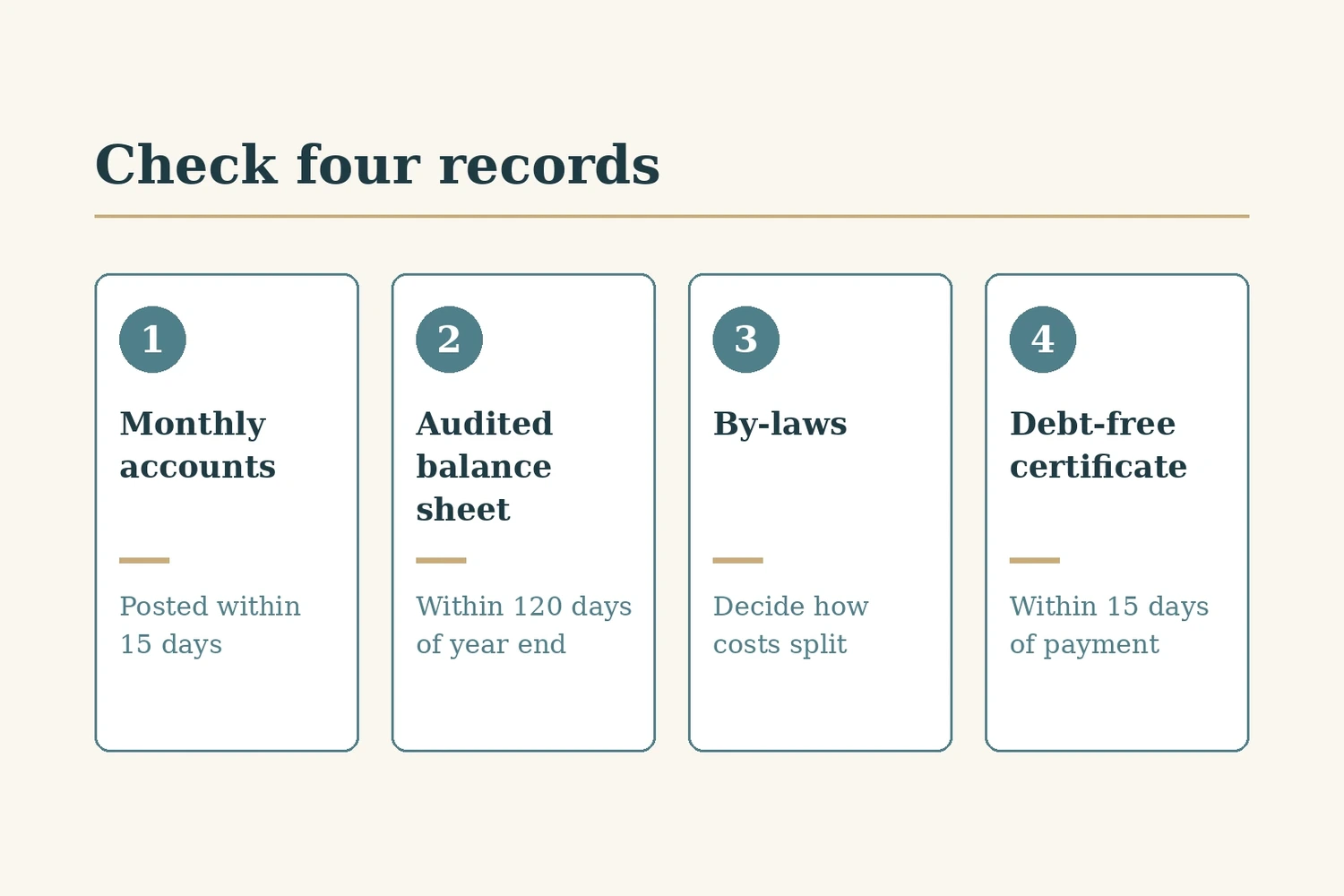
The monthly common fee in a Bangkok condominium is not a price the developer sets once and quotes forever. It is your share of what the building actually costs to run, tied by law to the size of your ownership stake and to the building's by-laws, and the owners can change it at a general meeting. So the useful question before you buy is not "what is the fee per square metre?" but "what do the building's records show?" Four documents answer it: the monthly accounts, the audited annual balance sheet, the by-laws and a debt-free certificate. A buyer who reads them knows the real running cost. A buyer who reads only the brochure does not.
Everything below comes from the Thai text of the Condominium Act B.E. (Buddhist Era) 2522 (1979), as amended to No. 4 (B.E. 2551), in the consolidated version hosted by the Department of Lands (DOL), read on 25 October 2026. The consolidated text lists amendments No. 2 (B.E. 2534, 1991), No. 3 (B.E. 2542, 1999) and No. 4 (B.E. 2551, 2008). We could not reach an official English translation, so every English description of a section here is our own paraphrase of the Thai.
What you pay each month, and why it is a share, not a price
Section 18 of the Act splits the shared bills into two groups. Taxes on the common property are divided among owners in proportion to each owner's ownership ratio. The costs of common services, and of looking after and operating the common property, are divided either by ownership ratio or by the benefit each unit gets, whichever the building's by-laws specify.
Two consequences follow. First, the fee is only as stable as the costs behind it: if the building's staffing, utilities or repair bills rise, the owners' shares rise with them. Second, the by-laws matter as much as the Act, because they decide how the service and maintenance costs are divided. Section 18 also says the developer pays these expenses for units it has not yet transferred, so unsold units in a new building do not shift their share onto buyers.
We give no typical fee per square metre here. We have no official or dated source for one, and any figure would hide the point that the fee is a share of a specific building's costs.
Where does your share come from? Section 14 sets each unit's ownership ratio in the common property as a proportion of the unit to all units. That ratio is the default key for dividing taxes and, where the by-laws choose it, service and maintenance costs.
The same ratio decides your voice. Under section 45, each owner's votes at a general meeting equal their ownership ratio, and if one owner holds more than half, their votes are capped at the combined votes of everyone else. A larger unit therefore usually means a larger share of the bills and a larger say in the meetings that set them, but no single owner can outvote the rest on their own.
The other money: the "sinking fund" and other payments
"Sinking fund" is a market term, not a phrase the Act uses. Section 40 is the part of the Act that covers it. In our paraphrase, owners pay the juristic person three kinds of money: expenses payable in advance per unit, a fund collected at the start of operations under the by-laws or a general meeting resolution, and other money required by general meeting resolutions.
The amounts are set by each building's by-laws and resolutions, not by the Act, so we give no sinking-fund figure or multiple. Ask the building what it charges and which by-law or resolution sets it.
Who sets the fee: juristic person, manager, committee and meeting
Once registered, the condominium juristic person (the owners' legal entity that runs the building) has legal status under section 33. Several bodies act for it:
- A single manager, who may be an individual or a company (section 35).
- A committee of three to nine members appointed by the owners' general meeting, serving two-year terms (section 37), which meets at least once every six months (section 38).
- The owners in a general meeting. The manager must call the first ordinary meeting within six months of registration to appoint the committee and approve the by-laws and manager (section 42). After that, the committee calls an annual meeting within 120 days of the end of the accounting year to approve the balance sheet, consider the annual report and appoint the auditor (section 42/1).
Owners holding at least 20% of all votes can ask in writing for an extraordinary meeting, which the committee must hold within 15 days, and the manager or the committee can also call one (section 42/2). Unless the Act says otherwise, resolutions pass by a majority of the votes of owners attending (section 44). Some decisions need a higher threshold, which we do not set out here. Check the Thai text or a Thai lawyer before relying on one.
If an owner does not pay
Section 18/1, added by amendment No. 4, sets the penalties for late payment. An unpaid share carries a surcharge of up to 12% a year, simple interest, at the rate in the by-laws. Once arrears reach six months, the cap rises to 20% a year, the by-laws may suspend the owner's access to common services or common property, and the owner loses the right to vote at the general meeting. The surcharge itself counts as a section 18 expense. The juristic person also has a preferential claim over unpaid common charges under section 41.
To show the scale, take a purely illustrative unpaid balance of THB 10,000. A full year at the 12% cap would add up to THB 1,200 (10,000 x 12%). At the 20% cap for arrears of six months or more, a full year would add up to THB 2,000 (10,000 x 20%). The actual rate is whatever the by-laws set, up to those caps.
Arrears across a building also matter to a buyer who pays on time. Other owners' unpaid shares leave a gap in the budget.
The debt-free certificate, and why your transfer waits for it
Under section 29, the Land Office will register a transfer of a unit only when the unit owes nothing under section 18, shown by the latest debt-free certificate from the juristic person. The manager must issue the certificate within 15 days of a request, once the owner has paid in full.
For a resale buyer this is the practical lock. The seller's arrears have to be cleared before the transfer can be registered, so ask for the certificate early and build its 15-day window into your timetable. The rule does not apply to transfers made before the juristic person is registered, which in practice means a first sale from the developer in a new building. Our guides to Thai title deeds and Thai property taxes and fees cover the rest of the transfer.
What the building's records should show
The Act requires a set of records an owner can read:
- A monthly income and expense account, which the manager posts for owners within 15 days of month end and leaves up for at least 15 days (section 36(5)). Failing to do so carries a fine under the penalty provisions added by amendment No. 4.
- An audited balance sheet at least once every 12 months, showing assets, liabilities, income and expenses, submitted to the general meeting within 120 days of the end of the accounting year (section 38/1).
- An annual report presented with the balance sheet, with copies sent to owners at least 7 days before the meeting (section 38/2).
- The annual report, balance sheet and by-laws kept at the juristic person's office for owners to inspect, with reports and balance sheets kept for at least 10 years from approval (section 38/3).
Together these show what the building spends, what it holds in reserve, how many owners are behind, and whether the meetings are being held on time.
Questions to ask before you pay a deposit
Built from the sections above:
- Which basis do the by-laws use to divide service and maintenance costs: ownership ratio or benefit to each unit (section 18)?
- What is this unit's ownership ratio (section 14)?
- May I see the last three monthly accounts (section 36(5)) and the last audited balance sheet (section 38/1)?
- When was the last annual general meeting held, and may I see the annual report and minutes (sections 38/2 and 42/1)?
- What one-off payments apply at transfer, and which by-law or resolution sets them (section 40)?
- Are any levies planned or under discussion?
- How much of the building's dues are in arrears, and what surcharge rate do the by-laws apply (section 18/1)?
- How soon can the seller's debt-free certificate be issued (section 29)?
Our cross-border due diligence guide puts these alongside the title and legal checks, and the Dubai service charges guide answers the same question for another market.
Who this is not for
This is not for buyers of houses or villas in a housing estate. The Condominium Act governs condominium units, so houses and villas fall outside it. It is not a guide to whether a foreign buyer can own a particular unit: the quota limits are in our Thai condo foreign quota guide, with wider context in owning property in Thailand as a foreigner, company land ownership risks, the 30-year lease and foreign property ownership explained. And it is not legal advice on a specific building's by-laws.
Where that leaves you
As listed on avacasa.life on 25 October 2026, we have 19 apartment listings in Bangkok condominium projects, including projects in Huai Khwang and Sathon. None of them shows a common fee or sinking-fund figure, so the listing will not tell you the running cost. The building's records will. Ask for the by-laws, the monthly accounts, the last audited balance sheet and the debt-free certificate, read them against the Act, and then decide. If you plan to let the unit, our guide to holiday rental management overseas covers the costs that sit on top. Our Bangkok guide, Thailand guide and Phuket guide describe the places themselves.
Sources
- Department of Lands: Condominium Act B.E. 2522 as amended, Thai text (page)
- Department of Lands: Condominium Act B.E. 2522 consolidated Thai text (PDF)
- Department of Lands: Condominium Act with ministerial regulations (page)
Ready to find your next holiday home?
Browse our curated collection of vacation homes and managed farmland across India and beyond.