Service Charges and Running Costs of a Dubai Apartment
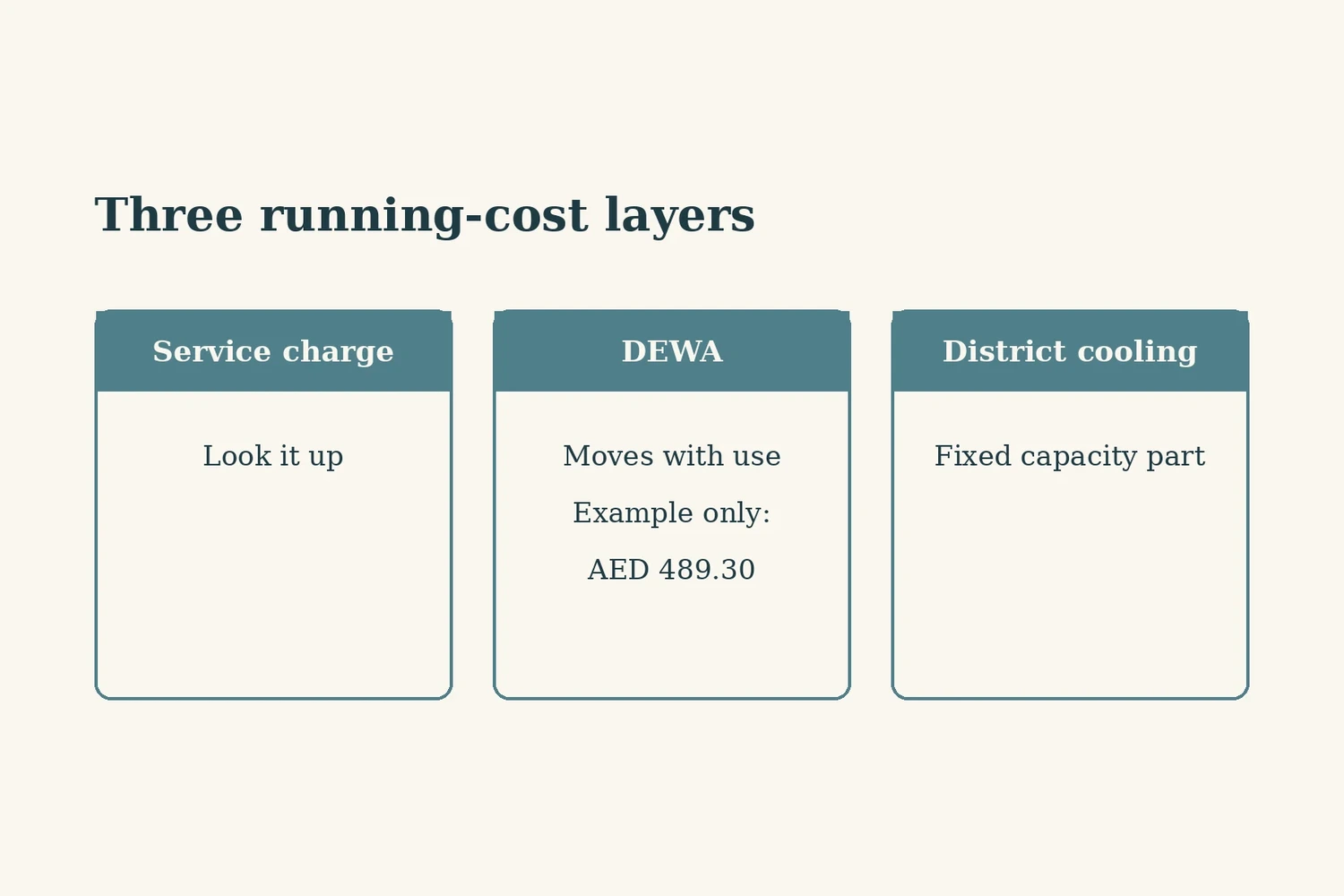
Search for Dubai service charges per sq ft and you will find tables by community, mostly from agents and aggregators. None is the number you will pay. A service charge is a budget that the Real Estate Regulatory Agency (RERA) approves for a building each year, divided by the registered area of each unit, and the approved rate is a public record you can look up before you make an offer. Running a Dubai apartment has three cost layers: the service charge, electricity and water from the Dubai Electricity and Water Authority (DEWA), and in some buildings a district cooling bill that charges for reserved capacity even when the flat is empty. Only the first is a lookup, and only the first is a debt the law lets the building recover from the unit.
Money is in United Arab Emirates dirhams (AED), with United States dollars (USD) alongside at AED 3.6725 per USD 1, the rate shown on the Central Bank of the UAE (CBUAE) exchange rate table, last updated 23 October 2026 on the page. We give no service charge figure for any community, because the only official source is a lookup tool.
What a service charge is, and how it is set
Under Dubai Law No. 6 of 2019 on jointly owned real property (Dubai Legal Portal, issued 4 September 2019), each owner pays the management entity a share of the annual charge for running, maintaining and repairing the common parts. The share follows the ratio of the unit's area to the total area, using a method approved by the Director General of the Dubai Land Department (DLD), and the area is the one in the Real Property Register, not the brochure (Article 25).
A developer pays the share for units it has not sold, and for sold units only where the sale contract or reservation agreement says it will pay for the buyer (Article 25). On an off-plan purchase, that wording answers whether the developer pays on a sold unit (see Oqood and off-plan title). We found no official page on when an owner's payments begin after handover, so we state no timing.
The management entity cannot collect anything without RERA approval, and RERA may not approve the budget unless a certified audit firm it recognises has approved it, though it may approve a temporary budget meanwhile (Article 27). The money sits in a separate service charge account at a bank licensed in Dubai, which the management entity's creditors cannot attach, and it may be spent only on listed items. These include cleaning, security, maintenance and repair of common parts, building insurance premiums, audit fees, management company fees set by RERA and a cash reserve (Article 30). Owners' share of the building insurance premiums sits inside the service charge (Article 41).
Look it up before you offer
DLD runs a Service Charge Index. You choose the project, the use and the year, and the result is immediate, through Mollak (DLD's service charge system), the DLD website or the Dubai REST app (DLD overview page and guide leaflet, no date shown, read 24 October 2026).
The index is per square foot, so convert: one square metre is 10.7639 square feet, and the annual charge is rate per square foot x 10.7639 x area in square metres. As an illustration only, take a 100 square metre unit and a round AED 10 per square foot: 100 x 10.7639 = 1,076.39 square feet, and 1,076.39 x 10 = AED 10,763.90 a year, about AED 897 a month (10,763.90 / 12), or USD 2,931 (10,763.90 / 3.6725). The AED 10 is a placeholder to show the arithmetic, not a market, typical or quoted rate.
A per-square-foot rate describes a building's budget, and your unit's bill depends on its registered area and the approved method, which we could not locate. Third-party sites republish community medians that disagree with each other, so we use none. Our guides to Downtown Dubai and Dubai Marina describe the areas, but a building's charge is a lookup.
The reserve, usage charges and the lien
Three provisions matter more than the headline rate. The first is the cash reserve. The law lists it among the permitted uses of the service charge account, for emergencies or to replace common-part equipment, and says it is held in a separate account and not usable except in critical emergencies without RERA approval (Article 30(e)(8)). The law sets no balance or percentage. If the reserve falls short, DLD may, with RERA's prior approval, ask owners to cover emergency costs (Article 30(f)). We found no official data on how often that happens.
The second is the usage charge. A master developer may collect usage charges from owners or sub-developers for managing and maintaining the common parts of the wider master project, on completed buildings, buildings under construction and vacant land, into a separate account (Articles 26 and 31). It can sit on top of the building's own charge. The law sets no amounts and we found no official list of communities that levy one, so we name none. Ask.
The third is enforcement. The management entity has a claim secured on each unit for unpaid service charges, and the unit cannot be sold or otherwise disposed of until they are cleared (Article 32). After a written notice approved by RERA, the owner has 30 days to pay, after which the claim is enforceable by the execution judge at the Rental Disputes Settlement Centre (RDSC), who may order a public auction. A defaulting owner also pays court and advocate fees. Because a unit cannot be sold until the charge is paid, the seller's statement of account matters. The related no objection certificate (NOC) step is in our transaction costs guide.
Electricity and water
DEWA bills electricity and water on monthly slabs, so this layer tracks use. The following figures are from DEWA's slab tariff page, which carries the October 2026 fuel surcharge, and DEWA says the surcharge varies with fuel prices. Residential electricity is AED 0.230 per kilowatt-hour (kWh) up to 2,000 kWh a month (USD 0.063), AED 0.280 from 2,001 to 4,000 (USD 0.076), AED 0.320 from 4,001 to 6,000 (USD 0.087) and AED 0.380 above that (USD 0.103), plus an October 2026 fuel surcharge of AED 0.060 per kWh (USD 0.016). Residential water is AED 7.700 per cubic metre (m3) up to 27 m3 (USD 2.097), AED 8.800 from 27 to 54 (USD 2.396) and AED 10.120 above 54 (USD 2.756), plus AED 1.100 per m3 (USD 0.300). Each dollar figure is the dirham rate divided by 3.6725 and rounded. Value added tax (VAT) of 5% applies.
Here is a worked example, assumed consumption and not a typical bill: 1,000 kWh and 20 m3 in a month. Electricity is 1,000 x (0.230 + 0.060) = AED 290.00. Water is 20 x (7.700 + 1.100) = AED 176.00. The subtotal is AED 466.00, VAT at 5% is AED 23.30, and the total is AED 489.30, or USD 133.23 (489.30 / 3.6725). It leaves out DEWA's meter service charge, whose period the page does not state.
There is also a one-off cost of holding. DEWA's move-in page lists an AED 2,000 security deposit for a flat (USD 544.59, 2,000 / 3.6725) and AED 4,000 for a villa, plus AED 155 of activation charges (AED 125 for small meters and three fees of AED 10), or USD 42.21 (read 24 October 2026). For owners, the same page says the deposit is refunded upon sale of the premises only, so while you own it is a cost of holding, not a float. The 5% housing fee that appears on the DEWA bill is a tenant cost, paid to Dubai Municipality at 5% of the yearly rent (UAE Government portal, page dated 20 January 2026), so it is not an owner's running cost. Our rental income piece shows what these lines do to a rental calculation. We found no other owner-side municipal charge in the sources checked.
District cooling
Many Dubai towers are cooled by a district cooling provider, not by units of their own. Dubai's Regulatory and Supervisory Bureau for the Electricity and Water Sector (RSB) sets the charges providers may apply in document RD10, version 1.4, published 6 February 2026. A capacity tariff, in AED per refrigeration ton (RT) per year, pays for reserved cooling capacity and is approved for each system, so it differs by provider. A consumption tariff pays for cooling used, with a cap of AED 0.643 per refrigeration-ton-hour where a capacity tariff also applies (about USD 0.18, 0.643 / 3.6725), including the fuel surcharge. For a single-building system, the cap is AED 0.80 per refrigeration-ton-hour (USD 0.218, 0.80 / 3.6725) and no capacity charge may be applied to units. It also limits a deposit to 8 months of capacity charges unless otherwise approved.
Where a building passes the cost to its units, RD10 says capacity charges must follow each unit's allocated share of the building's contracted capacity, not the installed equipment. A closed-up flat on a capacity tariff therefore still carries a fixed cooling line. We give no provider's actual rates, because we found none on an official page.
What no primary source answers is whether district cooling is inside a given building's service charge or billed separately by the provider. It is building-specific, so ask in writing whether district cooling is inside the service charge. If it is billed separately, ask who the provider is and for the approved capacity tariff and your unit's allocated capacity.
Three layers side by side, and the VAT on them
The service charge is a RERA-approved budget, checkable in the index, owed whether or not anyone lives in the flat, and backed by a lien. DEWA electricity and water follows published slabs and moves with use. District cooling, where it applies, has a capacity part that does not move with use, and is checkable only through the provider's approved schedule.
A long-stay owner sees all three lines at work. A closed-up second home still carries three fixed lines: the service charge, the DEWA deposit tied up until sale, and any district cooling capacity charge. A budget with only the first line, or one that assumes the third is inside the first, will be wrong in a predictable direction.
VAT sits across the first layer. The Federal Tax Authority (FTA) real estate guide (dated April 2021) says charges for the upkeep of communal areas are subject to VAT at the standard rate and are neither zero-rated nor exempt, and that where a management entity can register, service charges attract 5%. An FTA clarification (dated November 2020) says that since 3 November 2019 management entities, not owners' associations, make the supplies and issue tax invoices. Ask whether a quoted figure includes VAT.
Questions to put to the seller or developer
Before you sign, ask for the following in writing. Which approved rate does the index show for this project, use and year? What area does the title deed or Oqood record for the unit, since that is the area that counts? Who pays on unsold or just-handed-over units, and what does the contract say? Is there a master community usage charge on top, and who sets it? What is the balance of the reserve fund? Is district cooling inside the service charge or billed separately, and at what approved capacity? And are any charges outstanding on the unit, because a lien follows it? The wider sequence is in the buying process, the freehold and leasehold zones and our Dubai guide, with cross-border due diligence for the checking habit.
Who this is not for
This is not for someone who wants a per-community number to plug into a spreadsheet, because we found no official figure and the third-party tables contradict each other. It is not for someone seeking a legal opinion on a dispute, which belongs with a Dubai lawyer and the RDSC. And it is not for a buyer who wants this to settle whether Dubai suits them. That belongs to our pieces on buying as a foreign buyer, whether to buy at all and infrastructure, with the wider setting in our UAE guide.
Where that leaves you
Treat the service charge as a lookup, not a quote, and treat electricity, water and cooling as separate lines that behave differently. Before an offer, find the approved rate in the index, convert it to your unit's registered area, and ask about usage charges, the reserve and cooling in writing. Recheck the DEWA rates before you rely on them, since the surcharge varies with fuel prices. The law makes the service charge the debt that follows the unit, which is the reason to know it first.
Sources
- Dubai Law No. 6 of 2019 on jointly owned real property, Dubai Legal Portal%20of%202019%20Concerning%20Ownership%20of%20Jointly%20Owned%20Real%20Property%20in%20the%20Emirate%20of%20Dubai.html)
- Dubai Land Department: Service Charge Index overview
- Dubai Land Department: Service Charge Index guide leaflet
- Mollak, Dubai Land Department's service charge system
- Federal Tax Authority: real estate VAT guide VATGRE1
- Federal Tax Authority: clarification VATP022 on Dubai owners' associations and management entities
- DEWA: slab tariff
- DEWA: activation of electricity and water (move-in)
- RSB: district cooling tariffs document RD10, version 1.4
- UAE Government portal: leasing a property in the UAE
- Central Bank of the UAE: exchange rate table
Ready to find your next holiday home?
Browse our curated collection of vacation homes and managed farmland across India and beyond.