Al Maktoum International and the Southern Dubai Corridor
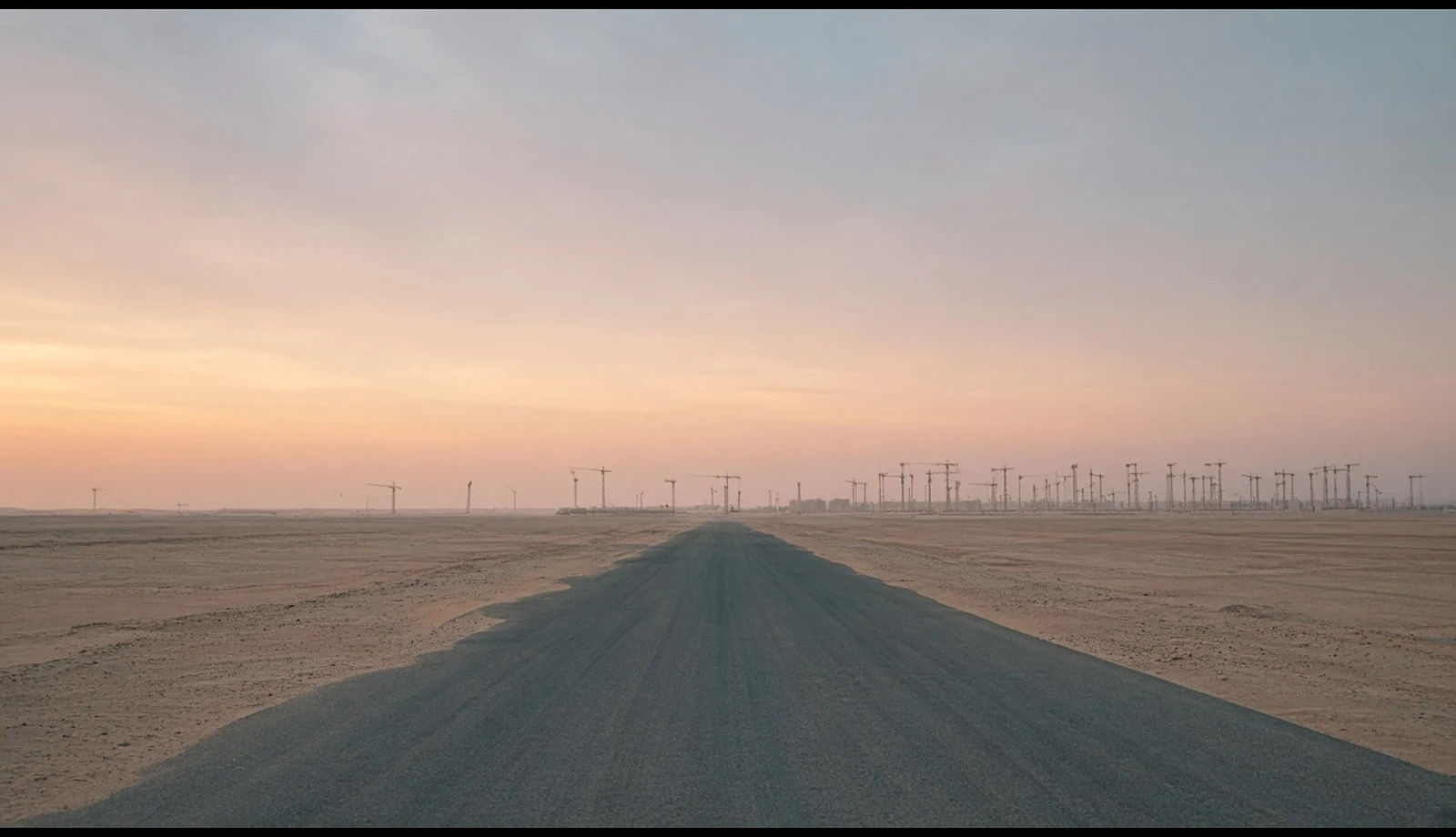
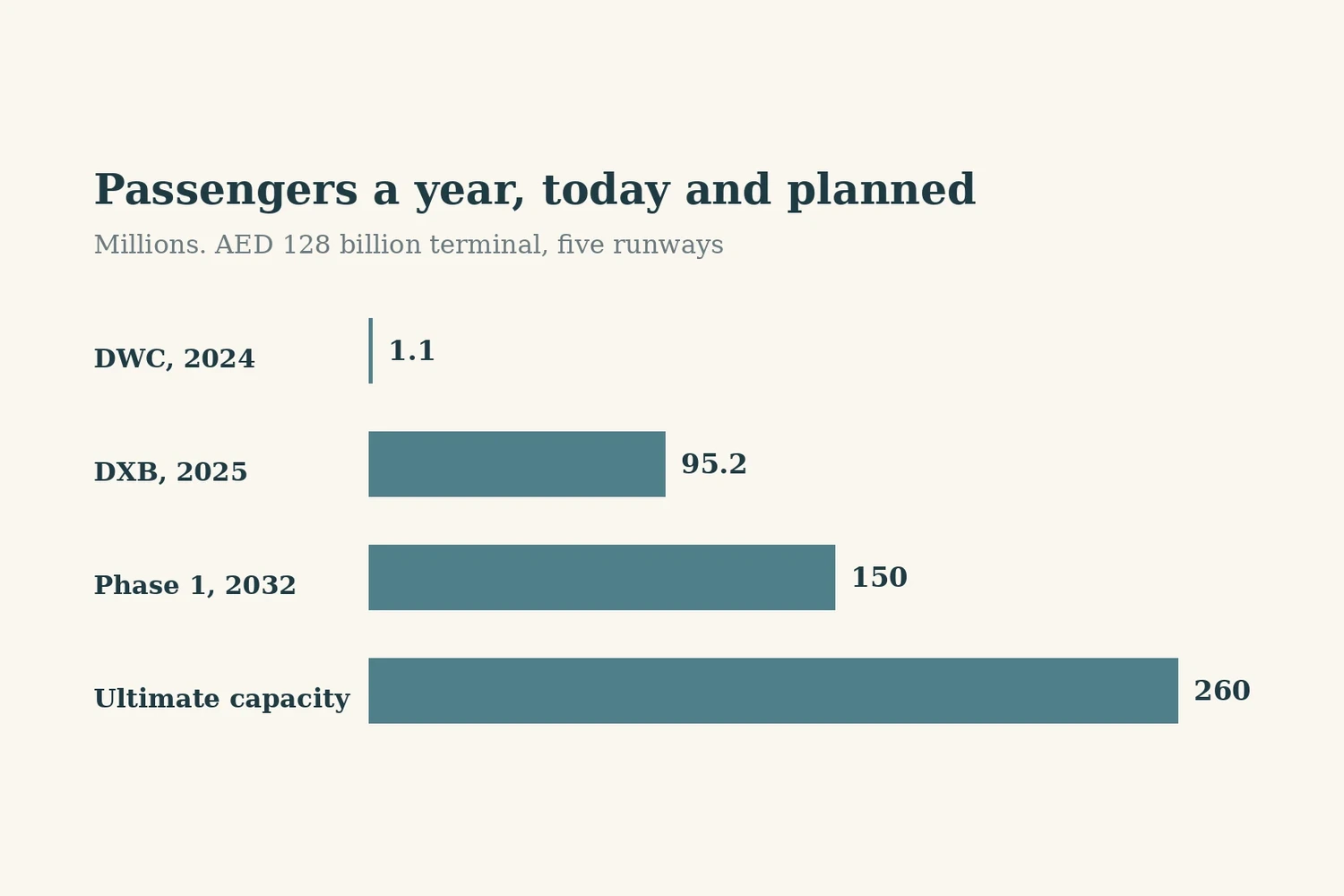
Anyone researching Al Maktoum airport and Dubai South property will meet the same big numbers again and again: a passenger terminal approved at AED 128 billion, an ultimate capacity of 260 million passengers a year, five parallel runways. The money and the concrete are real. But the date that matters to a buyer is not April 2024, when the project was approved. It is 2032, when the first phase is due to start operations. Today the existing airport at the site, Dubai World Central (DWC), handles around a million passengers a year, while Dubai International (DXB) handles about 95 million. So a home bought in the southern corridor today is, in part, priced on an opening that is still years away, and an off-plan home there carries two delivery dates at once: the developer's and the airport's. The honest way to look at the corridor is to separate what already works, the metro and now the railway, from what has been promised, and to treat the airport as an option rather than as something a buyer can count on yet.
Amounts are in United Arab Emirates dirhams (AED), with United States dollars (USD) alongside at AED 3.6725 to USD 1, the rate on the Central Bank of the UAE (CBUAE) rate table. For the general mechanics of buying, our guide to buying property in Dubai as a foreign buyer is the starting point, and our Dubai guide covers the city as a whole.
What was announced, and what exists today
On 28 April 2024 the Ruler of Dubai approved the designs and the start of construction of a new passenger terminal at Al Maktoum International, the airport known as DWC, at a cost of AED 128 billion. In dollars that is 128 billion divided by 3.6725, or about USD 34.85 billion. The Dubai Media Office described an ultimate capacity of 260 million passengers a year, 400 aircraft gates, five parallel runways and an airport five times the size of DXB, covering 70 square kilometres with capacity for 12 million tonnes of cargo. It said the first phase, with capacity for 150 million passengers, would be ready within 10 years, and that all operations at DXB would move to the new airport in the coming years. No date for that move was given, and we do not supply one.
The same announcement included a statement that a city around the airport in Dubai South would bring housing demand for a million people. That is an ambition stated by the Ruler, not a planning forecast with a method behind it, and it should be read that way.
Now set those numbers against today. Dubai Airports reports that DWC, which opened to passengers on 27 October 2013 and took over all cargo from DXB by May 2014, welcomed more than 1.1 million guests in 2024, up 95%, with nearly 50,000 aircraft movements. In the first nine months of 2025 it handled 915,000 passengers, up 35.9%, and 481,000 tonnes of cargo. We did not find a full-year 2025 figure.
DXB, by contrast, handled 95.2 million guests in 2025, up 3.1%, and Dubai Airports forecasts about 99.5 million in 2026. Working back, a 3.1% rise to 95.2 million implies about 92.3 million in 2024 (95.2 divided by 1.031). DWC's 1.1 million that year was therefore about 1.2% of DXB's traffic (1.1 divided by 92.3). The first phase of the new airport, at 150 million passengers, would be roughly 1.6 times DXB's 2025 traffic (150 divided by 95.2), and the ultimate 260 million about 2.7 times (260 divided by 95.2). The gap between today's DWC and the planned one is the whole story.
The timeline: 2032 is the date that matters
On 15 June 2026 the Dubai Media Office published a progress update. It said the project remained on course to begin operations in 2032, that contracts worth AED 13 billion (about USD 3.54 billion, 13 billion divided by 3.6725) were under execution, and that packages worth more than AED 55 billion (about USD 14.98 billion) were being prepared for award by the end of the year. It described the final configuration as five parallel runways, two passenger terminals and seven concourses connected to more than 430 aircraft stands.
Two details are worth noticing. First, the 2024 announcement spoke of 400 gates and the 2026 update of more than 430 stands. These are different words from different dates, and we report each as stated rather than treating one as a correction of the other. Second, the AED 13 billion under execution is about 10% of the AED 128 billion approved (13 divided by 128), which is consistent with a project in its early construction years rather than one nearing completion.
From the date of this article, 2032 is about six years away; from the 2024 approval, it is eight. Neither the 2024 announcement nor the 2026 update gives a year for moving all of DXB's operations to DWC. Any year you see quoted for that move should be checked against an official source before it shapes a purchase.
The corridor that already works: metro and rail
Not everything in the southern corridor is a promise. The Roads and Transport Authority (RTA) extended Dubai Metro along Route 2020, a 15 kilometre extension, 11.8 kilometres elevated and 3.2 kilometres in tunnel (11.8 + 3.2 = 15), with seven stations. The first stations, Jebel Ali interchange, The Gardens, Discovery Gardens and Al Furjan, opened on 1 January 2021. Dubai Investment Park and Expo 2020 stations followed on 1 June 2021, with the Expo station open to the public from 1 October 2021, and Jumeirah Golf Estates station opened on 1 September 2021. That is working infrastructure, five years old, and it is what already connects the area around Expo City to the rest of the network.
Rail has now joined it. The Dubai Media Office reported that Etihad Rail's Dubai station was inaugurated on 28 September 2026, and Etihad Rail's own passenger pages describe services linking Abu Dhabi, Dubai and Fujairah, along with Al Dhaid, from 30 September 2026, with a Sharjah station due on 30 March 2027. Details of the Dubai station's exact location and the frequency of services come only from trade press that we could not load, so we do not state them.
One thing we cannot confirm is a metro line to the new airport itself. Dubai Airports' fact file describes the airport as a landside hub that will include Dubai Metro, but we found no RTA alignment or opening date for such a link, so we do not promise a station.
The plan around it: Dubai 2040 and Expo City
The Dubai 2040 Urban Master Plan, launched in March 2021, named the Expo 2020 area as one of two new urban centres, described by the Dubai Media Office as an economic and growth hotspot with affordable housing, exhibitions, tourism and logistics. Dubai Municipality's executive summary of the plan calls it District 2020, to be developed through to 2040, earmarks a Jebel Ali centre for beyond 2040, and says growth is to be prioritised around transit stations.
Expo City Dubai's own master plan brochure says it retains more than 80% of the Expo 2020 infrastructure and is organised into five districts, Expo Downtown, Fields, Hills, Business and Valley, with DP World's global headquarters in the business district. That brochure is the developer's promotional material, and we read it as such.
The pattern across these documents is consistent: growth is planned around the transport that exists, and the timelines run to 2040. That is a reason to weigh proximity to working stations, not distance to a future airport, when choosing where to look. Our explainer on Dubai freehold and leasehold zones covers where foreign buyers can own.
What has measurably happened to property
Here we have to be plain. We have not cited any official price series for Dubai South or Expo City, and we have no sourced transaction volumes for the area. So this piece does not say that prices there have risen by any percentage since the 2024 announcement, and it does not quote a rental yield. If you are shown a figure, ask whether it comes from Dubai Land Department transaction data or from a broker's estimate, and treat the latter as a view. Avacasa has no listings in Dubai South, Expo City or the airport area, so nothing here describes stock we sell.
The sister pieces on how infrastructure has moved other markets, North Goa after the Mopa airport and Mulshi and its new roads, take the same approach: separate the measured from the claimed. For a realistic view of what Dubai homes earn, see our piece on Dubai rental income.
Off-plan: two delivery dates stacked
Much of what is sold in a growth corridor is off-plan, and here the timeline matters twice. An off-plan home has its own handover date, set by the developer, and registered on the interim Oqood register until completion, as our piece on Oqood and off-plan title explains. If the price you are paying assumes the new airport is open, you are also relying on a second date, 2032, set by a public programme of a scale that few developers or buyers can influence.
Those two risks do not cancel each other out. A unit delivered on time in 2028 still has several years before the airport's first phase is due. A unit delivered late may arrive closer to 2032, but with its own delays to absorb. In either case, the rental and resale market around the home in its early years is the one that exists then, not the one that is planned. Our walk-through of the Dubai buying process step by step and our breakdown of Dubai property transaction costs cover the mechanics and the fees.
A checklist before buying in the corridor
Before you commit to a home in the southern corridor, it is worth settling a few points in writing:
- Is the home within reach of a working metro station today, and which one?
- If it is off-plan, what is the developer's handover date, and what does the contract say about delay?
- Does the asking price assume the new airport is open, and if so, would the deal still make sense on today's demand?
- Is the price supported by Dubai Land Department transaction data, or only by a broker's projection?
- Are you relying on a metro link to the new airport or a year for the DXB transfer that has not been officially confirmed?
If residency is part of the reason you are buying, our guide to the Dubai golden visa property route sets out what the property must prove.
Who this is not for
This corridor is not for a buyer who needs rental income or resale value to depend on the new airport within the next few years. On the official timetable, the first phase is due in 2032, and the move of all DXB operations has no published date. It is also not a fit for anyone who wants an official price trend to anchor a decision, because we have not found one for the area. And if you are drawn to the idea of a Dubai home mainly because you visit often, our piece on whether to buy if you keep returning to Dubai is a better first read than any infrastructure story.
Where that leaves you
Al Maktoum International is a real project with real money behind it: AED 128 billion approved, AED 13 billion of contracts under way, and a stated opening for its first phase in 2032. Around it, the parts of the corridor that already work are the metro, open since 2021, and the railway, open since September 2026. What has not been shown is a measured effect on property prices, and what has not been set is a date for the full move from DXB. The sensible approach is to buy what the corridor delivers now, in terms of transport, jobs and daily life, and to treat the airport as an option that may add value later rather than as a promise already priced in. For the wider context, our UAE guide, our Downtown Dubai guide and Dubai Marina guide show how established areas compare, and our explainer on foreign property ownership covers the basics.
Sources
- Dubai Media Office: Al Maktoum International Airport approval, 28 April 2024
- WAM: Mohammed bin Rashid approves designs and start of work
- Dubai Media Office: Al Maktoum airport progress, 15 June 2026
- Dubai Airports: Dubai World Central
- Dubai Airports: fact file
- Dubai Airports: DXB traffic 2025
- RTA: Route 2020 to start operation on 1 January 2021
- RTA: Dubai Investment Park and Expo stations to open on 1 June
- RTA: opening of Jumeirah Golf Estates metro station
- RTA: operation of Dubai Metro Route 2020
- Dubai Media Office: Etihad Rail Dubai station opened, 28 September 2026
- Etihad Rail: passenger services
- Dubai Media Office: Dubai 2040 Urban Master Plan launch
- Dubai Municipality: Dubai 2040 Urban Master Plan executive summary
- Expo City Dubai: master plan brochure
- Central Bank of the UAE: exchange rates
Ready to find your next holiday home?
Browse our curated collection of vacation homes and managed farmland across India and beyond.