The Property Route to a UAE Golden Visa
Everyone who has looked at the Dubai golden visa property route knows the number: AED 2,000,000 of property. That figure is the easy part. What actually decides an application is what you can prove counts towards it, and the three official bodies involved describe that test in slightly different ways. A buyer with a large mortgage on a flat worth more than AED 2,000,000, a couple who split an AED 2,000,000 flat equally, and a buyer of an off-plan unit still waiting for its title deed can all find that the headline price was not the whole story. This piece works through those cases using the official service pages, says plainly where those pages leave a question open, and makes no promise about any outcome. Visa decisions belong to the authorities, not to a seller or an article.
Amounts are in United Arab Emirates dirhams (AED), with United States dollars (USD) alongside at AED 3.6725 to USD 1, the rate on the Central Bank of the UAE (CBUAE) rate table last updated on 20 October 2026. For a short comparison of the UAE route with residency schemes in other countries, see our piece on property-linked residency visas; this article goes deeper on the UAE route alone.
What the property route requires: three authorities, three descriptions
Three bodies publish the rules. They agree on the core and differ at the edges, and the edges are where applications fail.
The federal authority (ICP)
The Federal Authority for Identity, Citizenship, Customs and Port Security (ICP) says the investor must own one or more properties in the UAE with a total value of at least AED 2,000,000 (about USD 544,588, being 2,000,000 divided by 3.6725). Full ownership must be registered in the investor's name. A loan is allowed if it comes from an approved local bank, and the investor and family must hold valid health insurance throughout the residency. ICP also accepts one or more off-plan units totalling at least AED 2,000,000, if bought from an approved local real estate company authorised by the local authority.
The Dubai residency authority (GDRFA)
The General Directorate of Residency and Foreigners Affairs in Dubai (GDRFA) also asks for one or more properties totalling at least AED 2,000,000, and says all property types count. The value is certified by a property status certificate from the Dubai Land Department (DLD), and a valuation from a DLD-licensed office may also be accepted. Two of its conditions matter a great deal: a jointly owned share must itself be worth at least AED 2,000,000, and a lien is placed on the property for the life of the visa.
The land registry (DLD)
The DLD's own service describes an investor whose property had a purchase value of AED 2,000,000 or more at the time of purchase, owning one or more properties wholly in their own name, and applying from inside the UAE. ICP's Arabic entry permit page asks, in turn, for a letter from the emirate's land registry confirming property worth at least AED 2,000,000 in total.
The practical difference is the measure of value. The DLD speaks of purchase value at the time of purchase; GDRFA allows a status certificate or a licensed valuation. We cannot tell you which measure would be applied to your case, so the safe course is to check both before you rely on either. For how buying works in the first place, see our guides to buying property in Dubai as a foreign buyer and the Dubai buying process step by step.
Mortgages, joint ownership and several properties
Mortgaged property is accepted by both GDRFA and the DLD, and ICP allows a loan from an approved local bank. The DLD asks for a no objection certificate (NOC) from the bank, a letter saying the bank does not object to a residence permit on the property, stating the amount paid and the balance outstanding. Its summary also refers to a bank letter showing AED 2,000,000 paid.
That wording leaves a real question open. Take a flat bought for AED 2,500,000 with a loan of AED 1,500,000. The amount paid is 2,500,000 less 1,500,000, or AED 1,000,000. On a purchase value reading the flat clears the threshold by AED 500,000. On an amount paid reading it falls short by AED 1,000,000. No source we found settles whether your own equity must reach AED 2,000,000, or what share of the price must be paid, so confirm the position with your lender and the DLD before you sign the sale and purchase agreement (SPA).
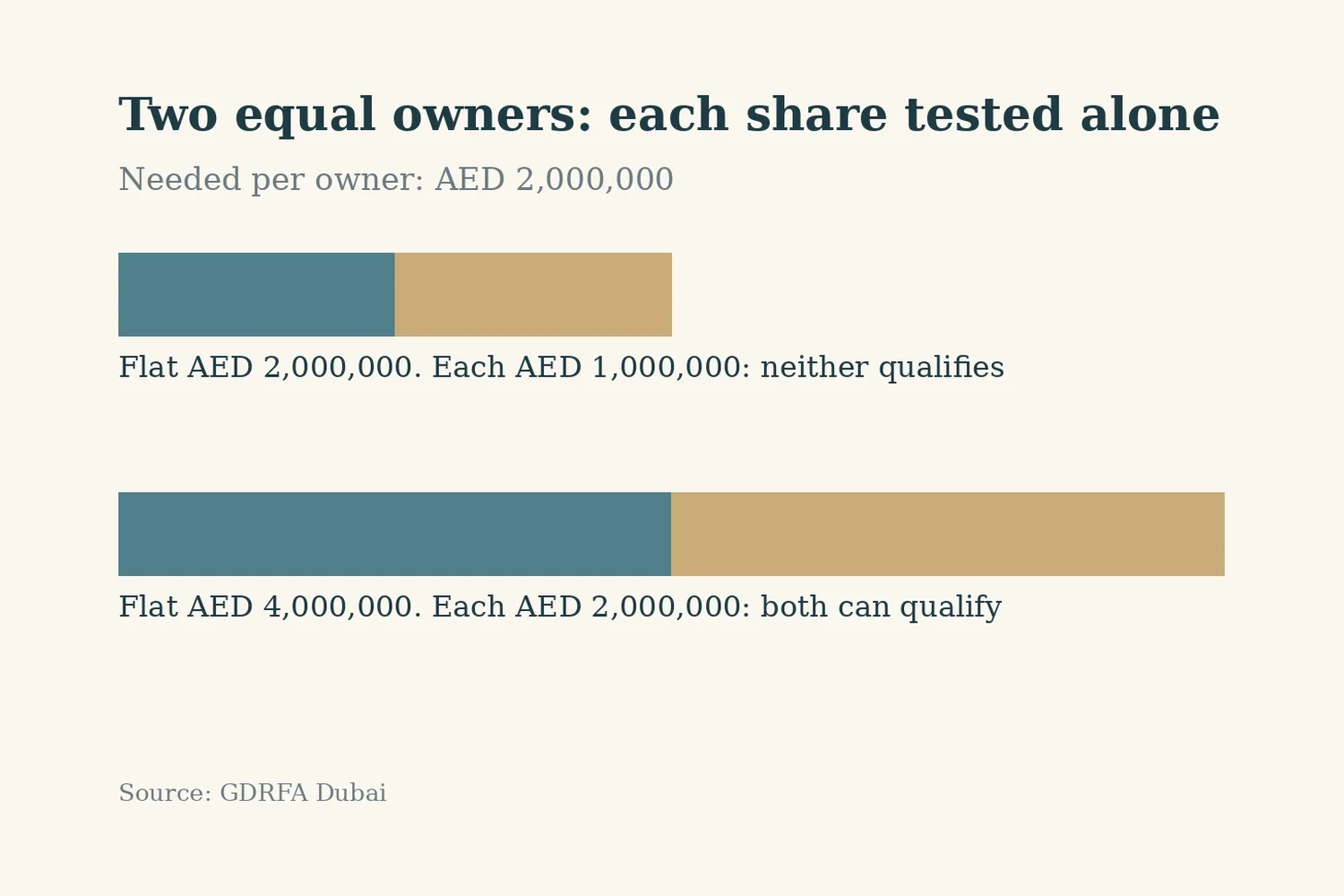
Joint ownership is clearer, and harsher than many couples expect. Because GDRFA tests each share on its own, a couple who split an AED 2,000,000 flat equally each hold AED 1,000,000 (2,000,000 divided by 2), and neither share meets the threshold. For two equal owners each to qualify on one property, its value would need to be at least AED 4,000,000 (2,000,000 multiplied by 2). The DLD, for its part, speaks of property wholly owned in the applicant's name.
Several properties can be added together: ICP, GDRFA and the DLD all refer to one or more properties. Whether land or commercial property counts for the DLD is not stated; only GDRFA says all types count. Our explainer on Dubai freehold and leasehold zones covers where foreign ownership applies.
Off-plan: approved developer, and the title deed gap
ICP accepts off-plan units from an approved developer. The DLD application, however, lists a title deed among its required documents, and an off-plan purchase in Dubai is first registered on the interim Oqood register rather than with a title deed, as our piece on Oqood and off-plan title explains. Whether an Oqood certificate is accepted in place of a title deed is not confirmed by any source we found, and none states a minimum completion or payment percentage. Figures of that kind circulate widely, but we have not seen one on an official page, so we do not quote one. If the visa is part of your reason for buying off-plan, ask the developer and the DLD in writing how your case would be documented.
The lien, validity and time outside the UAE
GDRFA places a lien on the property for as long as the visa runs. In plain terms, the visa ties up the asset: you should not plan to sell or refinance freely while relying on it. What happens to the visa if you do sell, whether cancellation or a grace period, is not confirmed by any page we read.
ICP and the DLD both describe a 10-year residence permit for property investors; ICP says it renews automatically and needs no sponsor. The federal u.ae portal's summary gives a different figure for real estate, but the two bodies that run the service both say 10 years, so that is the figure we use. We found no page setting out a renewal fee or procedure, or confirming that you must still own the property at renewal beyond the lien itself.
Eligible applicants outside the UAE can receive a six-month multiple-entry visa from ICP, renewable once for six months, to complete the process. On time away, u.ae says golden visa holders can stay outside the UAE for longer than the six months that keep an ordinary residence visa valid. No maximum absence was confirmed, so we do not describe it as unlimited.
Family, parents and domestic workers
ICP says a spouse and children can be sponsored regardless of age, and parents as well. The DLD lists a husband or wife, children and parents, and asks the sponsor to sign an undertaking that sons or daughters over 18 are unmarried. A mother sponsoring needs a notarised NOC from the father, and parents need a certified dependency certificate from their consulate. Health insurance is required for family members, though we did not confirm a minimum level of cover. We have not found an official age cut-off that differs between sons and daughters, so we do not state one.
ICP adds that domestic workers can be sponsored under the applicable rules, without giving numbers or conditions, and that sponsored family members may stay until their permits expire if the golden visa holder dies.
What it costs, worked through
The DLD publishes its fees for the 10-year investor permit. For the principal investor they are AED 700 for the medical test, AED 1,153 for the Emirates ID, AED 2,856.75 for residence confirmation, a DLD fee of AED 4,020 and an administrative fee of AED 1,155. That is 700 + 1,153 + 2,856.75 + 4,020 + 1,155 = AED 9,884.75, about USD 2,691.56.
A family residence permit costs AED 5,774.50 per person, there is a one-off family sponsorship file opening fee of AED 318.75, and AED 100 is added for each sponsored person.
For an investor, a spouse and one child:
- Investor: AED 9,884.75.
- File opening fee: AED 318.75.
- Two dependants at (5,774.50 + 100) x 2 = AED 11,749.
- Total: 9,884.75 + 318.75 + 11,749 = AED 21,952.50, about USD 5,977.54.
That assumes the AED 100 applies to each dependant and the file fee is charged once; the DLD page does not spell out either. Service time is 7 to 10 business days, the applicant must attend in person with no representatives, and the channels are the Al Manara Center, known as the Cube, and the Dubai World Trade Centre (DWTC) office. These fees sit on top of the purchase costs set out in our piece on Dubai property transaction costs.
The DLD also lists a separate retiree route: 5 years, property of AED 1,000,000 or more, applicants aged 55 and over, at a total of AED 6,984.75.
Below AED 2m: the 2-year property investor visa
If your property is worth less than AED 2,000,000, the DLD's Taskeen service offers a residency visa linked to owning property in Dubai, with a spouse and children sponsorable according to the type of ownership. Its documents include the title deed and a Dubai good conduct certificate addressed to the DLD, and the DLD's Cube platform handles it alongside the golden visa, family, parents and retiree visas. The Taskeen page we read states no minimum value and we did not capture its fee. Press reports have described changes to the value threshold, but we have not confirmed them on an official page, so check the current rule with the DLD.
Who this is not for
This route does not suit a buyer who needs certainty before signing. Several points, the paid-up question on a mortgage, off-plan documentation, renewal and sale, are not settled by the official pages, and no seller can settle them for you. It also does not suit couples who want two visas from one modest property, or anyone who needs to sell or refinance freely, given the lien. And if residency is the only reason you are buying, read should you buy if you keep returning to Dubai and our honest look at Dubai rental income first; the property still has to make sense as property.
Where that leaves you
The AED 2,000,000 threshold is real, but it is the start of the test, not the end. Before you sign, work out how much of the price is your own money, how the title will be split, whether the unit is ready or off-plan, and which bank is lending. Then put the open questions to the DLD and your bank in writing. Whether you are looking in Downtown Dubai, as described in our Downtown Dubai guide, or in Dubai Marina, the evidence the authorities need is the same. Our Dubai guide, UAE guide, the explainer on foreign property ownership and our piece on community life in Dubai cover the rest of the picture.
Sources
- ICP: UAE golden residency
- ICP: entry permit service (Arabic)
- GDRFA Dubai: golden residence for property investors
- Dubai Land Department: golden visa for investors
- Dubai Land Department: golden visa for retirees
- Dubai Land Department: investor visa (Taskeen)
- Dubai Land Department: Cube centre and the property residence visa system
- u.ae: golden visa
- Central Bank of the UAE: exchange rates
Ready to find your next holiday home?
Browse our curated collection of vacation homes and managed farmland across India and beyond.