Buying in Dubai Step by Step: MOU to Title Deed
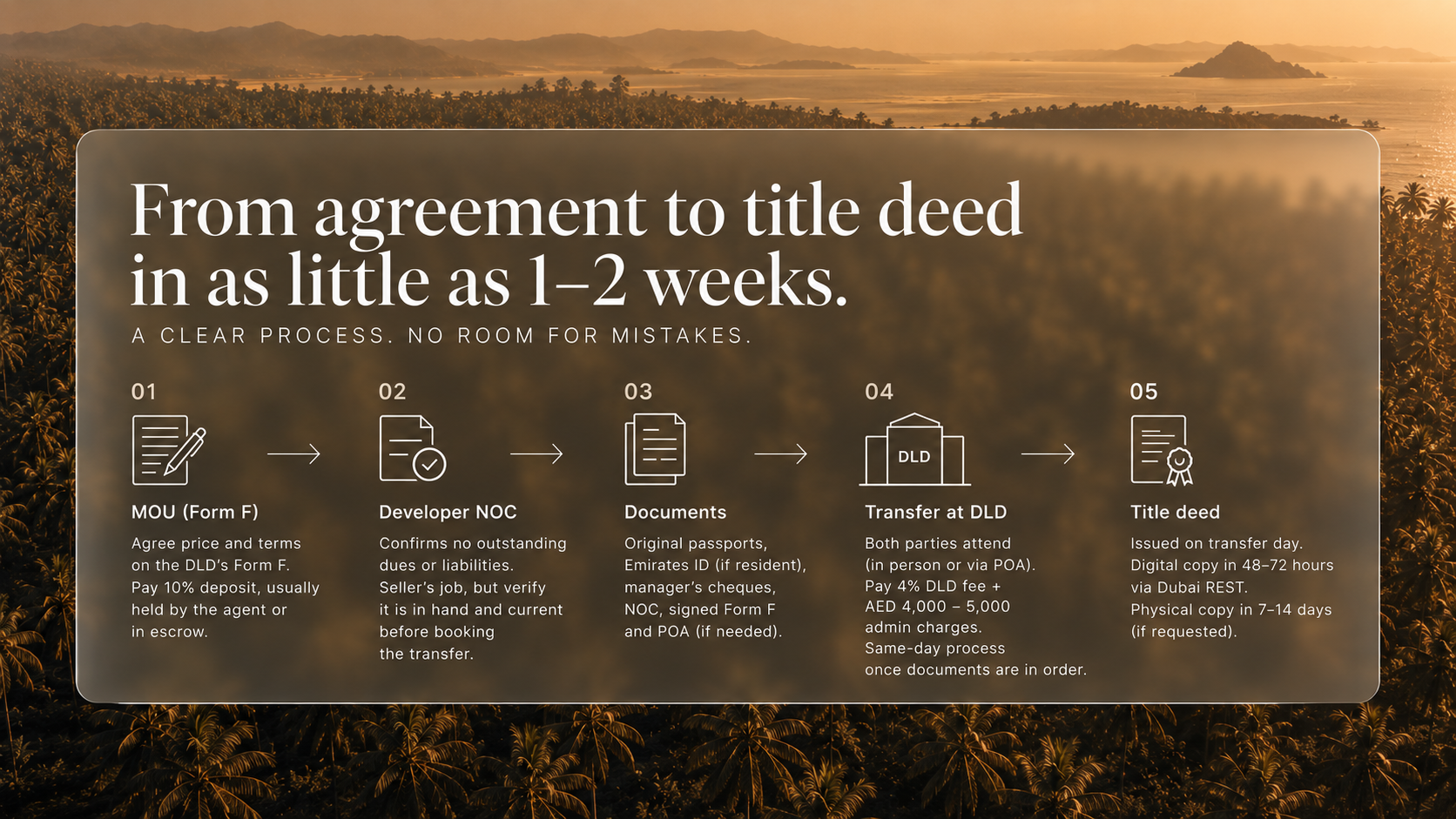
Buying property in Dubai runs faster than most foreign buyers expect, and the compressed timeline is exactly why skipping a step, or doing it out of order, causes more damage here than it would in a market where the same transaction takes months. A straightforward cash purchase can go from signed agreement to title deed in one to two weeks, which leaves very little room to catch a mistake made in week one.
Step one: the MOU, Form F
Once a price is agreed, the agent drafts a Memorandum of Understanding on the Dubai Land Department's own standard template, known as Form F, setting out the agreed price, payment schedule, completion date and each party's obligations. The buyer pays a deposit, typically 10% of the purchase price, at this stage, usually held by the agent or in an escrow arrangement until the transfer itself completes. This document is the DLD's own standard form for a reason: a buyer or agent drafting a custom agreement instead of using Form F is introducing unnecessary risk into a step the authority has already standardised.
Step two: the NOC, and why it is the seller's job but the buyer's problem
The No Objection Certificate, issued by the property's original developer or the managing community, confirms there are no outstanding service charges or other liabilities attached to the unit, and the property cannot be legally transferred without it. Obtaining it is the seller's formal responsibility, but a buyer who simply waits for the seller to produce it, rather than confirming it is actually in hand before the transfer appointment is booked, risks a stalled transfer at the DLD counter itself. Confirming the NOC exists, and that it is current rather than expired, is worth doing directly rather than trusting the seller's assurance that it is being handled.
Step three: the documents that actually get checked at the counter
The transfer appointment requires original passports and Emirates ID for resident parties, manager's cheques covering both the outstanding purchase balance and the DLD's own fees, the original developer NOC, the signed Form F, and a power of attorney document for anyone attending on another party's behalf. DLD fees themselves run to 4% of the purchase price, split between buyer and seller by negotiation or convention depending on the deal, plus additional administrative charges in the range of AED 4,000 to 5,000. A buyer arriving at the appointment with a personal cheque rather than a manager's cheque, or with an expired Emirates ID, is the most common reason a scheduled transfer does not actually happen on the scheduled day.
Step four: the transfer itself, at DLD or an approved Trustee office
The actual transfer happens at a Dubai Land Department office or one of its approved Trustee offices, with both buyer and seller required to attend in person or through a power of attorney representative. This is a same-day administrative process once all the documentation above is in order, which is precisely why the earlier steps, the NOC in particular, need to be resolved well before this appointment rather than treated as something that can be sorted out on the day.
Step five: the title deed, faster than most buyers expect
For a resale property, the title deed is issued on transfer day itself at the DLD Trustee office, with a digital copy available through the Dubai REST platform within roughly 48 to 72 hours. A physical printed copy, if specifically requested, takes a further 7 to 14 days to arrive. A buyer expecting a Dubai transfer to move at the pace of a market with a longer settlement convention should recalibrate: for a straightforward cash deal with no mortgage on either side, the entire sequence from signed MOU to digital title deed commonly completes within one to two weeks.
Off-plan is a genuinely different process, not a variation on the same one
Everything above describes a resale, an already-completed property changing hands. Buying directly from a developer, off-plan, runs on a different registration system entirely. The contract between buyer and developer is a Sale and Purchase Agreement, and rather than a title deed, the transaction is recorded through Oqood, the DLD's interim registration system that serves as proof of ownership until the actual title deed issues at handover. The developer submits the Oqood registration to the DLD, and the SPA itself has to be entered into the provisional register within 90 days of signing. Oqood registration carries its own fee structure, typically the same 4% of the purchase price plus an administrative charge, paid to the DLD through the developer rather than directly. A buyer treating an off-plan purchase as simply a resale with a longer wait for the building to finish is missing that the underlying registration mechanism, Oqood versus a title deed, is a different system with its own separate process.
Reselling before completion has its own threshold
An off-plan unit can be resold before the building is finished, but developers commonly require the original buyer to have paid a minimum share of the total price, typically somewhere between 30% and 40%, before approving the resale. The transaction itself is an assignment: the DLD de-registers the original buyer from the interim Oqood register and re-registers the new buyer in their place, executed at a DLD-approved Trustee office in the same way a completed-property transfer is. A buyer purchasing an off-plan unit specifically to resell before completion needs to confirm the developer's own minimum-payment threshold at the outset, since falling short of it can mean the exit is not available on the timeline originally planned.
Where financing changes the timeline
Everything above assumes a cash transaction. A mortgaged purchase, on either the buyer's or seller's side, adds the lender's own approval and disbursement timeline into the sequence, and the one-to-two-week window described above does not apply once a bank's own process is layered in. Mortgages for Non-Resident Buyers in Dubai covers what that additional timeline actually looks like and what it requires from a non-resident buyer specifically.
What Avacasa recommends
Use the DLD's own Form F rather than a custom-drafted agreement, and confirm the developer NOC is actually in hand, not merely requested, before booking the transfer appointment. Bring manager's cheques rather than personal cheques to the transfer itself, and budget the full 4% DLD fee plus admin charges into the purchase cost from the outset rather than treating it as a closing surprise. Buying Property in Dubai as a Foreign Buyer: The Complete Guide and Freehold and Leasehold Zones in Dubai: Where Foreigners Can Buy cover the ownership and zone questions that need answering before this process even begins.
Before you commit
Financing a Property Purchase Abroad and Currency Risk When Buying and Holding Property Abroad are relevant for a buyer transferring funds into the UAE specifically to cover this transaction, and Residency and Visa Routes Tied to Property Ownership covers what a qualifying purchase can secure beyond the property itself. Due Diligence When Buying Property in Another Country covers the verification habits worth applying before the MOU is even signed, and Realistic Rental Income From a Dubai Property is worth reading for a buyer planning to let the property out once the transfer above is complete.
Whatever the building, Dubai, Dubai Marina and Downtown Dubai all run through the identical DLD process described here, regardless of price point or neighbourhood.
Sources
- The MOU, Form F, deposit and NOC steps in a standard Dubai resale transaction
- DLD fees of 4% plus admin charges, and title deed issuance timeline via Dubai REST
- Oqood registration for off-plan purchases, the 90-day provisional registration window, and minimum payment thresholds for pre-completion resale
Ready to find your next holiday home?
Browse our curated collection of vacation homes and managed farmland across India and beyond.