Currency Risk When Buying and Holding Property Abroad
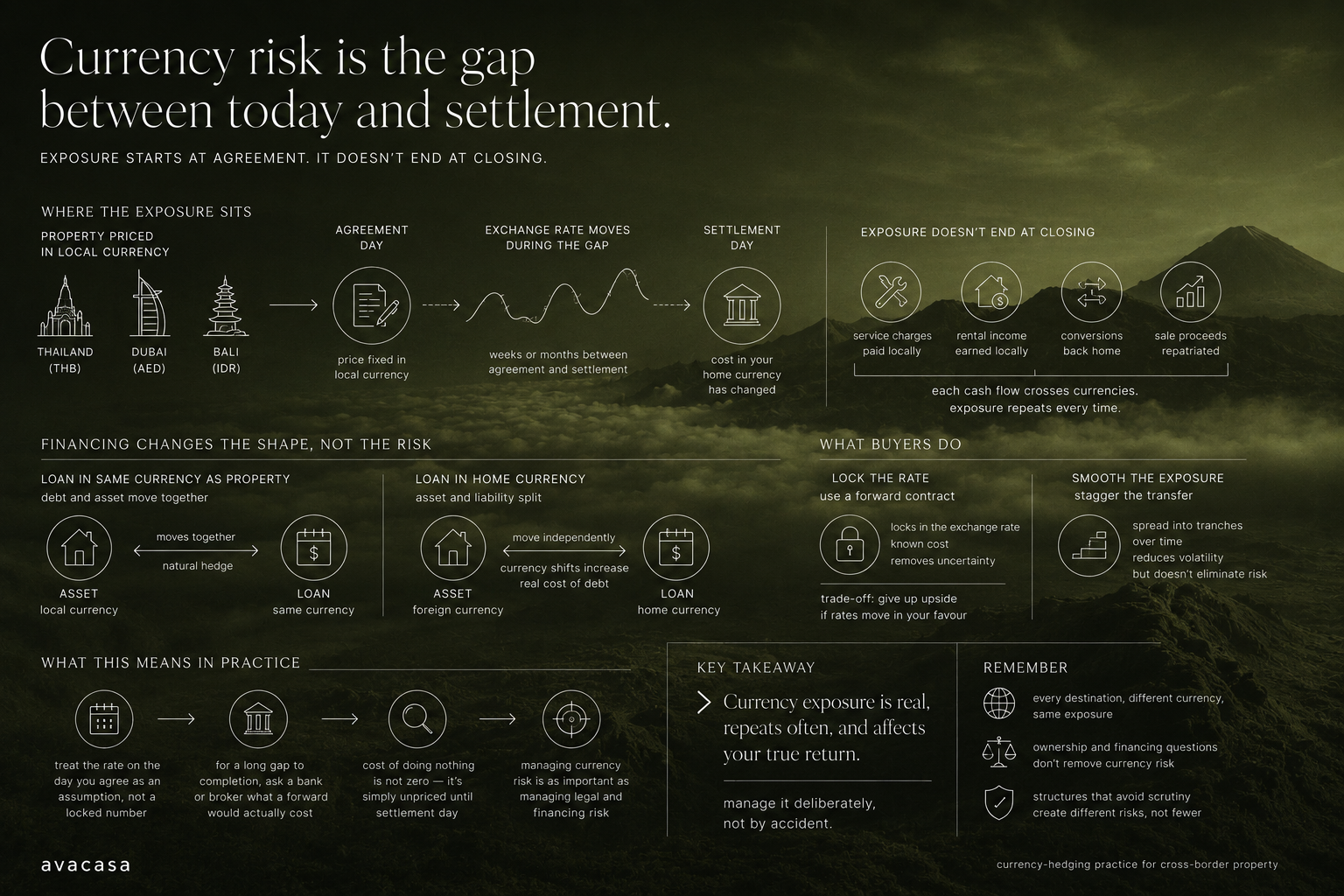
Currency risk on an overseas property purchase is easy to underestimate because it does not show up as a single number the way a purchase price or a tax rate does. It shows up as a gap, sometimes in the buyer's favour and sometimes against it, between what a property was worth in the buyer's home currency on the day it was priced and what it is worth on the day money actually changes hands, and again every time money moves between the two currencies afterward.
Where the exposure actually sits
A property priced in Thai baht in Thailand, UAE dirhams in Dubai, or Indonesian rupiah in Bali, is a fixed number in that currency regardless of what happens to exchange rates. What moves is the cost of that fixed number expressed in the buyer's own currency. A buyer who agrees a price, then waits weeks or months to complete the transfer, is exposed to that movement for the full gap between agreement and settlement, and a currency move of a few percent over that window changes the effective purchase price by a real amount, entirely independent of anything happening to the property itself.
This exposure does not end at closing. Every subsequent cash flow, a service charge paid in the local currency from a home-currency account, rental income earned locally and eventually converted, or the proceeds of an eventual sale, carries the same conversion risk each time it crosses currencies. A property bought as a straightforward cash purchase in year one can still generate currency-driven surprises in year five, on income the buyer assumed was simply the rental yield. Selling the property later and repatriating the proceeds is its own separate currency event, entirely apart from what the sale price itself does in local terms; Selling Indian Property as an NRI: The End-to-End Process covers the mechanics of one such repatriation in detail, and the same currency-conversion step recurs in some form wherever the eventual sale proceeds need to leave the country they were earned in.
Financing changes the shape of the exposure, not whether it exists
A loan taken in the same currency as the property keeps the debt and the asset moving together: if the local currency weakens against the buyer's home currency, both the property's home-currency value and the home-currency cost of servicing the loan fall in step, which is a form of natural hedging even though nobody set it up deliberately. A loan taken in the buyer's home currency against a property valued abroad does the opposite, splitting the asset and the liability across two currencies that do not move together, so a currency shift can make the loan more expensive in real terms even while the property's value in its own currency has not changed at all. Financing a Property Purchase Abroad covers the financing tracks this interacts with in more detail than a currency-focused piece can.
What buyers actually do about it, and what most do not
Locking a rate ahead of a known settlement date, through a forward contract with a bank or currency broker, is the most direct tool available, and it converts an open-ended exposure into a fixed, known cost, at the price of giving up any upside if the rate moves favourably instead. Most individual buyers do not use this tool at all, either because nobody mentioned it was available or because the property purchase itself absorbed all the attention that currency management would have needed. Staggering a large transfer into smaller tranches over time is a rougher, lower-effort alternative that smooths out the exposure without eliminating it, useful mainly when a hard settlement date is not fixed and a forward contract is not practical.
What this means in practice
Treat the exchange rate on the day a price is agreed as a starting assumption, not a locked number, until money has actually moved. For a purchase with a long gap between agreement and completion, ask a bank or currency broker what a forward contract would actually cost before deciding the exposure is not worth managing, since the cost of doing nothing is not zero, it is simply unpriced until the day of settlement. Due Diligence When Buying Property in Another Country covers the verification steps that sit alongside this decision, and Rental Management and Yields in Foreign Holiday Markets is worth reading before assuming a headline rental yield survives currency conversion intact, since the yield calculated in the property's own currency and the return actually realised at home are not always the same number. You Keep Going Back to Dubai. Should You Own There? works through a full rent-versus-buy comparison in one specific currency pair, which is a useful worked example of the exposure described above rather than the abstract version of it.
Every destination this site covers carries this same exposure in a different currency: Can Foreigners Own Property Abroad? Freehold, Leasehold and Use Rights and Buying Property in Dubai as a Foreign Buyer: The Complete Guide cover two markets where the ownership question is settled, but the currency question underneath it still needs its own answer regardless of which market it is. A structure that tries to sidestep this scrutiny entirely does not make the currency exposure disappear either; Nominee Ownership Structures and Why They Fail covers a different risk entirely, but one that often gets raised in the same conversation as currency and financing questions.
Sources
- Forward contracts and international property purchases: locking a rate ahead of settlement
- Currency hedging strategies for buying international property, including staged transfers
Ready to find your next holiday home?
Browse our curated collection of vacation homes and managed farmland across India and beyond.