Manohar International Airport at Mopa: What It Has Done to North Goa Pricing
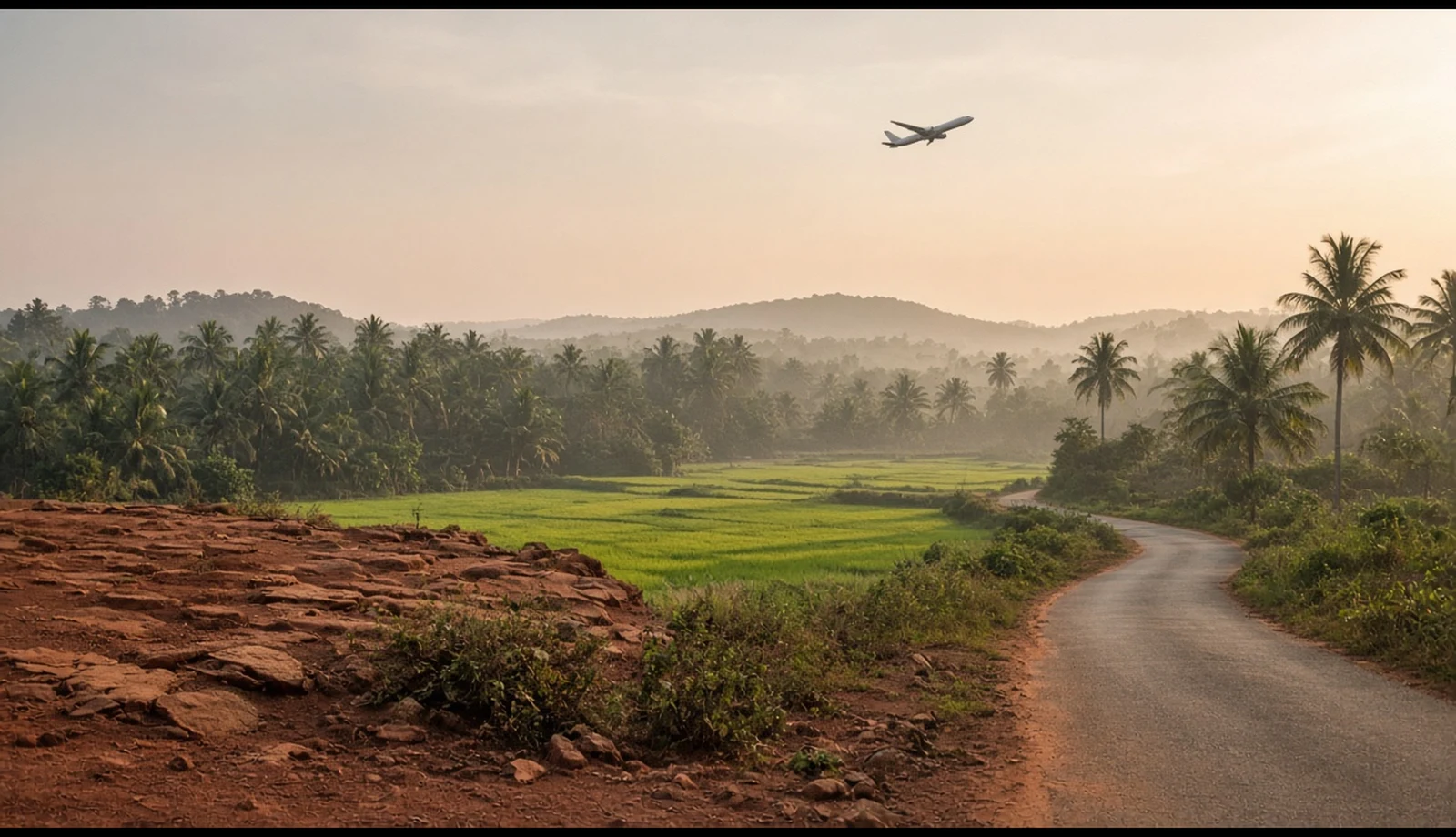
Ask anyone selling land in Pernem what the Mopa airport has done to prices and you will hear a confident number. Ask for the evidence behind it and the conversation usually gets shorter. Since the airport opened, only one price movement in North Goa has a public, checkable basis: the state government's own decision to raise the minimum land rate in Pernem and Bardez talukas, approved by the cabinet on 5 September 2024. That is not a record of what buyers have paid. It is a government benchmark, and the clearest thing it tells a buyer is that the cost of transacting has gone up, not that a market premium has been proven. This piece separates what is measured from what is claimed, and shows the arithmetic, so that a domestic high net worth individual (HNI) or a non-resident Indian (NRI) buyer can judge a deal on solid ground.
What actually opened at Mopa, and when
The Prime Minister inaugurated Manohar International Airport at Mopa on 11 December 2022, six years after the foundation stone was laid in November 2016. According to the government's PPP in India portal, domestic flights began on 5 January 2023 and international operations on 21 July 2023. The airport was built under a Design, Build, Finance, Operate, Transfer (DBFOT) model, a form of Public Private Partnership (PPP), on a site of 2,132 acres.
The cost depends on which official source you read. The Press Information Bureau (PIB) put it at around Rs 2,870 crore at inauguration. The PPP in India portal states an initial investment of Rs 3,400 crore. Both are government sources, neither explains the gap of Rs 530 crore (3,400 less 2,870), and we have not tried to reconcile them, so each number belongs to its source.
On capacity, the PIB release described Phase 1 as handling around 4.4 million passengers per annum (MPPA), expandable to 33 MPPA at full build-out. If you want the wider picture of how airports, highways and heliports shift second-home demand, our piece on connectivity and vacation homes sets out the general pattern, and the Goa guide covers the state as a whole.
Traffic three years in: already at its Phase 1 design
This is the part of the story that rests on the strongest evidence, because it comes from the operator's own stock exchange filing. GMR Airports reported to the Bombay Stock Exchange (BSE) that Mopa handled 4,659,452 passengers in the financial year (FY) 2024-25. For the first ten months of FY2025-26, April 2025 to January 2026, it reported 4,424,390 passengers, up 15.2 percent on the same period a year earlier. January 2026 alone carried 600,651 passengers, up 32.1 percent, and the airport had served 14.2 million passengers in total since domestic operations began.
The arithmetic that matters: 4,424,390 passengers in ten months, against a Phase 1 design of 4.4 million a year, is already about 101 percent of the annual design figure (4.42 divided by 4.4), with two months of the year still to count. The FY2024-25 figure of 4.66 million was itself about 106 percent of that design (4.66 divided by 4.4). The same filing describes the airport as projected to handle 4.5 million passengers annually, which is close to the PIB figure. Whichever you use, the airport is running at or above what its first phase was designed for. That is a real demand signal, and it is the one most worth watching.
The one hard price number: the September 2024 minimum rate decision
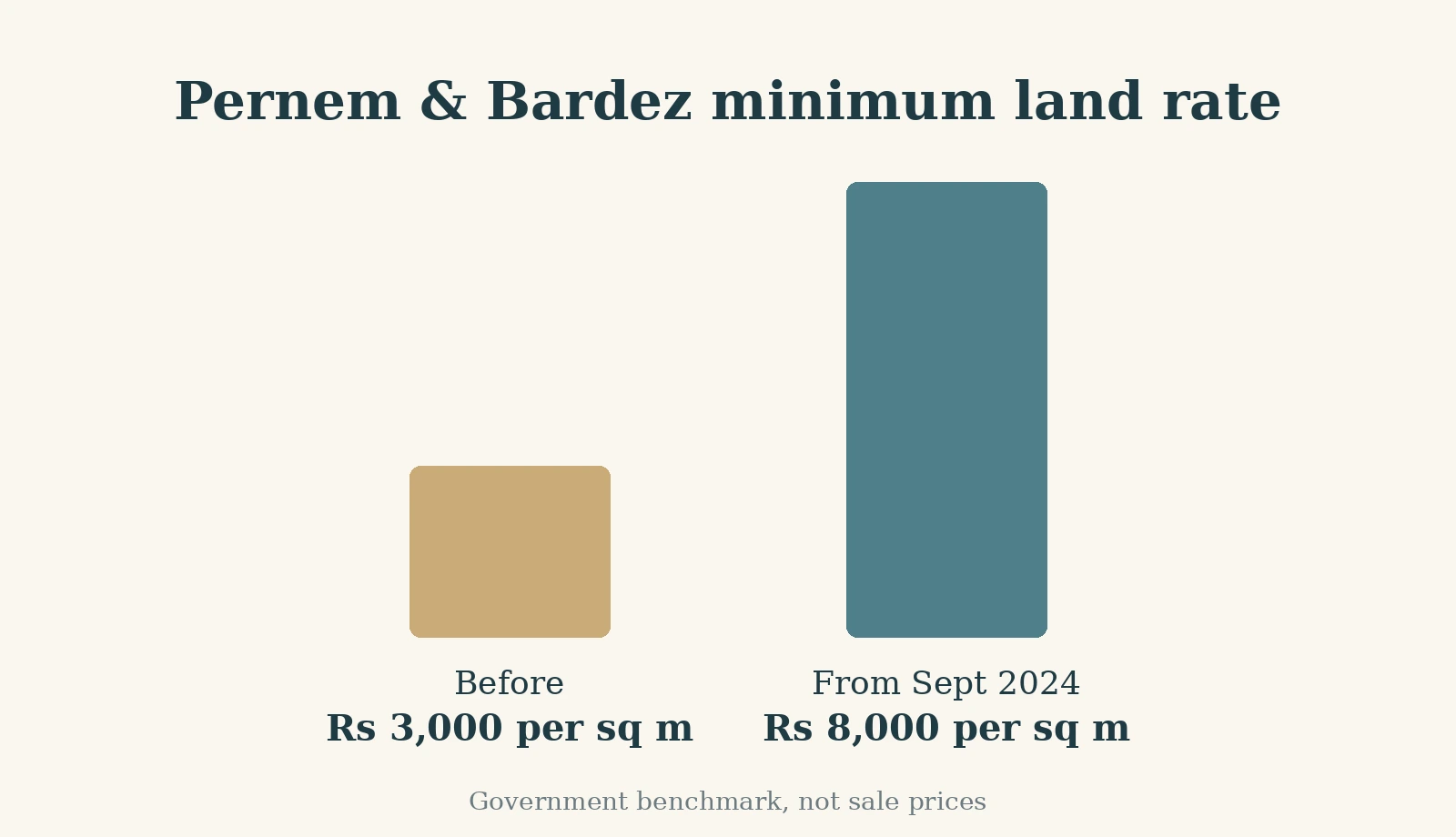
On 5 September 2024 the state cabinet approved an increase in the minimum land rate in Bardez and Pernem, the two talukas closest to the airport and to the busiest stretch of the coast. Announcing it, the Chief Minister said the minimum rate in the two talukas had been Rs 3,000 per square metre (sq m) and would rise to Rs 8,000, as reported by the Times of India and The Goan. He gave revenue and the pace of development in Bardez and Pernem as reasons, and The Goan's report linked Pernem's demand to the commissioning of the airport.
The headline percentage depends on who you read, and neither matches the arithmetic. The Times of India described the rise as almost 130 percent; The Goan called it over 100 percent. Going from Rs 3,000 to Rs 8,000 is an increase of Rs 5,000, which is about 167 percent of the old rate (5,000 divided by 3,000), or 2.7 times. The Goan's "over 100 percent" is true but understated; the Times of India's 130 percent does not follow from the two figures given. Use the rupee figures, not the percentages.
Be precise about what this is. It is a government valuation benchmark, set by decision. It is not a record of transactions. We found no registered-transaction price index for North Goa, no taluka-level average registered values and no transaction volumes, so nobody can say from public data how far actual sale prices have moved since 2022. Village-by-village rates under the revision exist, but we could not verify them against a source that loads, so they are not reproduced here. Our Goa Land Revenue Code guide explains how land classification sits alongside these benchmarks, and our explainer on Goa Form I and XIV covers the title records you will be asked about.
What the higher floor means for a buyer
The Times of India put the consequence plainly: buyers in the two talukas will now pay more. The mechanism is that the government's minimum rate acts as the benchmark for valuing land at registration, so a higher benchmark raises the minimum value on which charges are worked out, whatever price you negotiate. We are not quoting current stamp duty or registration fee rates here, because we could not confirm them against an official source that loads; ask your lawyer for the schedule in force on the day you register. Our list of questions to ask before signing a land deal is a sensible companion to that conversation.
What the market claimed, and why it is weak evidence
Several price claims have circulated since 2022. Each should be read as a claim by its source, not as data.
The consultancy 360 Realtors, as reported by Goemkarponn in 2022, put property near the airport at Rs 6,700 per square foot and forecast a 27.8 percent rise in the following 12 months, set against a compound annual growth rate (CAGR) of 3.9 percent over the previous four years. It made a similar forecast of 29.2 percent for neighbouring Sindhudurg, from Rs 4,921 per square foot. The same report mentioned 232 acres earmarked near the airport for commercial, logistics and residential development. These are forecasts from a firm in the business of selling property, and we have no follow-up showing whether they came true.
Dainik Gomantak reported on 30 December 2022 that land rates in Pernem rose by 50 to 75 percent within days of the inauguration; the body of the same article gives 50 to 70 percent. Its basis was a panel discussion, which is thin sourcing for any number, and the article does not agree with itself on the upper figure.
Set side by side, a forecast of 27.8 percent over a year and a claimed jump of up to 75 percent in days describe very different markets. Neither is a measurement. Our guide on how to negotiate land price is the practical response: anchor on the government benchmark and on comparable deals you can actually see documented, not on a headline percentage.
Pernem, Bardez and the border
The two talukas share the new minimum figure but not the same story. Pernem, around the airport and along the Morjim coast, was historically the quieter, cheaper end of North Goa, and it is where the airport is the obvious new factor. Bardez, with villages such as Assagao and Siolim, was priced on tourism, lifestyle and proximity to the coast well before Mopa, and the airport is one influence among several. Our North Goa guide and Pernem guide go into each area's character, and the North Goa long weekend itinerary gives a feel for the ground before a visit.
Mopa also sits close to the Maharashtra border, and some buyers look across it to Sindhudurg and Dodamarg. Beyond the 360 Realtors forecast already mentioned, we have no price data for that side. What is certain is that the rules change: land there is governed by Maharashtra law, with its own land records and conversion procedures. Our Maharashtra Land Revenue Code guide is the starting point, and the same discipline about evidence applies.
What has not changed, and the risks
The airport's success in passenger terms is not the same as certainty about its future, and nothing here should be read as a promise of expansion on any schedule. The move from Phase 1 towards the 33 MPPA figure is a design ceiling, not a timetable.
The small-plot position needs care. The Chief Minister said, as reported by both the Times of India and The Goan, that people building homes on residential plots of up to 500 sq m would continue on the old rates, and that the increase was aimed mainly at commercial development. That is a statement at a press briefing. We have not been able to check the wording of the notified order against a source that loads, so confirm how your specific plot is treated with the Sub-Registrar before relying on it.
The Goan has also reported developers' view that higher benchmarks may attract high-end buyers while limiting affordable housing near Mopa, and that the state later raised base rates in Salcete, Mormugao and Tiswadi, with some locations in Taleigao seeing increases of over 450 percent. Benchmark revisions, in other words, are a statewide policy tool, not something peculiar to the airport.
Who this is not for
If your case for buying in Pernem rests on a forecast percentage, the evidence does not support you. If you need to sell within a few years, a market with no public transaction data is hard to exit at a price you can defend, and the higher benchmark raises costs for your buyer too. And if you want certainty that the airport will keep expanding on a known timetable, nothing in the public record gives you that.
Where that leaves you
The airport is real and busy, already at or past its Phase 1 design on the operator's own figures. The state has reflected growth in Bardez and Pernem in a higher minimum land rate, and every buyer there now transacts against a higher benchmark. Beyond that, the price story is told largely by people with something to sell. Judge a deal from the benchmark, documented comparables and a proper site visit, and treat the rest as narrative. If you are weighing Goa against other markets shaped by new infrastructure, our pieces on Mulshi and the Bengaluru Satellite Town Ring Road make useful comparisons, the guide to owning property in Goa covers the basics, our Goa second-home research adds context, and capital gains tax on land sale explains what an eventual exit costs.
Sources
- PIB: inauguration of Mopa airport
- PPP in India: Manohar International Airport, Mopa
- GMR Airports traffic filing on BSE
- Times of India: land price hike in Bardez and Pernem
- The Goan: hike in land rates in Pernem and Bardez
- The Goan: developers on revenue and transparency
- Goemkarponn: 360 Realtors forecast
- Dainik Gomantak: Pernem rates after inauguration
Ready to find your next holiday home?
Browse our curated collection of vacation homes and managed farmland across India and beyond.