Thai Property Transfer Fees and Annual Land Tax

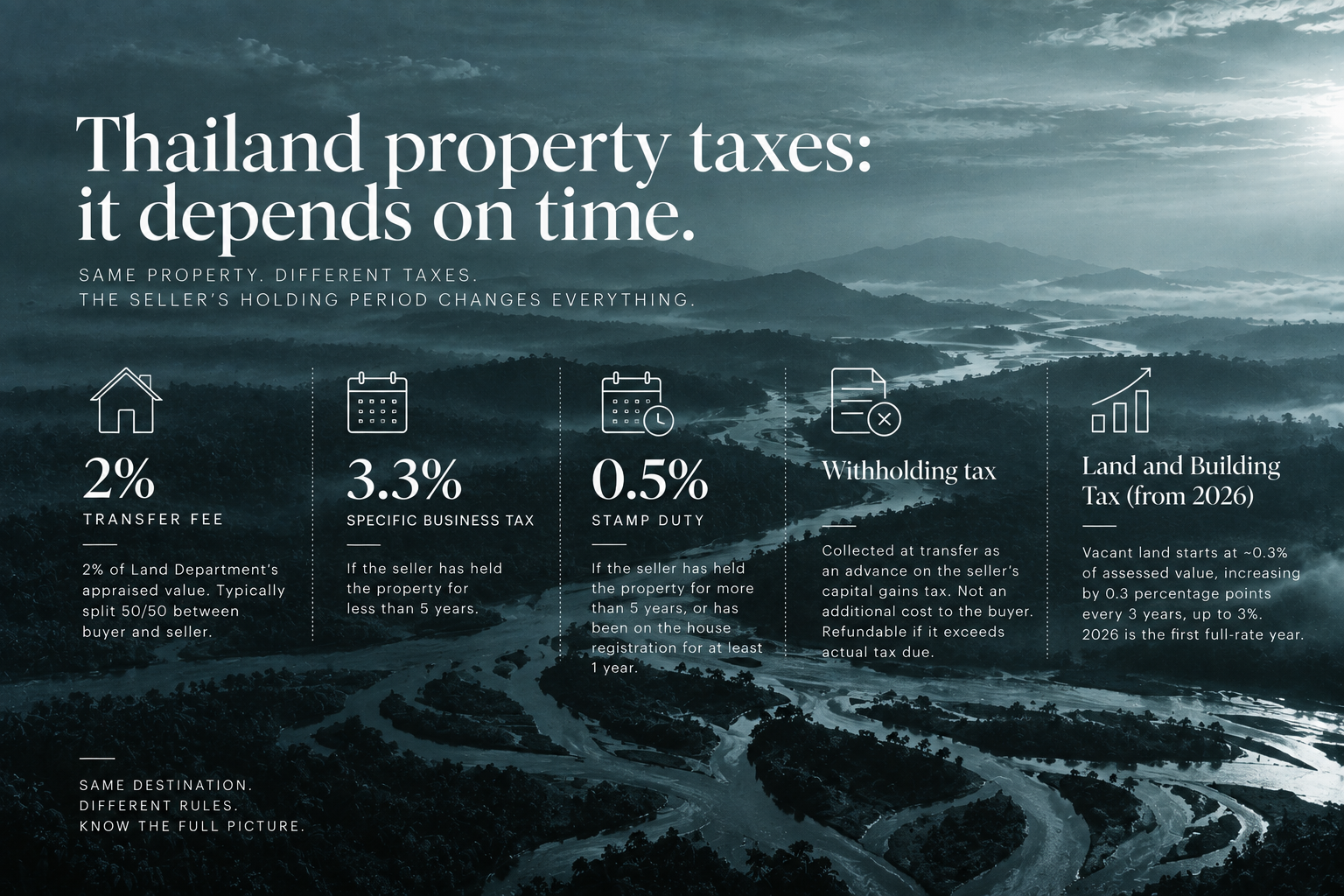
A buyer who prices a Thai property purchase around the 2 percent transfer fee alone is missing a second tax that can run considerably higher depending entirely on one specific factor: how long the seller has actually held the property. Understanding that factor changes not just what a seller pays, but what a buyer should reasonably expect to negotiate on a property that has been held only briefly.
The transfer fee, and how it typically gets split
The standard property transfer fee in Thailand is 2 percent of the official appraised value, assessed by the Land Department rather than the negotiated sale price, and this applies uniformly to foreign buyers regardless of the property's value or location. This fee is customarily split 50/50 between buyer and seller, though the split itself is negotiable and worth confirming explicitly in the sale agreement rather than assumed by default.
Specific Business Tax versus stamp duty: the distinction that actually matters
Where the seller has held the property for less than five years, the transaction is subject to Specific Business Tax at 3.3 percent, calculated on whichever is higher, the sale price or the Land Department's own appraised value. Where the seller has held the property for more than five years, or has had their name on the house registration document for at least one year, the considerably lighter stamp duty of 0.5 percent applies instead. This distinction is worth checking directly for any specific property under consideration, since a five-year-old listing described casually as "long-held" needs its actual holding period confirmed against Land Department records rather than taken on the seller's word.
Withholding tax is an advance, not a separate cost
Withholding tax collected at the point of transfer functions as an advance payment against the seller's own personal income tax liability on the capital gain from the sale, collected by the Land Department on the Revenue Department's behalf rather than an additional charge layered on top of the other transfer costs. The seller can subsequently claim this withheld amount as a credit against their actual tax liability when filing their annual return, and receive a refund where the amount withheld exceeds what is actually owed. A buyer should understand this mechanism clearly, since it affects the seller's own net proceeds and therefore the negotiating dynamic around who absorbs which cost, even though the withholding tax itself is not something the buyer directly pays.
Why 2026 specifically matters for the annual Land and Building Tax
Vacant or unused land carries a Land and Building Tax starting at roughly 0.3 percent of assessed value, and this rate increases by 0.3 percentage points for every subsequent three-year period the land remains unused, up to a cap of 3 percent. 2026 is the first full-rate year for this tax since its introduction, meaning temporary pandemic-era discounts have fully expired and the step-up penalty for genuinely long-vacant land is now applying at its intended severity. A buyer holding land purely as a speculative asset, without any development or active use, should factor this escalating annual cost into the holding-period arithmetic specifically for 2026 onward, since the discounted rates that made extended vacancy more affordable in prior years no longer apply.
What this means for negotiating a purchase
A seller offloading a property held for under five years is facing the considerably heavier 3.3 percent Specific Business Tax rather than the 0.5 percent stamp duty, a real cost difference that a buyer can reasonably factor into price negotiation, particularly where the seller's own holding period suggests they are motivated to sell before crossing that threshold rather than after. Chanote and Lesser Title Deeds in Thailand covers a separate but related verification question, the underlying title tier, worth checking alongside these tax considerations rather than in isolation.
Why the appraised value, not the sale price, is the real number to check
Nearly every tax and fee covered here, the transfer fee, Specific Business Tax, and the Land and Building Tax, is calculated against the Land Department's own appraised value rather than the actual negotiated sale price, and this appraised figure can differ meaningfully from market price in either direction depending on how recently the area's official valuations were updated. A buyer estimating total transaction cost purely from the agreed sale price, without separately checking the current appraised value at the Land Department, may be working from the wrong base figure entirely, and the gap between appraised and market value is worth confirming directly rather than assumed to track closely together.
How these costs interact with financing
A buyer financing part of a Thai purchase should confirm with their lender how the transfer fee, tax and any other closing costs are treated, since some are paid at the point of transfer regardless of financing arrangement while others may be rolled into the overall transaction cost the lender is underwriting. This is a detail worth clarifying early in the financing conversation rather than assumed to work the same way a domestic mortgage closing would in the buyer's home country, since Thai practice around what a lender covers versus what falls to the buyer directly can differ from more familiar frameworks elsewhere.
What Avacasa recommends
Confirm the seller's actual holding period against Land Department records before assuming which of the two tax regimes, Specific Business Tax or stamp duty, applies to a specific transaction, since this materially affects the seller's net position and the room for negotiation. For any land purchase intended to sit vacant rather than developed promptly, model the escalating 2026 Land and Building Tax rate honestly rather than assuming the discounted rates of prior years still apply.
Before you commit
Due Diligence When Buying Property in Another Country covers the wider verification discipline this tax question sits inside, and How to Verify a Developer's Track Record is relevant where a developer, rather than an individual seller, is involved. 10 Questions to Ask Before Signing Anything and How to Negotiate Land Price Like a Pro round out the practical checklist, and Sri Lankan Property Taxes and Transfer Costs for Foreigners, Checking a Certificate at BPN Before You Sign and Oqood and Off-Plan Title in Dubai: What You Actually Hold cover structurally similar tax and verification questions in other markets, worth reading for the parallels each draws.
Whatever the destination inside the country, Thailand, Indonesia and Sri Lanka each carry their own distinct transfer tax framework, and Thailand's specific five-year holding-period threshold described above does not carry over to either of the other two markets.
Sources
- The 2 percent transfer fee, 3.3 percent Specific Business Tax under five years of holding, and 0.5 percent stamp duty over five years
- The 2026 Land and Building Tax on vacant land, its step-up structure, and the expiry of prior discounted rates
Ready to find your next holiday home?
Browse our curated collection of vacation homes and managed farmland across India and beyond.