Before You Pay Anything in Maharashtra: The Order of Checks

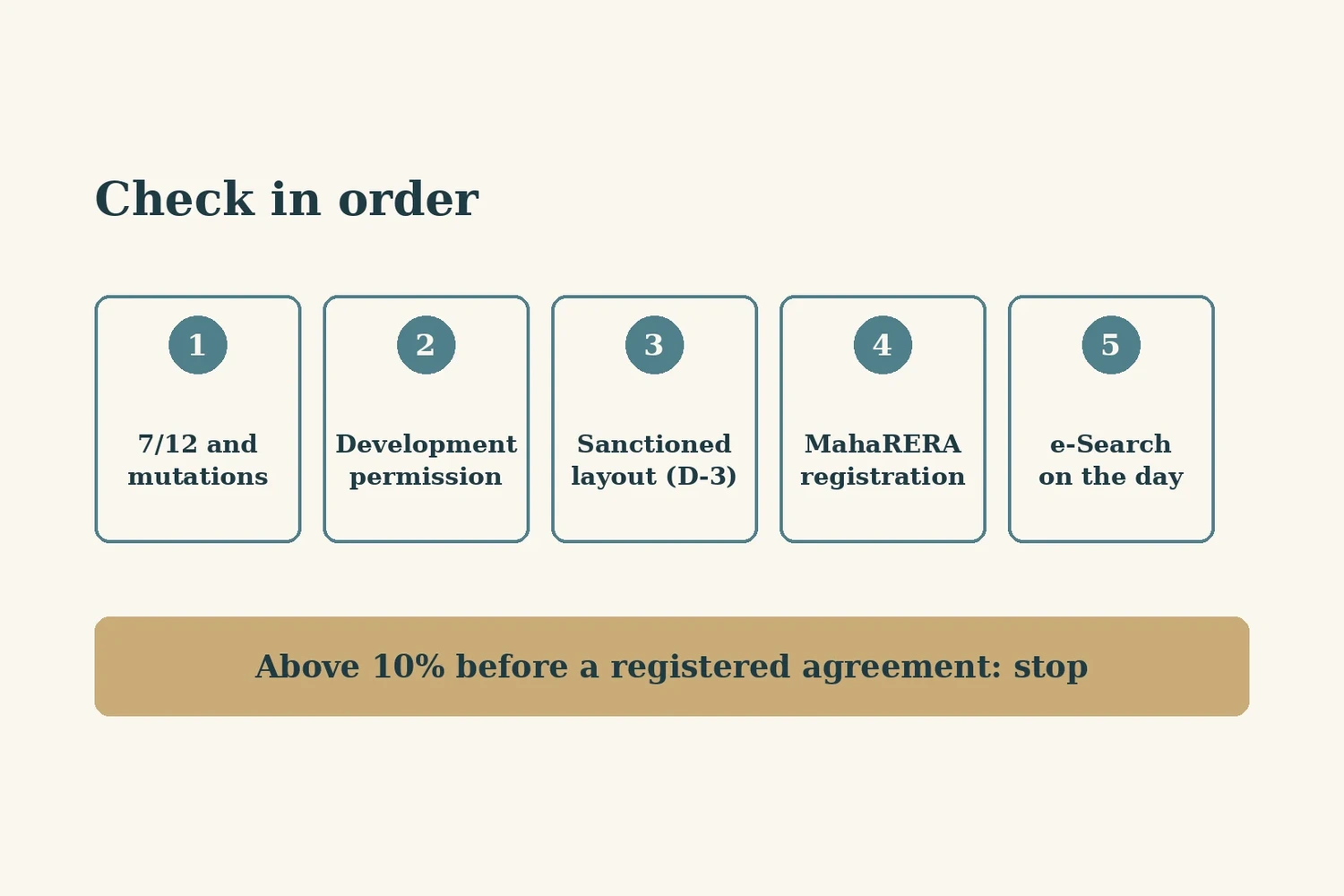
Most expensive land mistakes in Maharashtra happen at the token, the first payment that turns interest into commitment. If you are working out which checks to run before paying a token on Maharashtra land, the usual advice is a pile of documents: the 7/12 extract, the non-agricultural (NA) status, the layout and the registration under the Real Estate (Regulation and Development) Act, 2016 (RERA). The pile hides the important part. These checks have an order, and each one only means something if the one before it passed. A RERA number looked up first tells you nothing if the land underneath is in someone else's name. This piece sets out that order, the point at which each check should stop you, and the rule that limits how much a registered promoter may take before an agreement exists.
Why the order matters more than the list
Think of the checks as a chain. The 7/12 tells you who owns the land and what sits on it. Only once that is clean does the NA question make sense, because a development permission granted on land with a disputed owner or a restricted occupancy class does not cure either. Only once the land may be used for building does a layout mean anything, because a layout is a plan for using land in a way the land must already allow. And registration with the Maharashtra Real Estate Regulatory Authority (MahaRERA) comes last because MahaRERA itself asks the promoter to upload the layout approval, a title report and the encumbrance details (see check 4). The registration is a wrapper around the earlier checks, not a substitute for them.
Brokers often present the same documents in reverse, with the RERA number first because it is the easiest to show. That order misses the cases that matter: a project registered by a promoter whose name differs from the owner on the 7/12, a plot number shown at a site visit that does not appear on the sanctioned layout, or land whose occupancy class means the permission does not change what you can do with it. Checked in the right order, each of those surfaces before you have paid anything.
At every stop point below, the safe answer is either not to pay or to pay only into a refundable arrangement drafted by your own lawyer. A token is not made safe by being small.
Check 1: the 7/12 and its mutation trail
The 7/12 extract is the record of rights for agricultural land: owner, area, occupancy class and the rights of others. Our guide on how to read a 7/12 extract explains each column, so here we use only the stop conditions. You can view the 7/12 and the 8A extract on Mahabhulekh, the state land record portal, and the Inspector General of Registration (IGR) lists a link for a digitally signed 7/12 and property card on its ease of doing business page (both read 24 October 2026). The Mahabhumi portal lets you check the status of a mutation application by district, taluka, year and mutation number.
Stop at this check if any of these is true. The seller's name does not match the owner on the 7/12. The other rights column carries a loan, a tenancy, a court case or a government entry. The occupancy is shown as Class II, which matters at check 2. Or a recent mutation, the entry that records a change of ownership, is still pending and not certified. For buyers abroad, our NRI land documentation checklist covers the papers a Non-Resident Indian (NRI) needs, and our power of attorney guide covers acting through someone else.
Check 2: NA status after the 2025 rewrite
This is the check most guides now describe wrongly. Under the Maharashtra Land Revenue Code (MLRC), the old route was a Collector's NA permission, with deemed NA provisions in sections 42A to 42D and related rules in section 44. Those are now the previous rules. The Maharashtra Land Revenue Code (Second Amendment) Act, 2025 (Maharashtra Act No. LVII of 2025, published in the Maharashtra Government Gazette on 31 December 2025) replaced section 42 and deleted sections 42A to 42D and 44, 44A, 45 and 46, according to the Act's text reproduced in the Revenue and Forest Department's Government Resolution of 10 February 2026.
Under the new section 42, no Collector permission is needed to change land from agricultural to non-agricultural use where that use is allowed by a draft or final Development Plan or Regional Plan under the Maharashtra Regional and Town Planning Act, 1966 (MRTP Act), or by the development control rules made under it. The planning authority grants development permission or approves the building plan, collects a one-time premium first, and the revenue records are then updated. So the question at check 2 is no longer "is there an NA order?" but "has the planning authority given development permission, and does the plan's zoning allow the use you are buying for?" Our explainers on agricultural to NA conversion and the land revenue code cover the change in depth, and NA plot versus agricultural land sets out the choice.
One trap survives the rewrite. The new section 42(2) says that development permission or a building plan approval does not by itself change an occupancy status other than Class I. A Class II entry you found at check 1 therefore still stops you here, whatever permission has been granted. If a seller offers an older Collector NA order, sometimes called a sanad, ask a lawyer how it is treated under the 2025 transition. We found no official guidance on that point and make no claim.
Check 3: the sanctioned layout
For a plotted scheme, the layout is the approved plan that divides the land into plots, roads and open spaces. MahaRERA's Order No. 62/2024 of 22 October 2024 treats the final layout approval in Form D-3 under the Unified Development Control and Promotion Regulations (UDCPR), or an approval of a similar kind, as the commencement certificate for a plotted project, according to a summary of the order by the law firm S&R Associates. We have not read the UDCPR form itself, so we attribute that reading to MahaRERA's order.
Stop if there is no sanctioned layout, or if the plot number you were shown on site is not on it. That second test is the one people skip. Take the sanctioned layout to the site and match the plot, its boundaries and the roads, as our plot site visit checklist describes. For how Karjat schemes compare on approvals and layout, see our comparison of Karjat plotted projects.
Check 4: MahaRERA, last not first
The RERA Act, section 3(1), says a promoter may not advertise, market, book, sell or offer plots, apartments or buildings in a project in a planning area without registering it. Section 3(2)(a) exempts a project where the land does not exceed 500 square metres or the apartments do not exceed eight, counting all phases, and each phase counts as a separate project (Act as published in the Gazette of India, 2016, from the Uttar Pradesh RERA official copy). MahaRERA reads that exemption as either limit being enough: under Order No. 62/2024, a project whose land is 500 square metres or less is exempt whatever its unit count, and a project of eight units or fewer is exempt whatever its land area, according to S&R Associates' summary of the order. A project that meets either limit does not need registration.
MahaRERA's guide for promoter registration lists what a promoter must upload: the sanctioned layout approval for a layout, the commencement certificate or NA order for plotted development, a legal title report in the format set by circular 28/2021, details of legal and financial encumbrances, and a report from the Central Registry of Securitisation Asset Reconstruction and Security Interest of India (CERSAI) generated within 10 days before applying (page undated, read 24 October 2026). That is why registration is the last check: its documents are the first three checks, filed by the promoter. Your job is to match them to what you found yourself. Search the number on the MahaRERA portal, and stop if the registered promoter's name differs from the 7/12 owner without a recorded development agreement or power of attorney. Our post on what RERA registration protects covers what you gain once a project is registered.
The money rule: 10% and the registered agreement
The token itself is regulated in a registered project. Section 13(1) of the RERA Act says a promoter may not accept more than 10% of the cost of the apartment, plot or building as an advance or application fee without first entering into a written agreement for sale and registering it (Act, 2016). As an illustration, on a plot priced at ₹1,00,00,000 the cap is ₹10,00,000 (1,00,00,000 x 10%). A promoter asking for more than that before a registered agreement is a stop point by itself.
For a private seller, or a project that falls within the exemption, section 13 does not apply, and we found no official source on how a token paid to such a seller is regulated. That is exactly where the order of checks carries the most weight.
The last check happens on the day you sign. The IGR's e-Search page advises checking e-Search at the moment of executing or registering a document, to catch multiple transactions made in a short period (read 24 October 2026). Coverage varies by registration office, so we state no start year. Two limits apply. The paid e-Search disclaimer says its data is for information only, is not certified and is not an ownership certificate, with certified copies available from the Sub-Registrar. And the e-Search user manual says powers of attorney and wills are not included in search results, so if a seller acts under a power of attorney, ask to see the original and have your lawyer check it. Our list of questions before signing a land deal covers the wider points, and our step-by-step guide to buying an NA plot covers the full purchase. Where that guide describes an NA order, read it alongside check 2 above.
Reading our own listings this way
Two examples show how check 4 works as a lookup. BluBay by ORA Land in Karjat is a plot at ₹1.10 crore, as listed on avacasa.life on 24 October 2026, and the listing gives the MahaRERA number PP1271012600752. Palm Hills in Igatpuri is a villa at ₹87 lakh, as listed on avacasa.life on 24 October 2026, with the number P52100017856. We have not searched either number on the MahaRERA portal for this piece. The method is the same for both: search the number, read the registered promoter's name, and match it to the 7/12 owner you found at check 1. A number on a listing is where the checks begin, not where they end. Our guides to Karjat, Igatpuri and Lonavala describe the areas, and our total cost of ownership comparison covers what each kind of land costs to hold.
Who this is not for
This is not a substitute for a lawyer's title search, which goes back further and reads documents we cannot see from a portal. It is not a guide to stamp duty, registration fees or Ready Reckoner rates, which we leave to our cost content. And it is not for a buyer who has already paid and signed: the checks are still worth running, but the order matters most before money moves.
Where that leaves you
Run the checks in order: the 7/12 and its mutations, then development permission and zoning, then the sanctioned layout, then MahaRERA, then e-Search on the day. Stop at the first failure, and do not let a registration number persuade you to skip what sits beneath it. In a registered project, nothing above 10% should move before a registered agreement. Before money moves to a private seller, the order of checks is your main protection.
Sources
- Revenue and Forest Department, Government Resolution of 10 February 2026 reproducing Maharashtra Act No. LVII of 2025
- Real Estate (Regulation and Development) Act, 2016, official copy hosted by Uttar Pradesh RERA
- MahaRERA: guide for promoter registration
- MahaRERA: orders and circulars
- S&R Associates: summary of MahaRERA Order No. 62/2024
- Mahabhulekh land records portal
- Mahabhumi: 7/12 mutation application status
- IGR Maharashtra: ease of doing business
- IGR Maharashtra: about e-Search
- IGR Maharashtra: paid e-Search
- IGR Maharashtra: e-Search user manual
Ready to find your next holiday home?
Browse our curated collection of vacation homes and managed farmland across India and beyond.