Dubai Escrow and Off-Plan Buyer Protection
When you buy off-plan in Dubai, your instalments do not go into the developer's general bank account. They go into an escrow account in the project's name, held by a bank the Dubai Land Department (DLD) accredits, and the law limits what that money can be used for. That is a real protection, and it is often described as more than it is. Escrow protects where your money goes. It does not promise that the building will be finished on time, to the specification in the brochure, or at all. And it says nothing about what you lose if you are the one who stops paying, which is set by a separate law. This guide sets out what the escrow law actually provides, where it stops, and what to check before you pay. Every statutory point below comes from the official English translations on the Dubai Legislation Portal, read on 26 October 2026; the Arabic text prevails where the two differ.
What escrow means in Dubai
The governing law is Law No. 8 of 2007 concerning escrow accounts for real estate development in Dubai. In our paraphrase of its definitions (article 2), an escrow account is the project's bank account into which payments from off-plan buyers, and from anyone financing the project, are deposited. An escrow agent is a bank or financial institution accredited by the DLD to manage such an account.
So when a sales agreement names an escrow account, it should name an account tied to one project and run by an accredited agent. Our guide to Dubai's off-plan title and the Oqood register explains how your interest in the unit is recorded while it is being built.
Before any sale: the approvals that come first
The escrow law and its companion, Law No. 13 of 2008 on the Interim Real Property Register, set conditions that must be met before a developer can sell off-plan:
- A developer may not advertise or display off-plan units without the DLD's written authorisation (Law 8, article 5).
- To sell off-plan, the developer must apply to the DLD to open an escrow account, supplying the land title deed, the approved initial designs and a cost and revenue statement certified by an auditor (Law 8, article 6). The account is opened under a written agreement between the developer and the escrow agent, with a copy to the DLD (article 7).
- No off-plan sale may take place before the developer has taken possession of the land and obtained the required approvals (Law 13, article 4).
- Any sale or other disposal of an off-plan unit must be entered in the Interim Property Register, or it is void (Law 13, article 3), and off-plan sale contracts in projects that are not approved are null and void (Law 13, article 10).
These conditions are why the first check for any off-plan purchase is whether the project is approved and registered, not what the brochure promises. Our step-by-step guide to buying in Dubai walks through the order of events.
Where your instalment goes
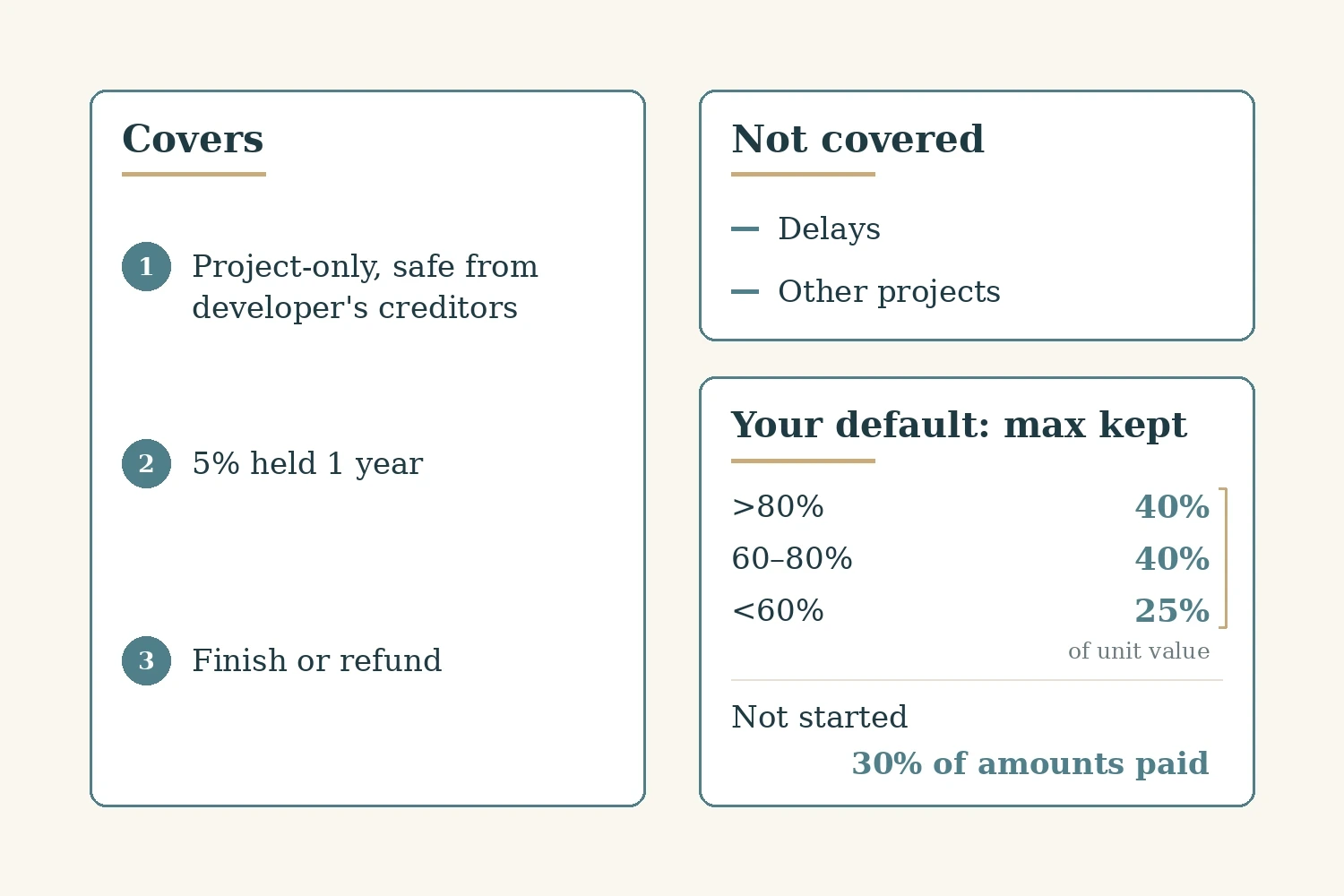
Article 9 of Law 8 is the core of the protection. In our paraphrase: the escrow account is opened in the project's name and used only for building that project; payments in it cannot be seized by the developer's creditors; and a developer with several projects must keep a separate escrow account for each.
Two further points follow from the law. If the developer borrows against the project, the lender must pay the loan into the same escrow account, where it is managed under the same rules (article 13). And you, as a depositor, may see your own accounting records in the account and ask for copies (article 12).
What article 9 does not do is protect you against everything else. Money in one project's account cannot be used for another project, but it also does not cover losses on a different project, delays, or changes to the unit. More on that below.
Who controls the money
The escrow agent manages the account. The DLD keeps a register of escrow agents (article 10), receives regular statements of the account's income and spending from the agent, and may audit them (article 11).
Which payments can come out of the account? The law sets out who manages the money and how it is supervised, but not a schedule of releases. The DLD's own guidance, in its frequently asked questions, says that as a general rule payments from an escrow account go only to the contractors, consultants and marketing involved in the project, that not every developer cost qualifies, and that only 5% of total sales can be spent on marketing (DLD frequently asked questions, read 26 October 2026). That 5% marketing limit is DLD guidance, not a figure in the law. The same guidance says the written agreement between the developer and the escrow agent lists the main construction stages that must be completed before payments are released, and that the agent's engineer inspects the site before each release (DLD frequently asked questions, read 26 October 2026). That staged release comes from the agreement and DLD practice, not from the text of Law 8. Ask the developer or the escrow agent how releases work for your project, rather than assuming a schedule.
After completion: the 5% retention
Under article 14 of Law 8, once the developer obtains the completion certificate, the escrow agent must hold back 5% of the total value of the escrow account. That retained amount is released to the developer one year after the units are registered in the buyers' names.
To show the scale, on a purely illustrative escrow account holding 1,000,000 UAE dirhams (AED), the retention would be AED 50,000 (1,000,000 x 5%). The retention is on the whole account, not on your unit. The law itself does not say what it is for, but the DLD's frequently asked questions describe it as security for the developer or contractor to put right defects that are apparent at completion or appear within a year of handover (DLD frequently asked questions, read 26 October 2026). It is a holdback against the developer, not a fund you can draw on directly.
If the project stalls, or if you stop paying
If a project is not completed, article 15 of Law 8 says the escrow agent, after consulting the DLD, must take the measures needed to protect depositors' rights and ensure the project is either completed or depositors are refunded. The law does not say who pays to finish the project or how quickly refunds are made, so do not read article 15 as a timetable.
Separately, under article 11 of Law 13 as replaced by Law No. 19 of 2017, if the Real Estate Regulatory Agency (RERA) cancels a project by a reasoned decision, the developer must refund all buyers' payments under the procedures in Law 8.
The same article 11 sets out what happens if the buyer defaults. In our paraphrase of Law 19 of 2017 (read in full on 26 October 2026):
- The developer notifies the DLD on its form. The DLD checks the breach, gives the buyer 30 days' written notice to perform, and may try to broker a settlement.
- If that fails, the DLD issues the developer a document confirming the procedure was followed and the unit's percentage of completion, measured to RERA's standards. The developer can then act without going to court or arbitration.
- Above 80% complete, the developer may keep the contract and everything paid and claim the balance; ask the DLD to sell the unit at public auction; or terminate, keep up to 40% of the unit's contract value and refund the rest.
- Between 60% and 80% complete, the developer may terminate and keep up to 40% of the unit's value.
- Below 60%, where work has started, the developer may terminate and keep up to 25% of the unit's value.
- Where work has not started for reasons beyond the developer's control, the developer may terminate and keep up to 30% of the amounts paid, refunding the rest within 60 days.
- In the first three cases, any excess is refunded within one year of termination or 60 days of resale, whichever is earlier.
- The buyer may still go to court or arbitration if the developer abuses these powers.
To show the scale, on a purely illustrative unit with a contract value of AED 1,000,000, a developer terminating at 70% completion could keep up to AED 400,000 (1,000,000 x 40%). Below 60% completion, the cap would be AED 250,000 (1,000,000 x 25%). These are maximums the law permits, measured against the unit's value, not against what you have paid.
What escrow does not cover
Read against the text, the escrow law is silent on several things buyers often assume it covers:
- Delay. Nothing in Law 8 sets a completion date or compensation for late handover. That is a matter for your contract.
- Specification and quality. The law ring-fences money; it does not set what the finished unit must look like. The 5% retention is held for one year after registration; the law does not tie it to defects, though the DLD's frequently asked questions describe it as security for defect repairs.
- The developer's other projects and liabilities. Each project's account stands alone.
- Money paid outside escrow. A payment made to any other account is outside the protection of article 9. Fees and charges at registration are covered in our guide to Dubai property transaction costs, and Oqood registration is a DLD service with its own fees.
- Resale prices and running costs. Our guide to Dubai service charges and running costs covers what you pay once the building is finished.
Buyers coming from India should also note that the rules differ. India's real estate law has its own escrow requirements, and none of them carries over to Dubai.
Who this is not for
This is not for a buyer of a finished, ready property: it covers off-plan purchases only. It is not legal advice on a particular contract: the sale and purchase agreement (SPA) and the developer's terms matter as much as the law. It does not cover the rules that govern how escrow funds are released stage by stage, or the fee schedule for registration. And it says nothing about whether any particular project, including any we list, has an escrow account or is in good standing: that is what the checks below are for.
Where that leaves you
Escrow in Dubai answers one question well: where does my money go? It goes to one project's account, managed by an accredited bank, under DLD supervision, beyond the reach of the developer's creditors. It does not answer whether the building will be finished on time, and the forfeiture rules show that a buyer who stops paying can lose a large share of the unit's value. Before you pay:
- Check that the project is approved and registered with the DLD.
- Make sure the escrow account and agent are named in the SPA, and pay only into that account.
- Make sure the sale is entered in the Interim Property Register through Oqood.
- Ask the escrow agent for your own account record.
- Read the payment schedule against the forfeiture bands, so you know your exposure at each stage.
Our guides to buying property in Dubai as a foreign buyer, checking a developer's track record, Dubai's freehold and leasehold zones, the golden visa property route and cross-border due diligence cover the rest of the decision. Our Dubai guide, Business Bay guide and Dubai Marina guide describe the places. A forthcoming piece will compare how under-construction buyers are protected in India, Dubai and Thailand.
Sources
- Dubai Legislation Portal: Law No. 8 of 2007 concerning escrow accounts for real estate development%20of%202007.html)
- Dubai Legislation Portal: Law No. 13 of 2008 regulating the Interim Real Property Register%20of%202008.html)
- Dubai Legislation Portal: Law No. 19 of 2017 amending Law No. 13 of 2008
- Dubai Land Department: frequently asked questions
- Dubai Land Department: register the initial sale (Oqood)
Ready to find your next holiday home?
Browse our curated collection of vacation homes and managed farmland across India and beyond.