The 99-Year Lease Route in Sri Lanka
A 99-year lease sounds like a formality attached to Sri Lankan land, a paperwork detail on the way to something closer to ownership. It is the actual product being sold, not a step toward a different one, and treating it as anything less permanent than it functionally is misreads what a buyer actually acquires.
Why 99 years, and what it is not
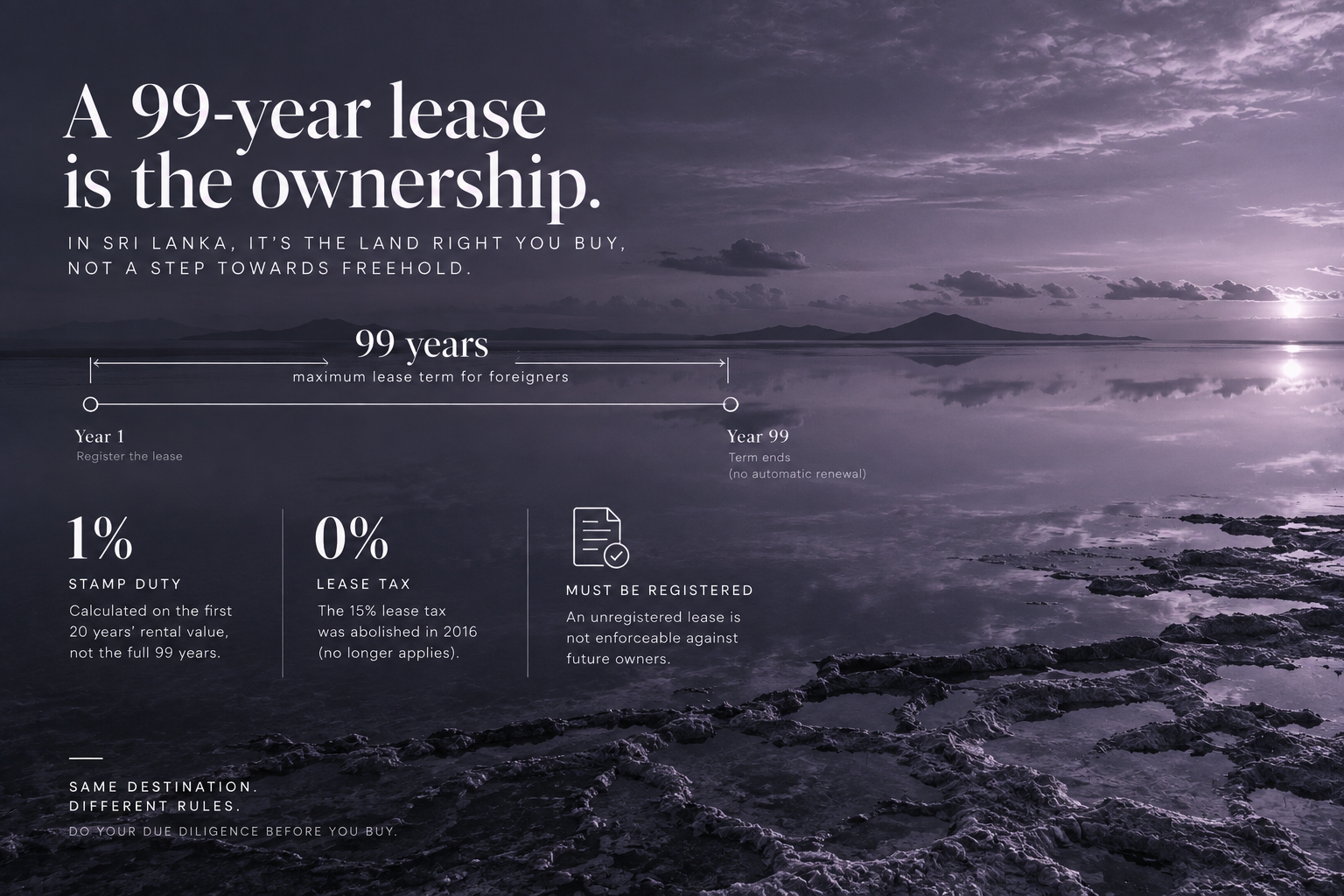
Foreign nationals cannot hold freehold title to land in Sri Lanka under any structure, and a 99-year lease is the maximum term the law permits as the alternative, the ceiling rather than a starting point that stretches further with the right negotiation. This term applies specifically to land, houses included, as distinct from the condominium route that allows outright ownership; a buyer looking at a standalone house with land under it is, by definition, looking at a lease, regardless of how the listing itself describes the arrangement.
What registration actually costs
Registering a lease attracts a 1% stamp duty, though the calculation is not applied to the full 99-year term's total rental value. Sri Lankan law caps the stamp duty calculation at the aggregate rental for the lease's first 20 years, a genuinely useful detail for structuring a lease agreement, since a longer nominal rent schedule stretched further out does not proportionally increase this particular cost. A lawyer's fee for preparing the lease documents typically runs a further 2 to 3%, on top of the stamp duty itself, and a buyer budgeting only the headline stamp duty percentage is underestimating the actual cost of getting a lease properly registered and enforceable.
The tax that used to apply, and no longer does
A 15% lease tax on foreign land leases, once a real cost layered on top of registration, was abolished for leases executed from 1 January 2016 onward under an amendment to the Land Restrictions on Alienation Act framework. A buyer working from an older source describing this tax as still current is working from a rule that has not applied for a decade, and the absence of this tax is worth confirming explicitly with current counsel rather than assumed correct simply because a specific guide happens to be recent in tone.
Why the lease has to actually be registered, not just signed
An unregistered lease is not simply a weaker version of a registered one, it functions as a materially shorter right in practice, since only a registered lease is enforceable against third parties, including a future buyer of the underlying land. A private agreement describing 99 years that was never taken to the land registry is, in the event the land changes hands, a promise the new owner has no legal obligation to honour, precisely the same structural weakness that undermines unregistered leases in other markets this site covers.
What actually happens as the lease term runs down
A 99-year lease does not renew automatically, and a buyer purchasing a leasehold property partway through someone else's original term is acquiring whatever years genuinely remain, not a fresh 99. Title Verification and the Sri Lankan Land Registry covers how to confirm the actual remaining term directly against the registry rather than relying on a listing's description of "99-year lease" without specifying how much of it has already elapsed. A lease nearing its final years is a structurally different asset from a freshly registered one at the same nominal description, and pricing the two identically is a mistake a buyer only discovers at resale.
Why a leased property is genuinely harder to finance
Land transferred to a foreign national, or to a company with foreign shareholding of 50% or more, after 29 October 2014 cannot be mortgaged to any bank licensed under Sri Lanka's Banking Act, a restriction that applies regardless of how the lease itself is structured. Sri Lankan banks do not offer mortgages directly to foreign buyers in the first place, though a foreign investor can mortgage the leasehold rights themselves as security for other debt financing, a narrower and less conventional route than a standard property-backed mortgage. A dual citizen, or a foreign buyer partnering with a Sri Lankan citizen to hold financing in that person's name or jointly, generally has meaningfully better access to local financing than a foreign buyer attempting to finance a leasehold purchase entirely on their own. A buyer planning to finance a Sri Lankan lease the way they might finance a comparable purchase in a market with conventional foreign-buyer mortgages available is planning around an option that does not really exist here in the same form.
What Avacasa recommends
Confirm a specific lease's actual remaining term against the land registry before treating "99-year lease" as a complete description of what is being purchased, and budget legal fees alongside stamp duty rather than the stamp duty figure alone. Do not rely on any mention of a lease tax from a source describing rules predating 2016, since that cost no longer applies. Owning Property in Sri Lanka as a Foreigner: The Complete Guide covers where this lease route sits inside the country's wider ownership structure.
Before you commit
Sri Lankan Property Taxes and Transfer Costs for Foreigners covers the fuller cost picture this lease-specific detail sits inside, and Can Foreigners Own Land in Sri Lanka? The Current Position covers the company-structure routes that exist alongside this lease option for a foreign buyer specifically wanting land rather than a condominium, and Nominee Ownership Structures and Why They Fail covers a workaround worth avoiding entirely rather than treated as a substitute for a properly registered lease. Thai Land Leases: The 30-Year Rule and Its Limits is worth reading side by side with this piece, since Thailand solves the same foreign-land problem with a genuinely shorter maximum lease term and its own distinct registration risks, and Leasehold in Indonesia: How Long, How Renewable, How Safe covers a third country's version of the same underlying question, a use-right title rather than a straight lease. Due Diligence When Buying Property in Another Country covers the verification habits worth applying to any lease before signing.
Whatever the destination inside the country, Sri Lanka covers a wide enough range of markets that this same 99-year lease structure applies uniformly, from the south coast to the hill country, and the same holds across Thailand and Dubai, where a different national framework applies just as uniformly within each country.
Sources
- Sri Lanka's 99-year maximum lease term for foreign land holding, and the 1% stamp duty capped at the first 20 years' aggregate rental
- The 15% foreign land lease tax abolished for leases executed from 1 January 2016
- Restrictions on mortgaging foreign-held land to a Sri Lankan licensed bank, and the leasehold-rights financing alternative
Ready to find your next holiday home?
Browse our curated collection of vacation homes and managed farmland across India and beyond.