How to Read Project Status: Under Construction to Handed Over
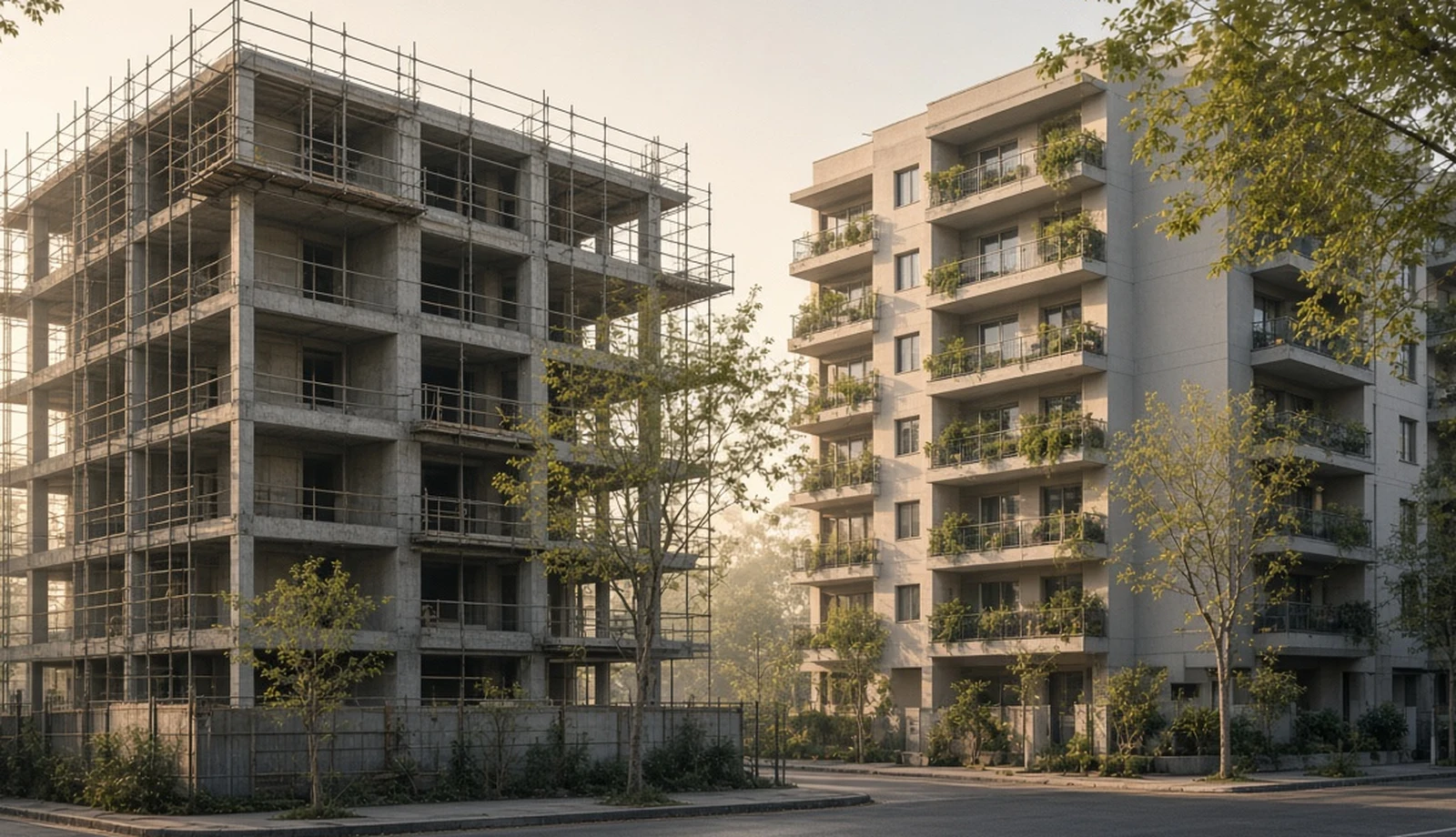
Most of what we list has not been built yet. As listed on avacasa.life on 28 October 2026, 917 of our 1,304 listings are marked Under Construction, which is 917 out of 1,304, or 70.3%. Add the 17 marked New Launch and the 12 marked Pre-Launch and the total is 946 out of 1,304, which is 72.5%. For a Non-Resident Indian (NRI) buyer who cannot easily visit a site, the label on a listing can feel like the main thing to go on. It should not be. A status label is the seller's word. What counts is the paper behind it, and in India and Dubai much of that paper can be looked up on a regulator's website from anywhere. This guide explains what each label should mean, which document backs it, and where to check it.
The labels you will see, in plain English
Listings on our site carry one of a handful of labels: Pre-Launch, New Launch, Under Construction, Ready to Move, Completed, Available and Sold Out. These are our labels, not legal categories, and other sites use their own. None of them proves anything on its own. Read them like this.
Pre-Launch and New Launch mean the project is being marketed early, often before construction has moved far. In India, the question is whether it is registered with the state regulator yet. Under Construction means building is under way and the handover is in the future; the proof is a registration you can look up, with a completion date the developer has committed to. Ready to Move and Completed should mean the building is finished and approved for people to live in; the proof is a certificate from the local authority. Available simply means units can be bought, and says nothing about the stage. Sold Out means no units are left from the developer.
We also have to be candid about our own data. As listed on avacasa.life on 28 October 2026, none of the 96 Indian listings marked Completed or Ready to Move has our occupancy certificate field filled in. That is most likely a gap in our records rather than proof that no certificate exists, but it is exactly why you should ask for the document, not trust the label.
India: pre-launch and new launch
India's Real Estate (Regulation and Development) Act, 2016, usually called the RERA Act after the Real Estate Regulatory Authority it sets up, makes registration with the state authority the starting point for selling most projects (RERA Act as enacted, read from Uttar Pradesh RERA's official copy, 28 October 2026). Smaller projects can fall outside it: the Act exempts projects where the land is no more than 500 square metres or the number of apartments is no more than eight, including all phases, though a state government may set a lower threshold (section 3(2)(a)). So a project marketed as pre-launch with no registration number is either exempt, or should not be selling yet, and you should find out which.
The Act also limits what you can be asked to pay early. Under section 13(1), a promoter may not accept more than 10% of the cost of the apartment, plot or building as an advance or application fee without first entering into a registered written agreement for sale. On a unit costing 80,00,000 Indian rupees (Rs 80,00,000), for example, that cap is Rs 80,00,000 x 10% = Rs 8,00,000. A request for more than that before a registered agreement is a warning sign in itself. Our guide to pre-payment due diligence in Maharashtra works through these checks in one state.
India: what under construction should show
When a promoter applies for registration, section 4(2)(l)(C) requires a declaration stating the time period within which they undertake to complete the project or phase. That date is on the record, and it is the one to hold the listing against, not a date in a brochure.
Once registered, the promoter must keep the project's page on the authority's website up to date. Section 11(1) lists what must be entered there for public viewing, including the registration details, a quarterly updated list of units booked, a quarterly updated list of approvals taken and approvals still pending after the commencement certificate, and the quarterly updated status of the project. Section 11(2) adds that advertisements must prominently show the website address of the authority where the project's details are entered.
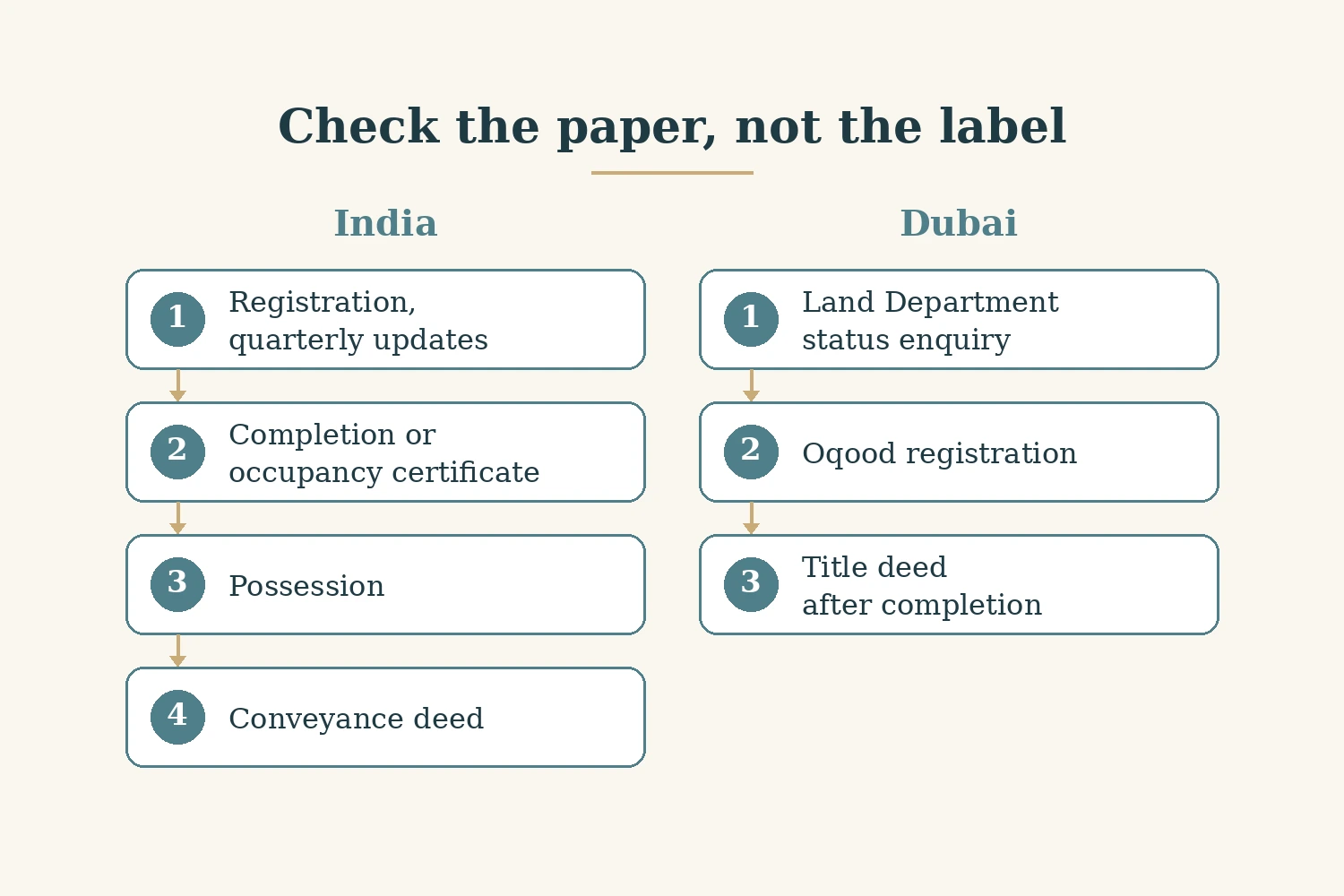
In practice, then, an under construction project in India should come with a registration number you can search on the state authority's website, a completion date the promoter has declared, and quarterly updates. If the updates have stopped, or the pending approvals list is long, that tells you more than the label does. What each state's portal shows, and how it labels lapsed or extended registrations, varies, and we have not checked it state by state. Our guide to checking a developer's track record covers what to look for in a promoter's earlier projects, and our India guide and Goa guide cover the places we list.
India: what ready to move should mean
Ready to move should rest on two certificates the RERA Act defines. A completion certificate (CC), under section 2(q), is the certificate, by whatever name called, issued by the competent authority certifying that the project has been developed according to the sanctioned plan, layout plan and specifications. An occupancy certificate (OC), under section 2(zf), is the certificate, by whatever name called, issued by the competent authority permitting occupation of a building, which has provision for civic infrastructure such as water, sanitation and electricity. The words "by whatever name called" matter: the name and the issuing body depend on local law, so ask for the certificate under whatever name your local authority uses.
The promoter is responsible for getting these. Section 11(4)(b) makes the promoter responsible for obtaining the completion certificate or the occupancy certificate, or both, and making it available to buyers individually or to the association of buyers. Section 19(10) then requires every buyer to take physical possession within two months of the occupancy certificate being issued.
Title follows. Section 17(1) requires the promoter to execute a registered conveyance deed in favour of the buyer, with the undivided proportionate title in the common areas going to the association of buyers or the competent authority, and to hand over possession and the other title documents within the period set by local law. Where there is no local law, the proviso says the conveyance deed must be carried out within three months from the date of issue of the occupancy certificate. So, taking the OC date as day zero, the Act's outer timings are possession within two months and, absent a local law, conveyance within three months. A ready to move listing with no OC to show has not reached the first step on that timeline. Our list of questions before signing a land deal covers the related paperwork.
Dubai: from off-plan to completion
In Dubai, the Dubai Land Department (DLD) runs a Project Status Enquiry service that lets anyone look up a real estate project's completion percentage and details, by land number, project number or project name (DLD service page, read 28 October 2026). The DLD's Dubai REST app page adds that buyers of off-plan units can see real-time information including the percentage of completion, actual pictures of the project, the escrow account number and payments due (read 28 October 2026). That gives a buyer in another country a figure from the regulator to set against any listing that says a building is nearly done.
The buyer's interest before completion is recorded in the interim register. Under Article 3 of Law No. 13 of 2008, off-plan sales must be recorded in the Interim Property Register, or they are void (Dubai Legislation Portal, text read 26 October 2026; page rechecked 28 October 2026). The DLD's Dubai REST page lists an online service called Oqood, shown as "Initial Registration (OQOOD 2.0)" (read 28 October 2026). How the money is held and released is the subject of our escrow posts, not this one. The title deed follows completion; we could not confirm the handover process from an official source, so we do not describe it here. Our guides to the Oqood register and buying in Dubai step by step cover the record and the order of events, our comparison of Business Bay, Jumeirah Village Circle (JVC) and Dubai Islands shows how much the stage differs by community, and our Dubai guide covers the city.
For Thailand, we have not confirmed a project status lookup service, so we say only that title to a condominium unit is a separate question covered in our guides to the foreign quota and Bangkok common fees, and our Thailand guide.
Where the money protection sits
A status label tells you nothing about what happens to your payments if the building stalls. That is a separate question with separate rules in each market. Rather than repeat them here, our guides to buyer protection on under-construction property in India, Dubai and Thailand and Dubai escrow and off-plan protection set out where the money is held and what the rules do and do not cover.
Five checks before you trust a label
First, take the registration number and look it up yourself on the regulator's website: the state RERA authority in India, or the DLD's Project Status Enquiry in Dubai. Do not rely on a screenshot sent by the seller.
Second, compare the dates. The completion date the promoter declared at registration, and any quarterly status update, should match what the listing and the sale agreement say.
Third, for anything labelled ready to move or completed in India, ask for a copy of the completion certificate or occupancy certificate, under whatever name the local authority uses, and check the date. The two-month possession rule and the conveyance timing both run from the occupancy certificate.
Fourth, for Dubai, check the completion percentage on the DLD's service against any claim in the marketing.
Fifth, see the site, in person or by a live video walk-through with someone you trust. Our site visit checklist and our guide to cross-border due diligence cover how to do this from abroad.
Who this is not for
This is not a guide to whether a project is a good purchase, or to prices, rents or future values; we make no such claims. It does not name the authority that issues completion or occupancy certificates in each Indian state, because that varies and we have not checked it. It does not describe Dubai's title deed process at handover or Thailand's condominium registration, which we could not confirm from official sources today. And it is not legal advice: for a specific purchase, a lawyer in that market should read the documents.
Where that leaves you
Treat every status label, including ours, as a question rather than an answer. In India, the answer is a registration number on the state authority's site, a declared completion date, quarterly updates, and then a completion or occupancy certificate. In Dubai, it is the DLD's completion percentage and the Oqood record. If the paper is there, the label is supported. If it is not, the label is only a claim, however confidently it is written.
Sources
- Uttar Pradesh Real Estate Regulatory Authority: official copy of the Real Estate (Regulation and Development) Act, 2016
- Dubai Land Department: Project Status Enquiry
- Dubai Land Department: Dubai REST
- Dubai Legislation Portal: Law No. 13 of 2008 on the Interim Property Register
Ready to find your next holiday home?
Browse our curated collection of vacation homes and managed farmland across India and beyond.