Title Search in Goa: Inscription, Description and the Portuguese Legacy

Ask most buyers what a property title search in Goa involves and they describe a pull of documents: a registered sale deed, a Form I and XIV, perhaps a certificate saying the land is free of mortgages. None of those, on its own, proves who owns the land. Goa has kept parts of the Portuguese land registration system alongside the survey records the rest of India uses, so the same piece of ground is described in more than one government register, in different vocabularies, by different offices. A title search here is therefore a reconciliation job: you are checking that the parcel described in one record is the same parcel the seller is pointing at on the ground, and that the person named as holder is the person selling. This piece is written for the domestic high net worth individual (HNI) and the non-resident Indian (NRI) buyer, and it goes a step deeper than our existing explainers on what each record contains, where it is kept, and what weight the courts give it. It is general information, not legal advice, and a Goa property lawyer should do the actual search.
Two entries, one parcel: the Descricao and the Inscricao
Portuguese law did not disappear when Goa joined the Indian Union. In Ethel Lourdes D'Souza Lobo v Lucio Neville Jude De Souza, decided on 19 September 2022, the Supreme Court dealt with inventory proceedings under the Portuguese code that governs them, and recorded that this code applies as law in force under Section 5(1) of the Goa, Daman and Diu (Administration) Act, 1962. The Bombay High Court at Goa, for its part, still applies the Portuguese Civil Code to land disputes, as the Pacheco case below shows through its use of Article 953. The land registry code that goes with it is the Codigo do Registo Predial, Decree-Law No. 42,565 of 8 October 1959. A published English translation describes registration under that code as declarative: it gives public notice and legal presumptions but does not create title. We rely on that translation as a secondary source, because we did not obtain the gazette text, and we cite no article numbers from the code.
For the Land Registration Office entry, two numbers matter. An advisory guide published by 1acre describes the Descricao as the entry that identifies the property, covering its survey number, area, boundaries, neighbours and its place in the registration books, and the Inscricao as the entry that records the person who holds it and how they acquired it. That field list rests on an advisory source, not on a statute we could read. What the court record does confirm is the two-number pattern in use. In Joaquim Antonio Pacheco v Gopal Datta Varik, the judgment records, from counsel's submission, a property described in the Land Registration Office under one number and inscribed under another, and also entered in the matriz records and in the survey records under their own numbers. One parcel, four numbers, recorded in different registers.
Why the inscription matters: a presumption you can rebut
The reason to read the inscription carefully is that Goan courts treat it as evidence of ownership. In Pacheco, decided on 4 September 2015 in Second Appeal No. 61 of 2007 by Justice F.M. Reis, the court held that the presumption under Article 953 of the Portuguese Civil Code runs in favour of the person in whose name the property is inscribed, and that the burden then shifts to whoever challenges it. It also held that the presumption is not defeated merely because the inscription does not show the earlier flow of title, and that a surveyor's report based on the Land Registration boundaries had been wrongly rejected. The text we read is a law-report mirror of the judgment, not the High Court's own page.
Two cautions follow. The presumption can be rebutted, so a clean inscription is where a search starts, not where it ends. And Pacheco shows how disputes actually turn. Both sides held paper. The inscribed holders' property carried survey numbers, and the question was whether the property the other side had bought, described under its own registration number, was the same land as the surveyed plots recorded for the inscribed property. The court found the buyers had failed to establish that it was. This was a second appeal, partly allowed, and the case was sent back to the lower appellate court to decide afresh, so it is a guide to how courts reason and not a final result on the facts. For a buyer, that is the real test: not whether a document is clean, but whether the described parcel sits on the plot you are being shown.
The Matriz and the survey record
The same Pacheco judgment shows the property entered in the matriz records and in the survey records. On the survey records, the court said a survey entry does not by itself give or take away ownership. In that case the survey record did not carry the owners' names, and the owners went to court to have it corrected. That matters because the Form I and XIV is the survey and land revenue record most buyers are handed. It tells you who is shown as occupant and what the land is classed as. It does not, by itself, establish title.
We did not find a primary source we could read that states what weight the matriz carries, so we do not rank it against the other records. Our explainers on Form I and XIV and the Goa Land Revenue Code set out how the records fit together, and we do not repeat them here.
Where to get each record, and what it costs
Form I and XIV is the simplest. According to the North Goa district website, you apply on plain paper to the Mamlatdar of the taluka, naming the survey number, subdivision number and village. No documents are required, and the fee is Rs 45 per copy, with Rs 15 for additional pages of the same form. The Directorate of Settlement and Land Records (DSLR) lists the Mamlatdar offices by taluka, and its service centres, run by Inspectors of Settlement and Land Records, are at Panaji, Mapusa, Margao and Vasco.
DSLR also holds the survey side: old and new survey records, pre-liberation records and comunidade plans. Its application form, which is undated, lists certified copies of a plan at Rs 35 per subdivision, a village map at Rs 150, the Registo do Agrimensor at Rs 40 plus paper, and an Auto de Demarcacao at Rs 20 plus paper. If a parcel like the one in Pacheco, with three subdivisions, needed certified plan copies, that would be 3 x 35 = Rs 105, before the other items and paper. Treat every rupee figure here as indicative, because fee schedules change.
The Goa Online property register lets you view a parcel by taluka, village and survey or city survey number, and shows the record of rights, a map and registration details, with an extract issued on payment. The page says registration details, so we cannot confirm that the text of the Descricao or Inscricao appears online, and we do not claim it does.
The Land Registration records themselves are less straightforward. The Registration Department's Citizens' Charter lists old Land Registration records under the Codigo do Registo Predial as held at Margao and Quepem only, and says records from North Goa stand transferred to the Archives. Other advisory material says buyers can apply at the taluka Sub-Registrar, and our existing explainer points to the Sub-Registrar of the sub-district. Those accounts conflict. The Charter is undated, so before you send anyone to an office for a North Goa parcel, confirm by phone or in writing where certified copies are issued now.
Nil Encumbrance Certificates and registration do not prove title
Two common documents are weaker than they look. The first is the Nil Encumbrance Certificate (NEC). The Charter says it is applied for with model forms, that it involves a search and should be requested well in advance, and that it normally takes between 3 and 15 days. The model application asks for the survey number, the Land Registration number and the Matriz number, with boundaries. It is a search of the encumbrance records, not a search of who owns the land, so it answers one question, whether the land is mortgaged, and not the main one. The Registration Department's services page describes the certificate as issued after a search of the mortgage index.
The second is registration itself. According to the Charter, the officer registering a document under the Registration Act, 1908 checks that the paperwork is in order (duty paid, parties identified, property described) and does not rule on whether the deed is legally sound, so legality is the parties' job, ideally settled through a lawyer before the deed is drawn up. A registered sale deed is evidence that a transaction took place in the correct form. It is not a finding that the seller had title.
Rights that sit outside the chain, and how far back to search
Some rights are not visible in the Descricao, the Inscricao or the survey record at all. The Goa, Daman and Diu Mundkars (Protection from Eviction) Act, 1975 defines a mundkar as a person who lives in a dwelling house on someone else's land with the landowner's permission (the bhatkar), and protects that person from being evicted other than through the Act's own procedure, whatever a custom, contract or decree might say. The text we read records that parts of the Act were amended and re-enacted after a High Court ruling, so we do not state its current form or any land extents. On site, a mundkar's house is a reason to ask questions before you pay.
Comunidade land has its own regime. The Code of Comunidades provides in Article 5 that comunidade immovable property may be granted on emphyteusis (a long-term grant of land for a ground rent) and alienated in the manner the Code provides, and in Article 7 that emphyteusis land may be alienated and divided. We therefore do not treat comunidade land as either freely saleable or barred, and say only that the particular parcel's status needs checking against the Code and the comunidade's records. Inheritance matters too, because gaps in an inscription often trace back to old estates. The Supreme Court's Lobo judgment concerned Goan inventory proceedings under the Portuguese Civil Procedure Code, and our piece on inheritance and succession for NRIs covers the outline.
How far back should a search go? We found no primary source fixing a period. Advisory sites describe a lawyer tracing the chain from the current owner back to a mother deed, covering matriz, inscription and description, registered deeds, succession or partition papers, litigation and land use. The length of that chain depends on the property, so ask your lawyer how far back they will go and why.
A short sequence for the buyer and the NRI buyer
In order: ask the seller for the sale deed, the Form I and XIV, the inscription and description details and the matriz number. Obtain a fresh Form I and XIV yourself, as above. Obtain the NEC. Ask your lawyer to match the described parcel to the surveyed plot, including boundaries and neighbours, and to trace the chain back. Check for tenants, mundkars and comunidade links, and confirm the land's zoning and use. Then visit the plot, as in our plot site visit checklist, and put the open questions to the seller in writing using our questions to ask before signing a land deal.
For an NRI buyer the paperwork travels with a representative, so the points in our guides to power of attorney for NRI buyers, the NRI land documentation checklist, cross-border property due diligence and buying a non-agricultural plot as an NRI apply. If the plot is in an area where zoning is the open question, emerging pockets around North Goa explains why that matters.
Who this is not for
This is not for a buyer who wants a one-document answer. No single record in Goa proves title, and a search that stops at a clean Form I and XIV or a clean NEC has not done the main job. It is also not for anyone expecting this piece to replace a lawyer: we have not read the registry code itself, we describe the Descricao and Inscricao fields through advisory sources, and where records are issued for North Goa remains unsettled. And it is not for buyers hoping a search will tell them what the land is worth. Price and infrastructure are separate questions, taken up in our pieces on what Mopa did to North Goa and the Morjim guide.
Where that leaves you
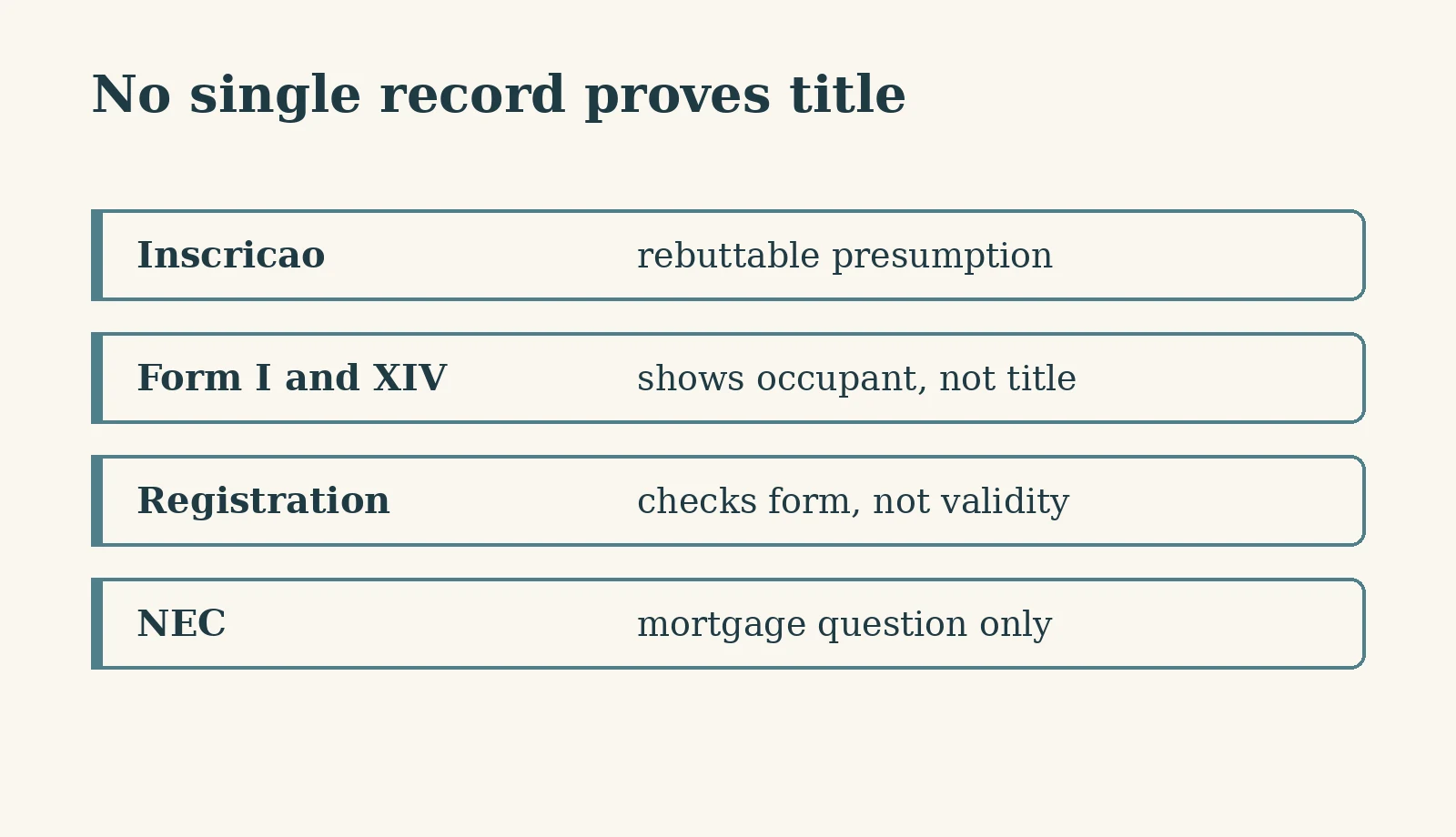
The useful question in Goa is not whether the paperwork is clean but whether the described, inscribed parcel is the surveyed plot in front of you. Inscription gives a rebuttable presumption in the holder's favour, survey entries neither create nor defeat title, registration tests form and not validity, and a Nil Encumbrance Certificate answers only the mortgage question. Hold the whole set side by side, and have a lawyer reconcile it, before you pay. For where this fits in a wider purchase, see our guide to owning property on the Goa coast and our April 2026 research notes, and the Goa guide, North Goa guide, Pernem guide and Siolim guide for the places themselves.
Sources
- Supreme Court: Ethel Lourdes D'Souza Lobo v Lucio Neville Jude De Souza, 2022
- Narayani Publications: Codigo do Registo Predial, English translation
- Goa Registration Department: Citizens' Charter
- 1acre: description certificate in Goa
- Pacheco v Varik, Bombay High Court at Goa, 4 September 2015 (CourtKutchehry)
- North Goa district: Form I and XIV service
- DSLR Goa: service centres
- DSLR Goa: services
- DSLR Goa: application form
- Goa Online: property register service
- Goa Online: land records
- PRS: Goa, Daman and Diu Mundkars (Protection from Eviction) Act, 1975
- Government of Goa: Code of Comunidades
- South Goa district: Code of Communidade
- Goa Registration Department: services and Nil Encumbrance Certificate
- Property Kawach: Goa title opinion
Ready to find your next holiday home?
Browse our curated collection of vacation homes and managed farmland across India and beyond.