Emerging Pockets to Watch Around North Goa

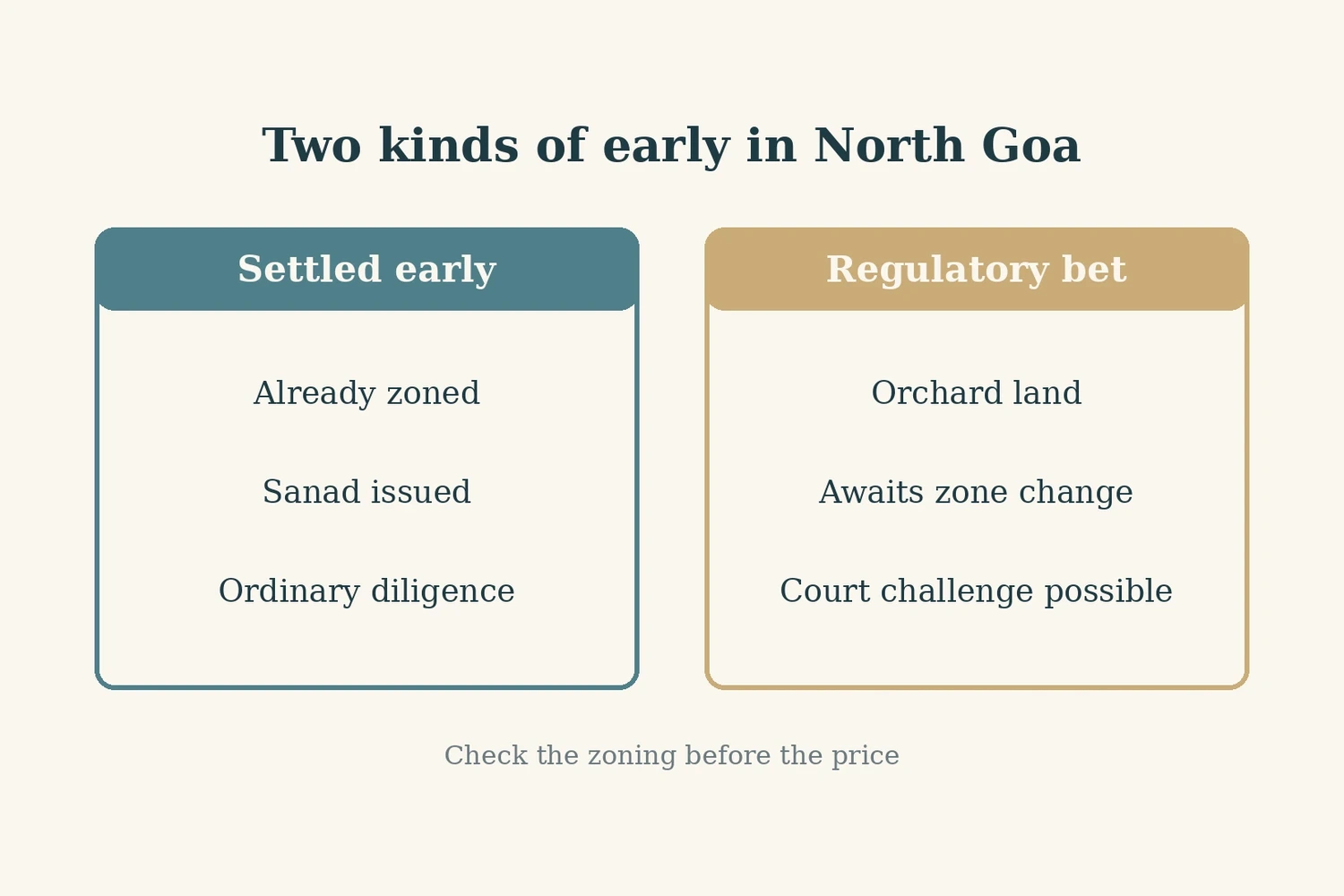
Most people looking for emerging areas in North Goa as an investment start from a simple picture: an airport has opened at Mopa, land near it is still cheap, and the trick is to buy before everyone else notices. The picture is not quite wrong, but it points at the wrong variable. In the villages that still look early, the thing that has not caught up with the airport is usually not the price. It is the zoning. Much of the inland land in Pernem taluka is orchard and settlement fringe, and the main way such land gains value is a change of use, either a zone change under the Town and Country Planning (TCP) Act or a conversion sanad under the Land Revenue Code. Both routes are legally live and both are contested in court. So buying early in North Goa is, in large part, a regulatory bet. This piece is written for the domestic high net worth individual (HNI), with non-resident Indian (NRI) buyers in mind as well, and its job is to help you tell a pocket that is early but settled from one that is early because nothing is settled yet.
One honest limit before we start. We have no registered transaction prices and no verified asking prices for any of these villages, so nothing here says that any pocket has risen by a given percentage. We also cannot quote the state's revised minimum land rates village by village, because the official gazette copy did not load when we checked it. The case for or against the airport as a price driver is made in our earlier piece on what Mopa and the new roads have done to North Goa, and we will not repeat it here.
What early means in North Goa now
In most markets, early means cheap relative to where the price is going. Around Mopa, that framing invites guesswork, because the price data that would support it is not public at village level. What is public, and checkable, is the state of the rules: which roads are open, which coastal stretches carry the strictest protection, and how land changes from orchard to buildable.
That gives a more useful way to sort the map. Some places are early on price but settled on zoning: the land is already in a settlement zone, or already converted, and the ordinary diligence a buyer would do anywhere is enough. Others are early because the zoning is not settled: the value depends on a change of use that has not happened and may be challenged if it does. The first is an ordinary purchase in a developing area. The second is speculation, and should be priced as speculation. Our wider North Goa property guide and the Goa guide cover the region as a whole; what follows takes the pockets one at a time.
Pernem: the inland belt, the town and the northern tip
The inland Pernem belt, Dhargal, Tuem, Chopdem and Agarwada, lies inland of the airport, with Dhargal on National Highway 66 (NH-66). Its strongest checkable fact is a road. According to the Press Information Bureau (PIB), the six-lane, access-controlled NH-166S link from Mopa airport to Dhargal, about 7 kilometres long and costing Rs 1,183 crore, was dedicated to the nation on 11 July 2024 by the Union Road Transport Minister. That is roughly Rs 169 crore per kilometre (1,183 divided by 7), and PIB restated the road in its inputs for Goa on 3 February 2026.
The road ends in a bottleneck. The Times of India reported on 4 August 2026 that the Dhargal flyover on NH-66 was still under construction, that Public Works Department (PWD) officials expected it to be finished by February 2027, about six months later, and that the airport approach saw daily congestion. That is a newspaper account of an official expectation, not a published completion date, so treat the timeline as a hope. The same PIB release of July 2024 also announced a 45 kilometre bypass from Vadgaon to the Karnataka border at Rs 3,500 crore and four-laning of 52 kilometres of the Panaji to Belagavi NH-748 at Rs 4,000 crore. Those were announcements; we have not verified the status of either, and a purchase should not depend on them.
Pernem town is a different kind of early. Land inside a municipal area generally comes with existing roads, services and a settlement character, which tends to mean fewer zoning unknowns than an orchard plot a few kilometres out. That is a reason to look at it with ordinary diligence rather than a reason to expect a premium. Our Pernem guide gives the local picture.
The northern tip, Querim and Tiracol, is coastal and thinly served. Anything near the shore there sits under the Coastal Regulation Zone (CRZ) rules discussed below, so a plot's position on the coastal maps matters more than its distance from the airport. Across the border, Dodamarg in Maharashtra draws some of the same buyers and has Avacasa listings, but it falls under a different state's law; our Maharashtra Land Revenue Code guide is the starting point there. For a sense of how these places feel on the ground, our North Goa long weekend itinerary passes through much of this stretch.
Avacasa lists projects in Pernem taluka, including in Morjim and Mandrem; nothing in this section describes them.
Across the Bardez line: Tivim, Assonora and Parra
Across the boundary in Bardez taluka, Tivim (also spelt Thivim) and Assonora are inland Bardez villages where Avacasa lists developments by GHD Group. We have not verified those listings' current prices or completion status, so we do not quote them. Parra, nearby, is the useful contrast: a village we would treat as established rather than early.
The point for a buyer is the same as in Pernem. An apartment in a completed or approved project is a settled purchase whose risks are about the developer and the price. A plot nearby is a different object, and its value depends on what the land is zoned for today. If you are weighing those two kinds of purchase, our piece on land versus apartments over the long term sets out the trade-off.
The coastal villages: where the rules are already written
Morjim, Mandrem, Arambol and Siolim are not early in any useful sense. They are established coastal villages, and our guides to Morjim, Mandrem, Arambol and Siolim describe them. They matter here for a different reason: they show what settled, strict rules look like.
Under the CRZ Notification 2019, issued on 18 January 2019, turtle nesting grounds are classed as CRZ-IA, the most protected category, and activity in and around them is barred except for conservation, including activity that causes light or sound pollution. Morjim and Mandrem are recognised sea turtle nesting sites, as reported by The Goan and the Times of India, and the nesting season runs from September to March. Goa's Coastal Zone Management Plan (CZMP), based on the 2011 CRZ notification, was notified on 6 September 2022, according to The Goan, with the demarcation of turtle nesting sites left to be corrected on local 1:4,000 maps. Because Goa's approved plan is a 2011-notification plan, the 2019 categories above describe the national rule, not Goa's current maps. Our guide to owning property on the Goa coast covers the practical side.
The first risk of early: zoning
The value lever for most inland plots is a change of zone, and that is where the law is most unsettled.
Section 39A of the Goa TCP Act lets the planning authority alter the zoning of land. The Times of India reported that the TCP department approved the conversion of just over 1 lakh square metres (sq m) from orchard and natural cover to residential use under Section 39A, across five applications, of which about 69,129 sq m was in Parcem in Pernem. That single village accounts for up to about 69 percent of the total (69,129 out of roughly 1,00,000). The report also said the approvals were expressly subject to the outcome of writ petitions pending before the High Court. In other words, a plot converted this way carries a live legal question, and a buyer inherits it.
Critics argue that orchard land treated as eco-sensitive zone category 2 (ESZ-2) under the Regional Plan can be converted through this route. The Hindu reported that view, including lawyer Norma Alvares's description of the earlier Regional Plan 2011 as classifying 83 percent of the state's land as eco-sensitive. That is an advocate's characterisation, reported by a newspaper, and we present it as such.
The older route has already been cut back by the courts. LiveLaw's analysis reports that under Section 17(2), inserted in 2023, and the 2023 rectification rules, there were 353 approvals covering about 26,54,286 sq m between March 2023 and January 2025, which averages about 7,519 sq m per approval (26,54,286 divided by 353). In a public interest litigation (PIL), Goa Foundation versus State of Goa, the Bombay High Court at Goa read down the wording that allowed changes for inconsistent and incoherent zoning proposals. The two accounts we have disagree on the date: LiveLaw gives the order as 13 March 2025, while The Hindu has reported it as April 2025. We have not seen the judgment itself, so we give both.
None of this means a converted plot is unsafe. It means that the word early, applied to an orchard plot, often describes a zoning outcome that a court could still revisit.
The second risk: conversion, title and coastal rules
Separate from zoning, land must usually be converted to non-agricultural use under Section 32 of the Land Revenue Code (LRC) of 1968, which ends in a document called a sanad. The Goa Land Revenue Code (Amendment) Bill 2026, Bill 8 of 2026, cut the time for deciding a Section 32 application from 60 days to 45, a reduction of 15 days or a quarter (15 divided by 60). The bill is deemed to have come into force on 2 December 2025 and repeals the ordinance that made the same change, Ordinance 5 of 2025. ThePrint, citing the Press Trust of India, reported it passed by the Assembly on 15 January 2026; we have not confirmed the date of assent.
The application itself is made online through Goa Online. The mandatory documents include a zoning certificate, Form I and XIV (the village land record, attached automatically), a site plan and a survey plan, and the designated officer is the Collector, Deputy Collector or Sub Divisional Officer. Our explainers on Form I and XIV and the Goa Land Revenue Code cover what those records show and how title problems surface in them. The sanad form itself has been revised: a copy of the Goa Land Revenue (Conversion of use of land and non-agricultural assessment) (Amendment) Rules 2026, hosted by a legal publisher rather than the government, shows Schedule II substituted, with the draft pre-published on 29 January 2026. We have not confirmed the final publication date.
We are deliberately not adding claims about specific title risks in this piece. Those are better read in the two explainers above than restated here without fresh sources.
A screening checklist for an early-pocket plot
Before you treat any inland plot as a good early buy, five questions are worth settling in writing:
- What does the zoning certificate say the land is zoned for today, and is that the use you want?
- Has a conversion sanad already been issued, and if not, does the case rest on a future Section 39A change that may be under challenge?
- Do Form I and XIV match the seller, the area and the survey number in the agreement?
- Where does the plot sit on the CZMP maps, and is it anywhere near a turtle nesting stretch?
- Is the asking price defensible from comparable deals the seller can show you, rather than from the airport story alone?
Our questions to ask before signing a land deal, the plot site visit checklist and the NRI land documentation checklist go further, and how to negotiate a land price helps with the last question.
Who this is not for
If you need certainty, this is the wrong corner of Goa to look for it. A plot whose value depends on a pending zone change is not a substitute for a fixed deposit, and nothing here suggests a return. If you need to sell within a few years, the lack of public village price data cuts both ways: it is hard to prove a gain to your own buyer, and the tax on any gain is a separate calculation, set out in our piece on capital gains tax on land sales. And if you are buying mainly because of the airport, read our post on what new highways and airports mean for a vacation home first. Mopa opened on 11 December 2022 with a first phase sized at about 4.4 million passengers per annum, according to PIB, and the road to it is already open, so the infrastructure is no longer a secret.
Where that leaves you
North Goa's early pockets divide into two groups, and the line between them is legal, not geographic. Land that is already zoned and converted, in a settlement area such as Pernem town or within an approved project in Tivim or Assonora, is an ordinary purchase in a changing area. Orchard land whose value depends on Section 39A or a new sanad is a bet on the planning system, with litigation pending and a recent court order already narrowing one route. Neither group has public price data we could verify. The sensible approach is to decide which group a plot belongs to before talking about price, and to let the paperwork rather than the airport set the number. If you want to compare with the more established inland villages, our Assagao guide is a useful benchmark, and our April 2026 notes on researching a Goa second home set the wider context.
Sources
- PIB: NH-166S Mopa to Dhargal link road dedicated, 11 July 2024
- PIB: inputs for Goa, 3 February 2026
- PIB: inauguration of Mopa airport
- Times of India: NH-66 congestion and the Dhargal flyover
- Times of India: TCP approves conversion of 1 lakh sq m under Section 39A
- The Hindu: from green to grey in Goa
- LiveLaw: Bombay High Court at Goa on the planning regime
- PRS: Goa Land Revenue Code (Amendment) Bill 2026
- ThePrint: Goa Assembly passes bill on conversion time limit
- Goa Online: conversion sanad service
- Goa Land Revenue Conversion (Amendment) Rules 2026, hosted copy
- CRZ Notification 2019
- The Goan: turtle beach management plan
- Times of India: turtle nesting habitat management plan
- The Goan: CZMP notified
Ready to find your next holiday home?
Browse our curated collection of vacation homes and managed farmland across India and beyond.