Owning Property in Morjim, Goa: A Neighbourhood Guide
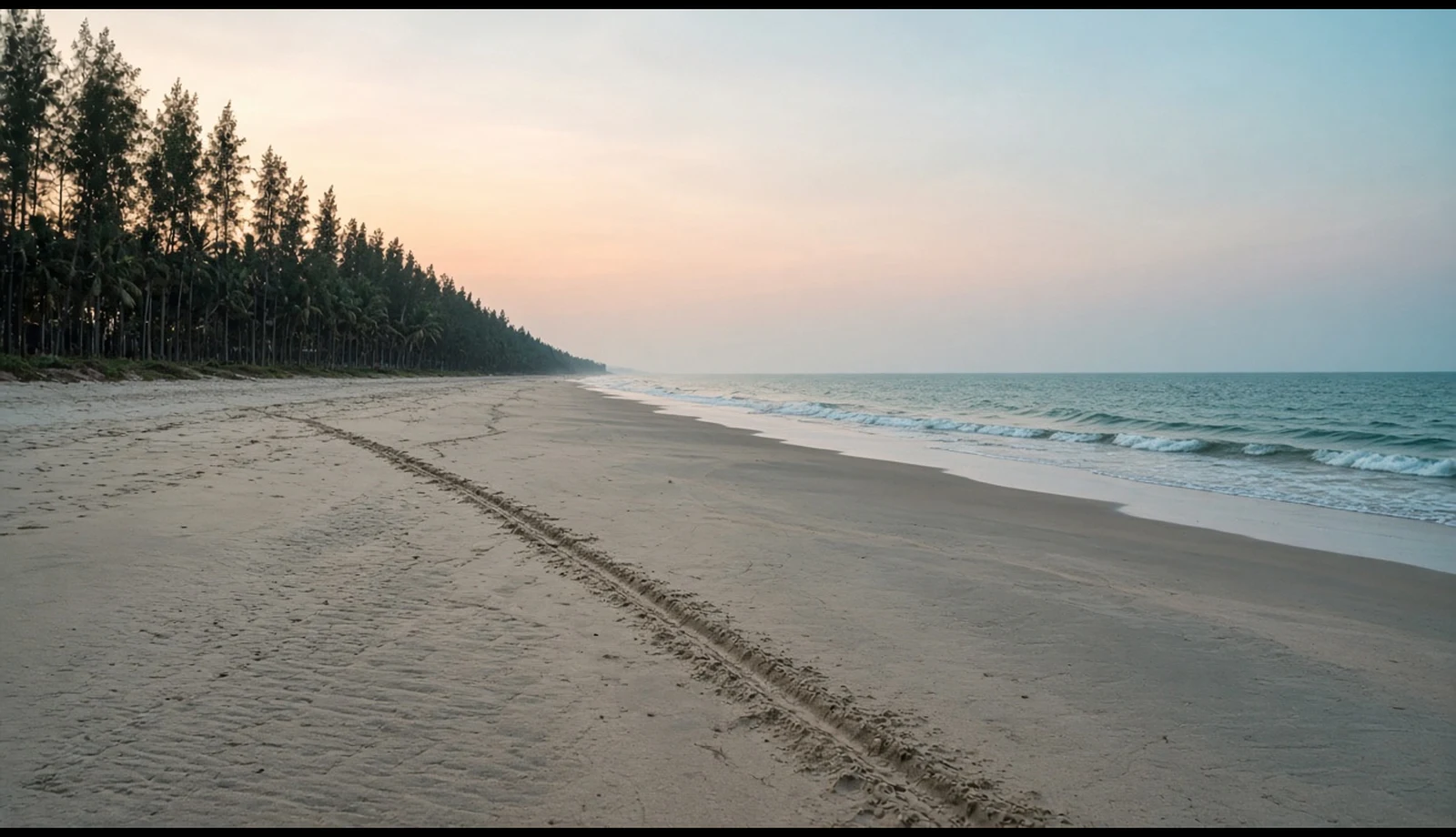
Most people who start searching for Morjim Goa property have a picture in mind: a house near the sand, the sea in view, the lights of a beach shack somewhere down the shore. Morjim does not quite allow that picture, and the reason is the beach itself. Its sand is a recognised nesting ground for sea turtles, and under India's coastal rules a turtle nesting ground sits in the strictest category of protection. The nesting season runs from September to March, which is also when most people want to be in North Goa. So the things that draw buyers closest to the shore, the view, the night lighting, the noise and the short-let income of peak months, are exactly the things the rules restrain there. Morjim is not a place where you buy a beach house. It is a place where the beach sets the terms.
A village that answers to its beach
Morjim sits in Pernem taluka, and our Morjim guide and Pernem guide give the lie of the land. We have no sourced record of particular restaurants, shacks or operators, so this piece names none.
What shapes the year is clearer. The turtle season runs from September to March, seven months that overlap with North Goa's busiest period. The protection of the nesting ground itself is not seasonal. If you want to see the area before deciding, our North Goa long weekend itinerary passes this way, and our North Goa guide sets Morjim in the wider region.
The turtle beach rules
The national rule is the Coastal Regulation Zone (CRZ) Notification 2019, issued on 18 January 2019. It places turtle nesting grounds in category CRZ-IA, the most protected, and it bars activity in and around them, including anything that causes light or sound pollution, apart from conservation work. Morjim and Mandrem are recognised sea turtle nesting sites, as reported by The Goan and the Times of India, and the season runs from September to March.
There is a wrinkle that matters to a buyer. Goa's own Coastal Zone Management Plan (CZMP), the map that turns the national categories into lines on the ground, is based on the earlier 2011 CRZ notification. The Goan reported that it was notified on 6 September 2022, with the demarcation of turtle nesting sites left to be corrected on local maps at a scale of 1:4,000. So the 2019 categories describe the national rule; they do not necessarily match Goa's current maps. We have not seen a Forest Department or coastal authority notice setting out Morjim's formal status, and we have not verified the setback distances that apply to different coastal zones, so we quote no metre figures.
The practical meaning is simple. Before you look at the house, look at where the plot falls on the coastal maps, and get that in writing. Our guide to owning property on the Goa coast covers the wider rules.
Getting to Mopa
The airport at Mopa was inaugurated on 11 December 2022 with a first phase sized at about 4.4 million passengers a year, according to the Press Information Bureau (PIB). The main new road towards it, the six-lane, access-controlled NH-166S link from the airport to Dhargal on National Highway 66 (NH-66), is about 7 kilometres long and cost Rs 1,183 crore, roughly Rs 169 crore per kilometre (1,183 divided by 7). PIB reported it dedicated on 11 July 2024 and restated it on 3 February 2026.
The weak point is where that road meets the highway. The Times of India reported on 4 August 2026 that the Dhargal flyover on NH-66 was still under construction, with Public Works Department (PWD) officials expecting completion by February 2027, and that the airport approach saw daily congestion. That is a newspaper account of an official expectation, not a fixed date. We have no official source for the distance or driving time from Morjim to the airport, so we give neither. Our piece on what Mopa and the new roads have done to North Goa covers the wider picture, and our post on what new highways and airports mean for a holiday home asks how much access should weigh in a purchase.
What Morjim costs: what we can and cannot tell you
Here we have to be plain. The state publishes minimum land rates for each village, but the official copy of the relevant order did not load when we checked it, so we do not quote Morjim's figure. We also have no verified asking prices, no registered transaction prices and no rental yields for Morjim. Any number you are given for the village should come with its source, and you should ask for it.
In a village where the beach limits building nearest the sand, a plot's position on the coastal map can matter more than any village average. Our piece on emerging pockets around North Goa explains why, in this part of Goa, zoning often matters more than price.
Renting it out: the homestay and B&B rules
If income is part of the plan, Goa's tourism rules decide the route. Under the Goa, Daman and Diu Registration of Tourist Trade Act 1982 and its 1985 rules, every homestay or bed and breakfast (B&B) must register with the Department of Tourism before it operates. The first certificate is valid for one year and is then renewed.
The Department of Tourism's policy sets the conditions. A unit needs between 2 and 6 rooms to let, and must be legally registered as wholly residential with the local authority. For a homestay, the owner and family must live on the premises; a B&B can instead have a resident agent or operator. In a cooperative housing society or gated complex, registration needs a no objection certificate (NOC) from the managing committee, and a trade licence from the panchayat or municipality and health and safety permissions are also required.
Applications are made on Goa Online, using Form XXIII for a homestay. The documents include proof of ownership (a sale or gift deed, Form I and XIV, or a house tax receipt), a Goods and Services Tax (GST) certificate where it applies, identity proof and a Permanent Account Number (PAN). The stated processing time is 90 days, and the designated officer is the Deputy Director for trade.
Put those rules together and two things follow. This is our reading, not a statement from the department. A villa in a gated complex bought for short lets needs the complex's agreement before it can be registered. And an owner who lives elsewhere, including a non-resident Indian (NRI), cannot meet the homestay condition of living on site, so the B&B route with a resident operator is the one to look at.
What to check before you buy
The checks are the ordinary Goa ones, applied with more care near the shore. First, the plot's position on the coastal maps. Then the land records: Form I and XIV, explained in our piece on Form I and XIV, and the wider rules in our Goa Land Revenue Code guide. If the land needs a change to non-agricultural use, that comes through a sanad under Section 32 of the Land Revenue Code (LRC) of 1968. The Goa Land Revenue Code (Amendment) Bill 2026 cut the time allowed to decide such an application from 60 days to 45, a reduction of 15 days or a quarter (15 divided by 60). The online application needs a zoning certificate, Form I and XIV, and site and survey plans.
Our plot site visit checklist, the questions to ask before signing a land deal and the NRI land documentation checklist go further. We have not sourced title risks specific to Morjim, so we leave those to the general explainers.
Who Morjim suits, and who it does not
Morjim suits a buyer who wants quiet, who is content to live set back from the sand, and who sees the turtle rules as part of the place rather than an obstacle to work around. It suits owners who will use the home themselves, or run a registered homestay while living there.
It does not suit a buyer whose plan depends on a sea view from a new building close to the beach, on lighting and noise in peak season, or on short-let income from a gated villa without the complex's consent. It does not suit anyone who wants a price figure they can rely on today, because we could not find one we could verify.
Where that leaves you
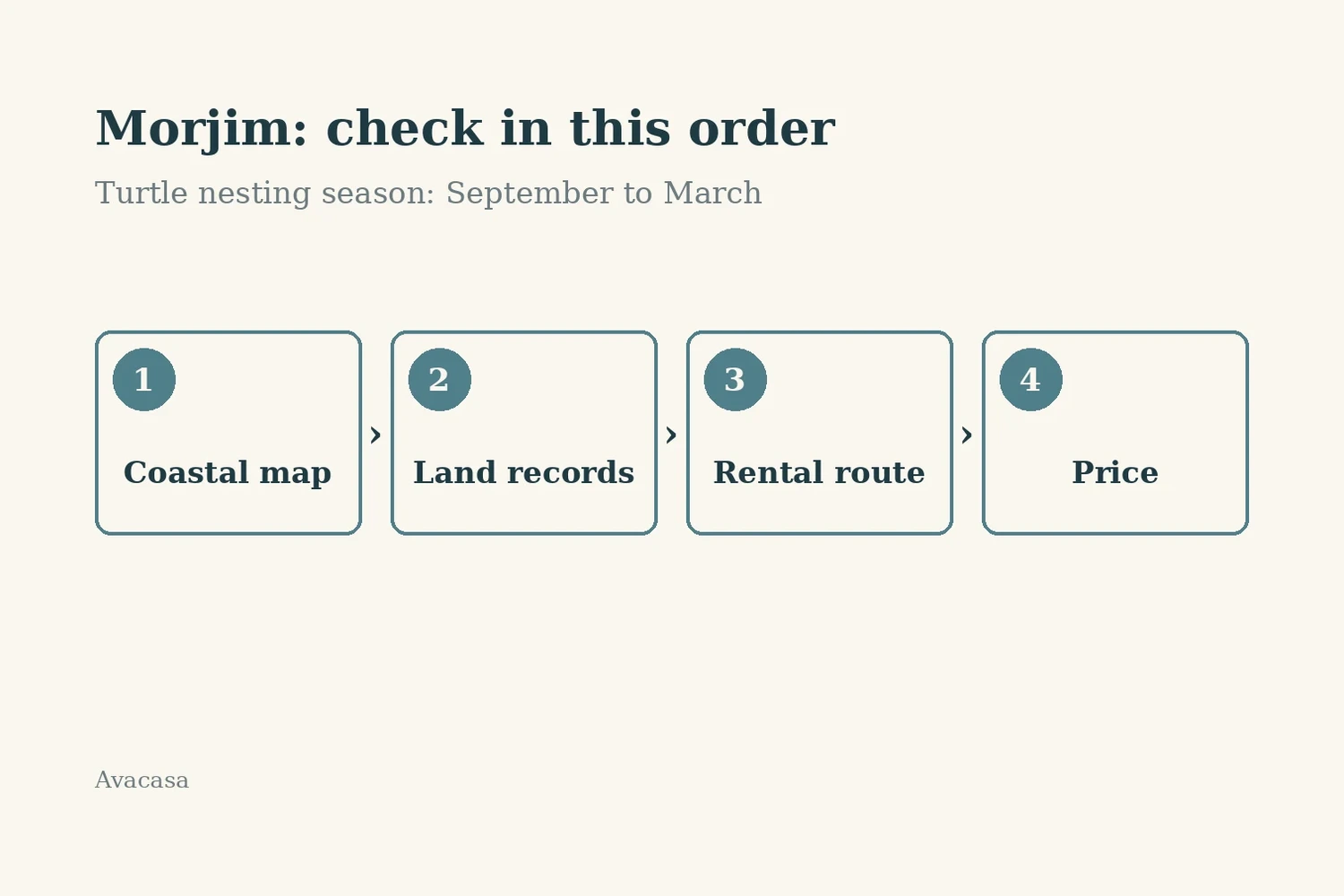
Morjim is best understood as a village shaped by a protected beach. The rules that limit building and activity near the sand are national, and Goa's own maps are still being corrected for the turtle sites, so a plot's exact position matters more here than in most places. Start with the coastal map, then the land records, then the rental route if you need one, and only then the price. For the wider context of choosing a second home in Goa, our April 2026 research notes and our Mandrem guide, for the neighbouring turtle beach, are good next reads.
Sources
- CRZ Notification 2019
- The Goan: turtle beach management plan
- Times of India: turtle nesting habitat management plan
- The Goan: CZMP notified
- PIB: NH-166S Mopa to Dhargal link road, 11 July 2024
- PIB: inputs for Goa, 3 February 2026
- PIB: inauguration of Mopa airport
- Times of India: NH-66 congestion and the Dhargal flyover
- Goa Tourism: homestay tourism policy
- Goa Online: homestay registration service
- Goa Online: homestay application form
- PRS: Goa Land Revenue Code (Amendment) Bill 2026
- Goa Online: conversion sanad service
Ready to find your next holiday home?
Browse our curated collection of vacation homes and managed farmland across India and beyond.