Carpet, Built-Up or Strata: How Area Is Measured in India, Dubai, Thailand and Bali
A flat in Goa, an apartment in Dubai, a condominium in Bangkok and a unit in Bali can each be advertised with an area figure, and those figures are rarely measured the same way. For a non-resident Indian (NRI) comparing homes across markets, that matters more than it first appears, because price per square metre is only as good as the area you divide by. Each of these four markets has one area that the law cares about: the area defined in the statute and written into the agreement or the title. That is the number to divide by. This guide sets out, market by market, which area the law uses and where it appears, then works through four examples from listings on avacasa.life. It is general information, not legal advice.
Why one flat can carry three area numbers
A single home can be described by several different areas. One may be measured inside the walls. Another may add the thickness of the walls, or a balcony. A third may add a share of lobbies, corridors and other common parts.
The fix is simple to say. Find out which area the law in that market uses for the sale or the title, and ask the seller in writing whether the figure on the listing is that area. If it is not, ask for the legal area and use it.
India: carpet area under the RERA Act
In India, the Real Estate (Regulation and Development) Act, 2016 (the RERA Act) defines carpet area in section 2(k). It means the net usable floor area of an apartment, excluding the area covered by the external walls, areas under services shafts, exclusive balcony or verandah area and exclusive open terrace area, but including the area covered by the internal partition walls of the apartment (RERA Act, Goa Real Estate Regulatory Authority copy, read 1 November 2026).
Put simply, carpet area under the Act is the floor inside the flat's outer walls, counting internal walls but not balconies, terraces or shafts.
The Act does not, in the text we read, contain a clause that expressly forbids quoting other area figures. What it does is define carpet area and require it to be disclosed, as the next section shows. That is the reason to ask for the carpet area of any Indian flat and to divide the price by it. Our Goa guide and Bengaluru guide cover the two Indian markets most of our readers look at.
Where carpet area must appear
Carpet area appears at several points under the RERA Act (read 1 November 2026). Section 4(2)(h) requires a promoter's application to register a project to include the number, type and carpet area of apartments for sale, along with the area of any exclusive balcony or verandah and exclusive open terrace. Section 13 requires a written, registered agreement for sale in the prescribed form before a promoter takes more than ten per cent of the cost. Section 14 requires the project to be built to the sanctioned plans and specifications, and, once they have been disclosed, bars additions or alterations to the apartment's plans and specifications without the allottee's previous consent, subject to a proviso for minor changes.
The prescribed form of agreement is set by each state. Maharashtra's model agreement for sale, published by the Maharashtra Real Estate Regulatory Authority (MahaRERA), sells the apartment by carpet area in square metres, using the section 2(k) wording (MahaRERA model agreement, read 1 November 2026). Under clause 1(g), the promoter confirms the final carpet area after the building is complete and the occupancy certificate is granted, subject to a variation cap of three per cent. If the area is smaller, the excess is refunded within 45 days with interest; if larger, the extra is charged at the next payment milestone, in both cases at the same rate per square metre as the agreement. That is Maharashtra's form only. For Goa's model agreement, we could not confirm from an official source as of 1 November 2026, so we give no figure for it. Our guide to Goa's Form I and Form XIV covers related Goa paperwork.
Dubai: net area for the register, and the five per cent shortfall rule
In Dubai, two laws deal with the area of a sold unit. Article 12 of Law No. 13 of 2008 says the area of a sold unit is deemed correct. If the area increases after delivery, the developer may not claim a higher price; if it decreases, the developer must compensate the buyer unless the decrease is inconsequential (Dubai Legislation Portal, read 1 November 2026).
Article 13 of Executive Council Resolution No. 6 of 2010, the implementing bylaw of that law, gives the detail (Dubai Legislation Portal, read 1 November 2026). The net area of a unit is the area used for registration, calculated as determined by the Dubai Land Department (DLD). Any excess over the net area is not charged unless agreed otherwise. The developer must compensate the buyer if the actual area is less than the net area by more than five per cent, with compensation calculated on the price agreed in the sale agreement, and the net area in the agreement and plan is the baseline.
The DLD's own e-service for registering project data says the developer appoints a survey company, which prepares the project data and matches it against the approved plans, and sends the application to the DLD's Survey Department (DLD, read 1 November 2026). For a published DLD standard setting out how net area is measured, we could not confirm from an official source as of 1 November 2026. Our guides to Dubai's Oqood off-plan title and the Dubai guide cover the wider buying process.
Dubai: what a strata unit includes
Law No. 6 of 2019 on jointly owned property defines a unit as a flat, shop, office or similar that is part of jointly owned real property, and common parts as the parts shown on the site plan for common use (Dubai Legislation Portal, read 1 November 2026). Article 9 says that, unless the site plan says otherwise, a unit includes its floors down to the joist base, its ceilings, its non-supporting internal walls and its surrounding walls, its balconies and other ancillary parts allocated to the owner, and attached facilities such as a garden, car park or storage, provided their area is not included in the net area of the unit.
So ask for the net area stated in the sale agreement and plan, and treat parking or storage as separate items, not as extra square metres.
Thailand: room area on the room title deed
In Thailand, the Condominium Act B.E. 2522 (Buddhist Era year 2522, which is 1979), as amended, is published in Thai by the Department of Lands (DOL). The English wording below is our paraphrase of the DOL's Thai text, not an official translation (Condominium Act, DOL copy, read 1 November 2026).
Section 4 defines a unit as the part of a condominium that can be owned individually; and common property as everything that is not a unit, including the land the building stands on. Section 21 says the room title deed must show at least the position and area of the land, the unit's location, area and a plan showing its width, length and height, the owner's share of common property, the owner's name and a register of rights. Section 14 sets each owner's share of common property as the ratio of that unit's area to the total unit area in the building at the time of registration.
A 2010 ministerial regulation on condominium registration, in the same DOL compilation, requires the registration application to attach floor-by-floor plans giving the width, length, height and area of each unit, and a schedule of each unit's share of common property (DOL, read 1 November 2026; our paraphrase of the Thai text). Whether a balcony is counted in the room area on the title deed, we could not confirm from an official source as of 1 November 2026. Our guides to the condominium foreign quota, common fees and the juristic person, the Bangkok guide and the Phuket guide go further.
Bali and Indonesia: a floor plan, and a share set by value
In Indonesia, apartments and other strata units are governed by Law No. 20 of 2011 on Rumah Susun, or multi-storey housing (state secretariat copy, read 1 November 2026). Article 47(3) says the strata title certificate, the Sertifikat Hak Milik Satuan Rumah Susun (SHM sarusun), consists of a copy of the land book and survey letter for the common land, a floor plan drawing showing the unit owned, and a pertelaan, or description, of the owner's share of the common parts, common objects and common land. Article 47(4) says it is issued by the district or city land office.
The share is not set by area. Article 1(13) defines the proportional comparative value, Nilai Perbandingan Proporsional (NPP), as the number showing a unit's share of common parts, objects and land, calculated on the unit's value against the total value of the building when the developer first works out its construction cost to set sale prices. That differs from Thailand, where the share follows area.
Articles 25 and 26 require the developer to separate the building into units and common parts in drawings and a description made before construction, which form the basis for the NPP, the certificate and the binding sale agreement, the Perjanjian Pengikatan Jual Beli (PPJB). Article 42(3) makes promises made in marketing before construction binding as the PPJB, and articles 98 and 110 bar a PPJB that does not match what was marketed, with a penalty of up to four years in prison or a fine of up to IDR 4 billion (Indonesian rupiah). Government Regulation (Peraturan Pemerintah, PP) No. 18 of 2021 adds that for foreign owners the share in common land is not counted, and that foreign home ownership is limited by minimum price, land parcel area, number and residential use (PP 18/2021, elucidation of article 67(1) and article 72, read 1 November 2026).
Whether Law No. 6 of 2023 amended these articles, and how the Ministry of Agrarian Affairs and Spatial Planning/National Land Agency (ATR/BPN) measures a unit's floor area, we could not confirm from an official source as of 1 November 2026. Our guides to Indonesian land title types and the Bali guide cover title more broadly.
Four listings, one basis question
Here are four examples from listings on avacasa.life, each as listed on 1 November 2026. None of the four listings states which area basis its figure uses, so each result may not be on the legal area for its market. Read each as what the listing implies, not a market rate. We use 1 square metre equals 10.7639 square feet.
A Goa apartment
Listed at Rs (Indian rupees) 57 lakh with an area of 447 square feet. 447 divided by 10.7639 is about 41.53 square metres, and Rs 57,00,000 divided by that area, without rounding it first, is about Rs 1,37,258 per square metre. Ask whether 447 square feet is the RERA carpet area.
A Dubai apartment
Listed from AED 1,800,000 (United Arab Emirates dirham) with an area of 689 square feet. 689 divided by 10.7639 is about 64.01 square metres, and 1,800,000 divided by 64.01 is about AED 28,120 per square metre. Ask whether 689 square feet is the net area in the sale agreement.
A Bangkok condominium
Listed from THB 8,900,000 (Thai baht). The developer's description gives units of 45 to 210 square metres, and the listing's area field holds 487 square feet, about 45.24 square metres. 8,900,000 divided by 45 is about THB 197,800 per square metre; divided by 45.24 it is about THB 196,700. Ask whether that is the room area that will appear on the title deed.
A Bali apartment
Listed at Rs 1.15 crore with an area of 458 square feet. 458 divided by 10.7639 is about 42.55 square metres, and Rs 1,15,00,000 divided by that area, without rounding it first, is about Rs 2,70,273 per square metre. The listing does not say whether the unit has a strata certificate, so ask what title it carries and what area that title records.
We have no exchange rate for these figures, so we have not converted the dirham or baht amounts.
Who this is not for
This is not legal advice and does not replace a lawyer or surveyor reading the agreement, plan and title for your unit. It does not cover land, plots or villas. It gives no average price per square metre for any market, and makes no claim that any market is cheaper than another. If you need to know a specific unit's legal area, only the agreement, the registered plan or the title can tell you. Our guides to due diligence across borders, buyer protection for under-construction homes and reading a project's status cover the wider checks.
Where that leaves you
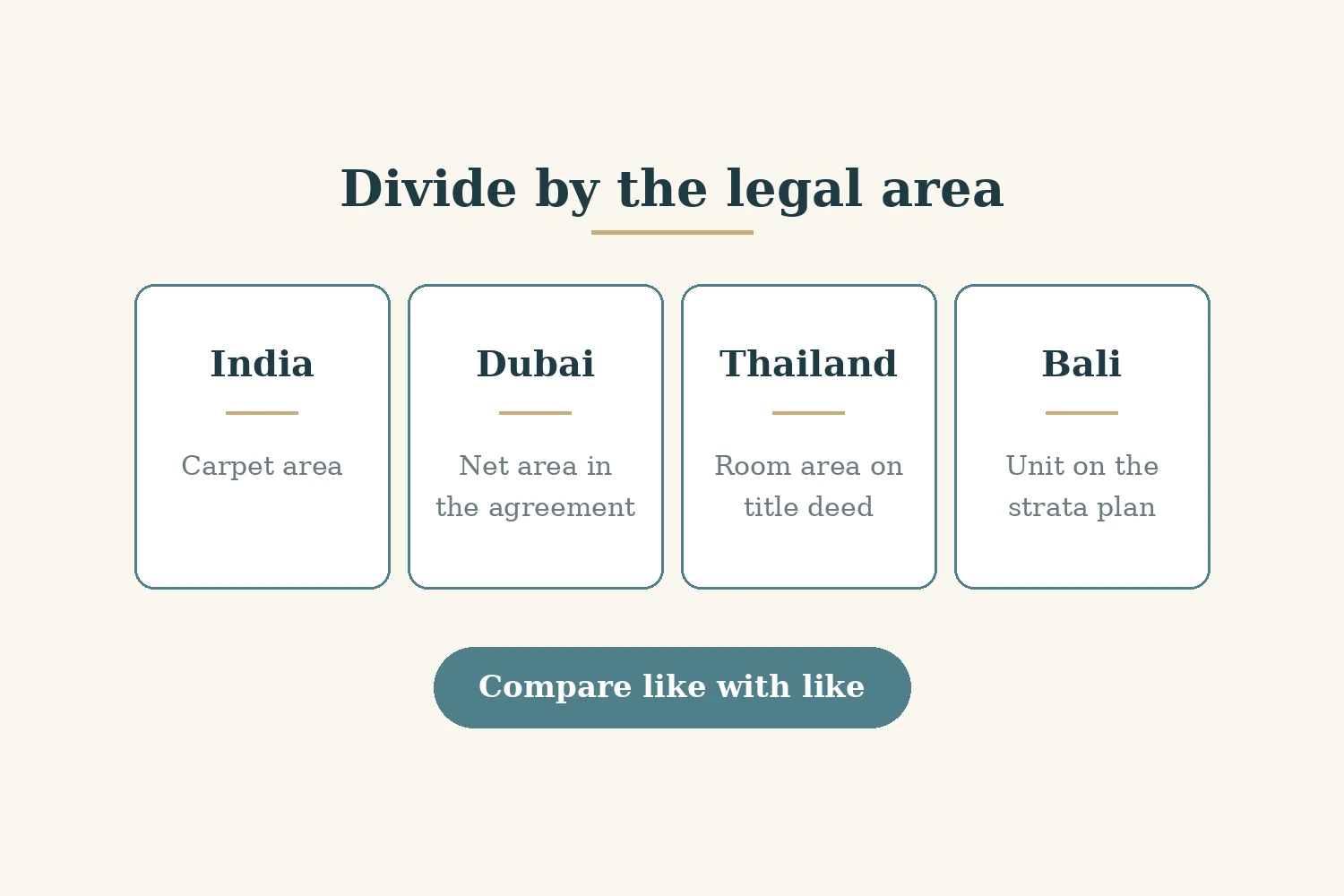
Before you compare prices across markets, put five questions to the seller, in writing. First, which area does the listed figure measure? Second, is that the legal area for this market: carpet area in India, net area in Dubai, the room area on the Thai title deed, or the unit on the Indonesian strata plan? Third, where will that area appear: in the agreement, the registered plan or the title? Fourth, what happens if the built area turns out smaller? And fifth, are parking, storage or balconies counted, or priced separately?
Then divide the price by the legal area, and compare only like with like.
Sources
- Real Estate (Regulation and Development) Act, 2016, Goa RERA copy
- MahaRERA model agreement for sale (Maharashtra)
- Dubai Law No. 13 of 2008%20of%202008.html)
- Dubai Executive Council Resolution No. 6 of 2010%20of%202010%20Approving%20the%20Implementing%20Bylaw%20of%20Law%20No.%20(13)%20of%202008.pdf)
- Dubai Law No. 6 of 2019 on jointly owned property%20of%202019%20Concerning%20Ownership%20of%20Jointly%20Owned%20Real%20Property%20in%20the%20Emirate%20of%20Dubai.html)
- Dubai Land Department: register or amend real estate project data
- Department of Lands: Condominium Act B.E. 2522 (Thai)
- Department of Lands: Condominium Act and ministerial regulations (Thai)
- Indonesia Law No. 20 of 2011 on Rumah Susun
- Indonesia Government Regulation No. 18 of 2021
Ready to find your next holiday home?
Browse our curated collection of vacation homes and managed farmland across India and beyond.