Moving Money Into Thailand to Buy a Condo: What the Land Office Needs

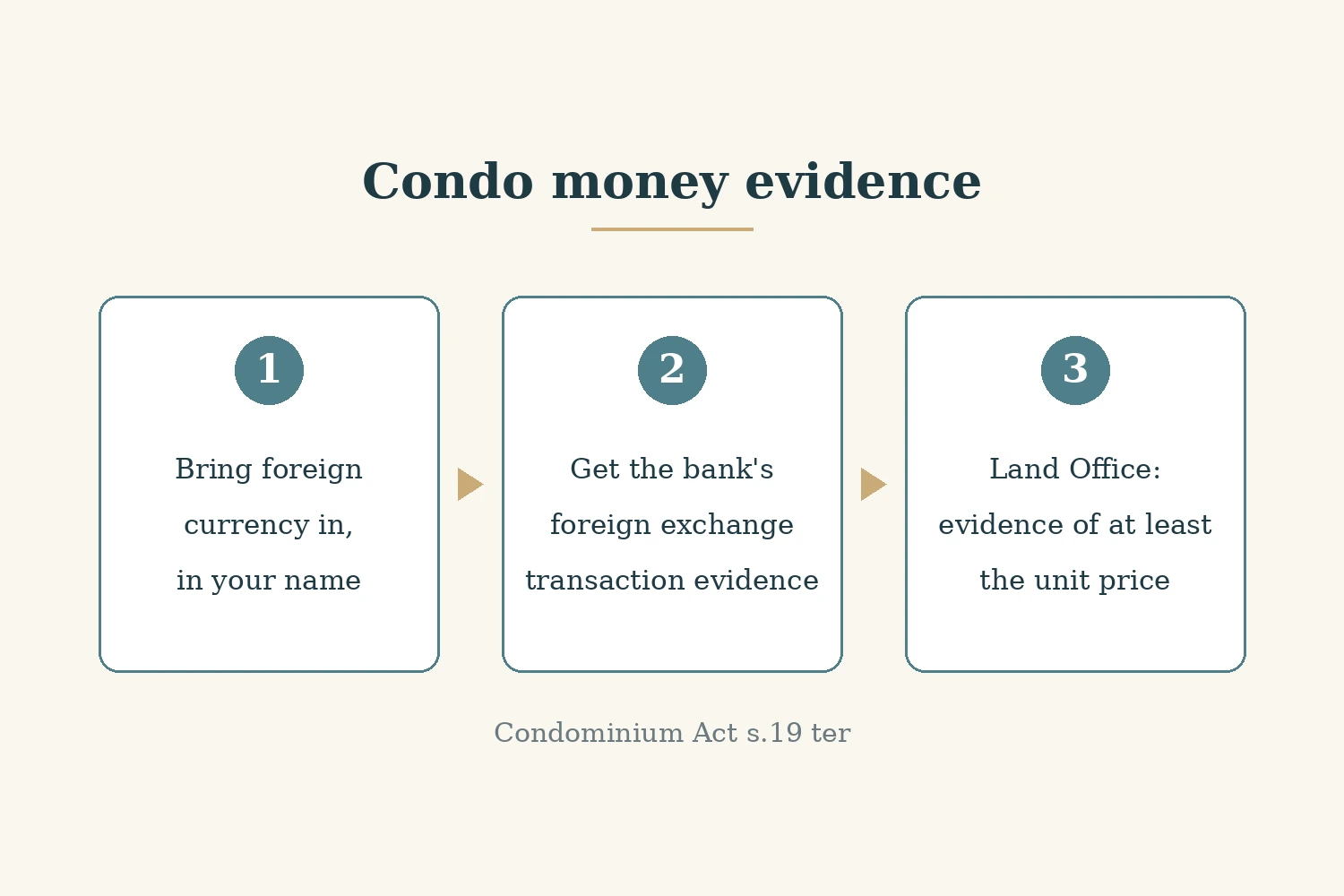
Most advice on buying a condominium in Thailand as a foreigner focuses on the 49% foreign quota. The step that catches buyers out comes earlier, when the money is sent. To register the transfer of a unit to most foreign buyers, the Land Office needs evidence that the money came into Thailand in a particular way, in an amount not less than the price of the unit. That requirement comes from the Condominium Act, not from a bank's rulebook, and the bank document used to show it has changed over the years. This guide covers condominiums only. It does not apply to land, houses or villas, which the Condominium Act does not cover. Statutory and regulatory points were read on 27 October 2026, the English is our paraphrase of the Thai text, and this is not legal advice.
The rule is in the Condominium Act, not the bank
The governing text is the Condominium Act B.E. (Buddhist Era) 2522 (1979), as amended to No. 4 (B.E. 2551), in the Thai consolidated version hosted by the Department of Lands (DOL), read on 27 October 2026. In our paraphrase:
- Section 19 lists who may own condominium units as foreigners. One category, in section 19(5), is a foreigner, or a juristic person treated as foreign, who brings foreign currency into Thailand, or withdraws money from a baht account of a person living outside Thailand, or from a foreign currency deposit account.
- Section 19 ter sets out the evidence each category must show when a unit is transferred to them. For the section 19(5) category, it is evidence of bringing foreign currency into Thailand, or of withdrawing from one of those two kinds of account, in an amount not less than the price of the unit being bought.
- Section 19 quater says that once the officer finds the documents correct and foreign holdings within the permitted share, the officer registers the transfer.
- Section 19 bis caps foreign holdings in a building at 49% of the total unit area. Our guide to the Thai condo foreign quota covers that limit in detail.
So the question at the Land Office is not "which form do you have?" but "does your evidence show qualifying money, in your name, of at least the unit price?" On an illustrative unit priced at 5,000,000 Thai baht (THB), the evidence must add up to at least THB 5,000,000.
Three ways the money can qualify
Read with section 19 ter, section 19(5) gives three routes:
- Foreign currency brought into Thailand.
- A withdrawal from a baht account held by a person living outside Thailand.
- A withdrawal from a foreign currency deposit account.
Each route needs evidence of the amount. The Act does not say how a bank should label a transfer, which currency it should be sent in, or how several transfers should be treated together. Those are practical questions for your bank and the Land Office, and we come back to them below.
Who relies on a different route
Not every foreign buyer depends on the money evidence. Section 19 ter sets different evidence for other section 19 categories: a residence permit under immigration law, an entry permit under the investment promotion law, registration as a Thai juristic person, or a Board of Investment promotion certificate. If you fall into one of those categories, the money route may not be the one you use, but confirm which category you are buying under with your lawyer before you send funds. Our guides to owning property in Thailand as a foreigner and company ownership risks explain the wider rules.
What the bank gives you today
The Bank of Thailand (BOT) sets the foreign exchange rules banks follow. Its English page on exchange control regulation, read on 27 October 2026, says that anyone buying, selling, depositing or withdrawing foreign currency with an authorised bank must give the bank details of the transaction. For transactions equivalent to 200,000 US dollars (USD) or more, the bank must ask for supporting documents, unless it has already carried out its know-your-business checks on the customer. After the transaction, the bank issues evidence of it to the customer. The BOT's Thai guideline for commercial banks, issued for the rules in force from 1 December 2025, uses the same USD 200,000 trigger for documents for customers the bank has not checked under know-your-business (read 27 October 2026).
That evidence is what the Land Office looks at. In this guide we call it the bank's foreign exchange transaction evidence (often still called an FET form). FET stands for Foreign Exchange Transaction. Banks, lawyers and agents still use the older name, so expect to hear it. What matters is that the bank's document shows the money, the currency, your name and an amount that, with any other qualifying evidence, reaches the unit price.
The USD 50,000 figure you will read elsewhere
Many guides say a bank issues an FET form for transfers of USD 50,000 or more, and something else below that. We could not confirm that this is the current rule from an official source. The BOT's own announcement of its foreign exchange regulation reform in June 2017 lists the old rule, under which customers dealing in USD 50,000 or more had to submit a Foreign Exchange Transaction Form with supporting documents, and sets out the reform as eliminating the form and the stamp requirement, with a timeline of the third quarter of 2017 (BOT reform document, read 27 October 2026). The BOT's current page, cited above, describes the USD 200,000 trigger instead.
So treat the USD 50,000 line as outdated. Do not plan your transfers around it, and do not assume that a transfer below or above any particular amount will be handled in a particular way. Ask your bank what evidence it will issue for your transfer, and ask the Land Office whether that evidence will be accepted.
Before you send
The practical risk is money arriving in a way that does not fit section 19 ter. Some of the common cases buyers ask about are money converted to baht before it leaves your home country, money sent in baht rather than foreign currency, a transfer in someone else's name, and a payment split across several transfers. We could not confirm from an official source how any of these is treated, so we state no outcome. In each case, ask the bank and the land office before sending.
Before transfer day, it also helps to:
- Tell your Thai receiving bank that the money is for buying a condominium unit, and ask what details it needs on the incoming transfer.
- Ask the bank what evidence it will issue, in whose name, and whether it can issue it for each transfer.
- Ask the developer or seller, and your lawyer, what the Land Office in that district has asked for recently.
- Keep your own home-bank records of each transfer alongside the Thai bank's evidence.
The money question sits alongside the other transfer-day steps. Our guides to Thai property taxes and fees, Bangkok condo common fees and the juristic person and buying under construction cover those, and our pieces on currency risk in overseas property and financing a purchase abroad cover how the money is raised and moved.
Who this is not for
This is not for buyers of land, houses or villas in Thailand: the Condominium Act and its money evidence rule apply only to condominium units. It is not for buyers who qualify under another section 19 category and are advised to use that route. It does not explain the BOT's rules on sending money out of Thailand, and it gives no exchange rate or conversion. And it is not a substitute for asking your bank and the Land Office about your own transfer.
Where that leaves you
The Land Office will register a unit to a section 19(5) foreign buyer only with evidence that qualifying money, of at least the unit price, came in by one of the routes the Act sets out. The bank issues that evidence; the older FET name lingers, and the USD 50,000 figure you may read is not something we could confirm as current. Plan the transfer with the bank and the Land Office before you send, not after. Our guides to cross-border due diligence and foreign property ownership cover the rest of the decision, and our Thailand guide, Bangkok guide and Phuket guide describe the places.
Sources
- Department of Lands: Condominium Act B.E. 2522, Thai consolidated text
- Bank of Thailand: exchange control regulation
- Bank of Thailand: foreign exchange regulation guideline for commercial banks, for rules in force from 1 December 2025 (Thai)
- Bank of Thailand: foreign exchange regulation reform, June 2017
Ready to find your next holiday home?
Browse our curated collection of vacation homes and managed farmland across India and beyond.