At the Thai Land Office: What Happens on Transfer Day

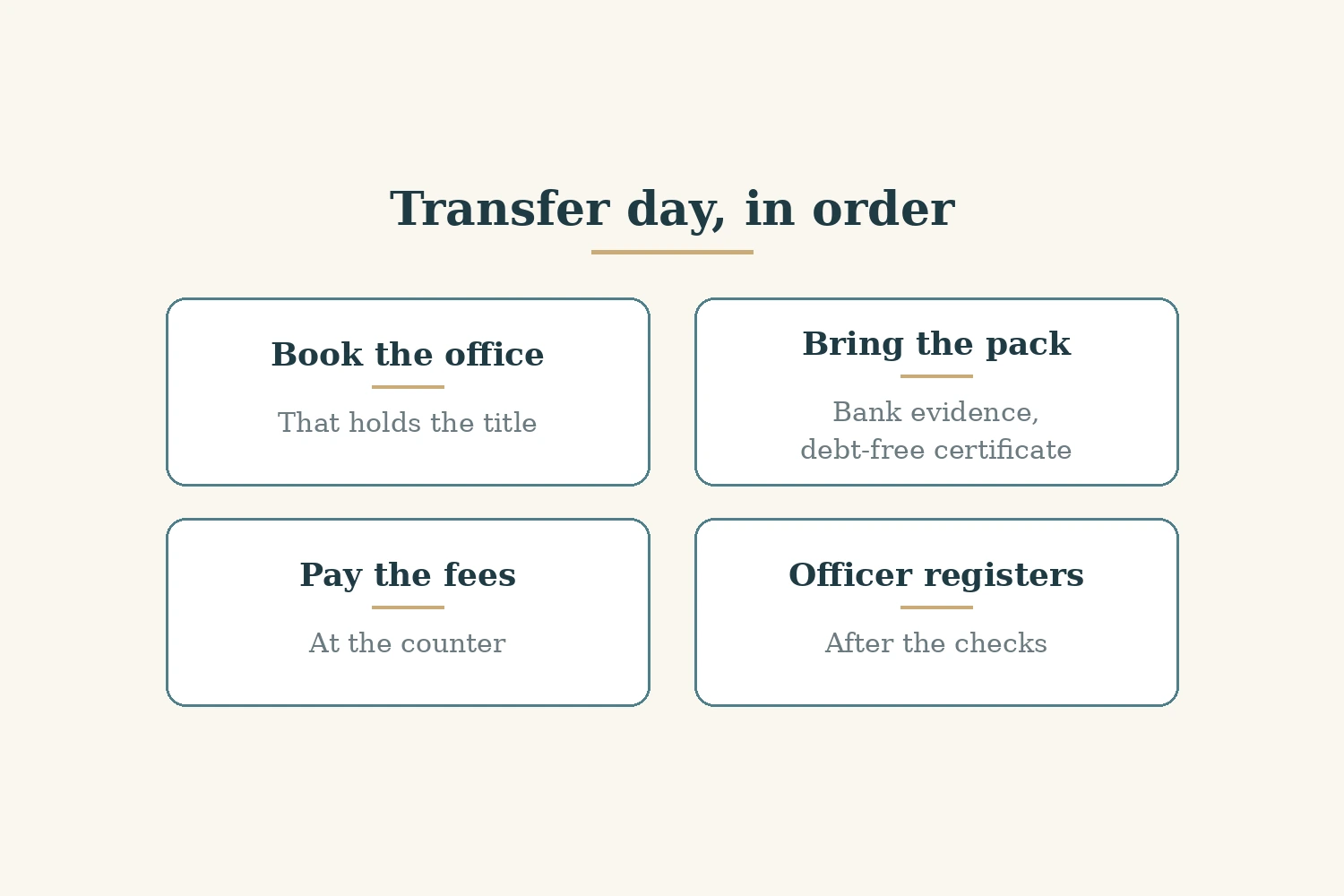
A Thai condominium purchase is not finished when the money lands or the contract is signed. It is finished at the provincial Land Office that holds the unit title, when an officer of the Department of Lands (DOL) registers the transfer in the buyer's name. The two papers most likely to stop it are not ones the buyer writes: one comes from a bank, the other from the building's juristic person, the legal body that runs the common property. If either is missing or out of date, the officer cannot register. This guide walks transfer day at the counter in order. The money movement that comes before it has its own guide on moving money into Thailand for a condo, and the quota question has its own piece on the foreign quota in Thai condominiums. This one starts after both.
Book the Land Office that holds the title
Registration happens at the Land Office where the unit title sits, not at the developer's suite or the bank. Whether the building is covered in our Bangkok guide, our Phuket guide or our Pattaya guide, the rule is the same: the title decides the office.
DOL runs an online queue booking system for registration and survey requests, called e-QLands. Its official user manual says registration is booked at the office where the title is situated (DOL e-QLands manual, read 10 Nov 2026). For a unit title it asks for province, district, condominium registration number and unit number.
Depending on the office, the manual shows a set time, a morning or afternoon window (08:30 to 11:00 or 13:00 to 15:00), or a date only. We could not confirm timed e-QLands slots at every provincial office, or how far ahead they are taken, on the DOL e-QLands manual as of 10 Nov 2026. Book early and keep the confirmation.
Attending in person or by power of attorney
Both sides attend, or an attorney attends for one or both of them on a written power of attorney (POA). DOL's manual says that where the transaction must be in writing, so must the POA (DOL power of attorney manual, read 10 Nov 2026).
DOL recommends its printed form, though it is not mandatory if the essential details are complete. Fill in the property identifier and the powers granted clearly, record and initial any alterations, and never sign a blank form. At least one witness is needed, two if the principal uses a fingerprint. A POA made outside Thailand should be certified by an embassy, a consulate or a notary public. If one attorney will act for both seller and buyer, the POA must record consent to that dual role. The attorney brings the POA and the principal's identity document (DOL power of attorney manual, read 10 Nov 2026).
One caution that is not a Land Office rule: if the unit is new, finish the inspection in our guide to snagging and defect liability before this morning, and see our piece on buyer protection in under-construction projects for the run-up to completion.
The paper pack on the counter
The Thai government portal, thailand.go.th, publishes a list of documents for registration by foreign owners (thailand.go.th documents page, read 10 Nov 2026). It starts with the original unit title, then the seller's identity papers (identity card, house registration, marriage or name-change papers and spouse consent where relevant, or a corporate pack), then the foreign buyer's identity, normally a passport.
The fourth part is labelled for condominium unit transfers and adds three items: a debt-free certificate from the condominium juristic person, the juristic person's statement that foreigners do not hold more than 49 per cent of the total unit area in the building, and, if an attorney acts, the POA and the attorney's identity papers. Foreign-language documents need certified Thai translations.
The same page also has a block on investment evidence and land permissions. That belongs to a land route, not to a condo unit; the condo funds rule sits in the Condominium Act, below.
Foreign currency evidence: the Land Office rule and the bank rule
The Condominium Act B.E. 2522 (B.E. is the Buddhist Era, the Thai calendar) lets a foreigner own a unit if they fall into one of several classes listed in section 19. Buyers living abroad usually rely on the fifth: a person who brings foreign currency into Thailand, or withdraws money from a baht account of a non-resident, or from a foreign-currency deposit account (Condominium Act, DOL compilation, read 10 Nov 2026). A buyer who has permission to reside in Thailand under immigration law may fall under the first class instead; that buyer shows evidence of the residence permission rather than the foreign-currency evidence (section 19 ter(1)), and the rest of the counter sequence is the same.
Section 19 ter then sets what the officer must see for a fifth-class buyer: evidence of one of those three routes, for an amount not less than the price of the unit (Condominium Act, DOL compilation, read 10 Nov 2026).
The Land Office rule is evidence not less than the unit price, under section 19 ter. The Bank of Thailand (BoT) rule is that authorised banks issue evidence of foreign exchange transactions to customers, and must ask for supporting documents for transactions of 200,000 United States dollars (USD) or more unless the bank has carried out Know Your Business (KYB) checks on the customer (BoT Exchange Control Regulation, read 10 Nov 2026). The USD 200,000 line is a bank document trigger, not a Land Office threshold. A purchase below it still needs bank evidence that adds up to the price (the line is repeated in the BoT bank guideline dated 29 September 2026, read 10 Nov 2026).
Brokers may mention a Foreign Exchange Transaction (FET) form by name. Ask the bank instead for its current evidence of transaction, in the buyer's name, with a readable purpose line, covering the unit price. We could not confirm a named 2026 bank-evidence form that Land Offices require on the BoT Exchange Control Regulation page or the DOL Condominium Act compilation as of 10 Nov 2026. The officer is checking route, name and amount, not a form number.
The 49 per cent cap and the debt-free certificate
Section 19 bis caps foreign ownership in each building at 49 per cent of the total area of all units, measured at the time the condominium is registered (Condominium Act, DOL compilation, read 10 Nov 2026). It is an area cap, not a headcount, so a large unit uses more of it than a studio. Unit areas are in square metres; our guide to area measurement across markets explains what they include.
The second paper from someone else is the debt-free certificate. Section 29 says the officer may register a transfer only when the unit owes nothing on the common expenses set under section 18, and the latest debt-free certificate from the juristic person must be produced. The building manager must issue it within 15 days of the request, once those expenses are fully paid. The requirement does not apply to a transfer made before the juristic person itself is registered (Condominium Act, DOL compilation, read 10 Nov 2026).
Section 29 is why one unpaid common-fee bill can stop the morning. Ask the seller to request the certificate early, check its date, and see our guide to common fees and the juristic person for what those expenses cover.
What you pay at the counter
The Act's fee schedule sets ceilings, and the Ministerial Regulation on condominium fees B.E. 2553, in the same DOL compilation, sets the rates charged: 2 per cent of the officially appraised value for a transaction with a capital value, 100 baht per unit where there is no capital value, and an application fee of 20 baht (Condominium Act sections 5 and 61 and Ministerial Regulation B.E. 2553, DOL compilation, read 10 Nov 2026). Who pays is for the sale contract.
The Rayong Provincial Land Office's answers page on condo transfer taxes gives the wider set: the 2 per cent transfer fee on the appraised value; personal income tax for an individual seller, worked out by years of holding and not more than 2.5 per cent of the appraised value; and either stamp duty at 0.5 per cent where the unit was held more than five years, or specific business tax (SBT) at 3.3 per cent where it was held five years or less, each on the higher of the sale price and the appraised value (DOL Rayong frequently asked questions (FAQ) page, read 10 Nov 2026). Exceptions sit in our guide to Thai property taxes and fees.
For conversion, this guide uses the BoT average buying transfer rate for the United States dollar of 33.3992 baht to one dollar, as of 9 Nov 2026 (BoT daily exchange rates, read 10 Nov 2026). Take an illustrative appraised value of 3,000,000 baht: 3,000,000 divided by 33.3992 is about USD 89,823. The transfer fee is 2 per cent of that, 60,000 baht, which is 60,000 divided by 33.3992, or about USD 1,796. If the seller held the unit more than five years, stamp duty at 0.5 per cent of 3,000,000 baht is 15,000 baht, about USD 449; if five years or less, SBT at 3.3 per cent is 99,000 baht, about USD 2,964. The income tax ceiling of 2.5 per cent is 75,000 baht, about USD 2,246. The 100 baht flat fee is about USD 3 (100 divided by 33.3992), and the 20 baht application fee about USD 0.60 (20 divided by 33.3992). These are illustrations; the officer's appraisal sets the base for the fee and the income tax ceiling, and stamp duty or SBT is charged on the higher of that appraisal and the sale price.
We could not confirm any current reduced transfer-fee rate for a foreign-quota transfer on the DOL Condominium Act compilation or the DOL Rayong FAQ as of 10 Nov 2026. We could not confirm the fee payment method, whether cash, cashier cheque or electronic transfer, on the DOL Condominium Act compilation or the DOL Rayong FAQ as of 10 Nov 2026.
What the officer does before registering
Section 19 quater sets the order. The officer receives the section 19 ter documents, checks that they are correct, and checks that the foreign share already held plus this transfer stays within the section 19 bis cap. Only then does the officer register the transfer under Chapter 4 of the Act (Condominium Act, DOL compilation, read 10 Nov 2026). Section 30 applies the Land Code's registration chapter to units, with the necessary changes.
We could not confirm the clauses of the DOL Regulation on foreign condominium ownership B.E. 2547 on the DOL page that hosts it as of 10 Nov 2026, so nothing here rests on them. We could not confirm the Condominium Act text on Krisdika, the legal database of the Office of the Council of State, as of 10 Nov 2026; the Act is read here from compilations hosted by DOL, and the English is our paraphrase, not an official translation.
Who this is not for
This sequence is for buying a unit inside the foreign quota of a registered condominium. It is not a route to land or a house. Selling is in our guide to selling a Thai condo and taking the money out. If the plan is to let the unit afterwards, the rules sit in our piece on long-term letting rules.
Where that leaves you
Transfer day checks other people's paperwork as much as yours: the bank's evidence must reach the unit price, and the juristic person's papers must be current and leave room under 49 per cent. Check the folder against this list: the e-QLands booking confirmation for the office that holds the title; the original unit title; both parties' identity papers, or the POA with the attorney's identity papers; the sale contract; for a fifth-class buyer, the bank evidence of transaction, covering the full price; the latest debt-free certificate; the juristic person's foreign-share statement; certified Thai translations of anything in another language; and the fee money in the form the office confirmed.
Walk out with the registered title, the fee and tax receipts, and the bank evidence kept together. If you sell, expect the bank to ask for that inward evidence again; that is bank practice, covered in our guide to selling a Thai condo. Our Thailand guide keeps the wider picture in one place.
Sources
- Department of Lands: Condominium Act B.E. 2522, official compilation (Thai)
- Department of Lands: Condominium Act B.E. 2522, second compilation (Thai)
- Department of Lands: Condominium Act listing page
- Department of Lands: e-QLands queue booking user manual
- Department of Lands: power of attorney manual
- Department of Lands: Regulation on foreign condominium ownership B.E. 2547
- Department of Lands, Rayong: frequently asked questions (FAQ) on condo transfer taxes
- thailand.go.th: documents required for registration by foreign owners
- Bank of Thailand: Exchange Control Regulation
- Bank of Thailand: commercial bank foreign exchange guideline, 29 September 2026
- Bank of Thailand: daily foreign exchange rates
Ready to find your next holiday home?
Browse our curated collection of vacation homes and managed farmland across India and beyond.