Selling a Thai Condo and Taking the Money Out

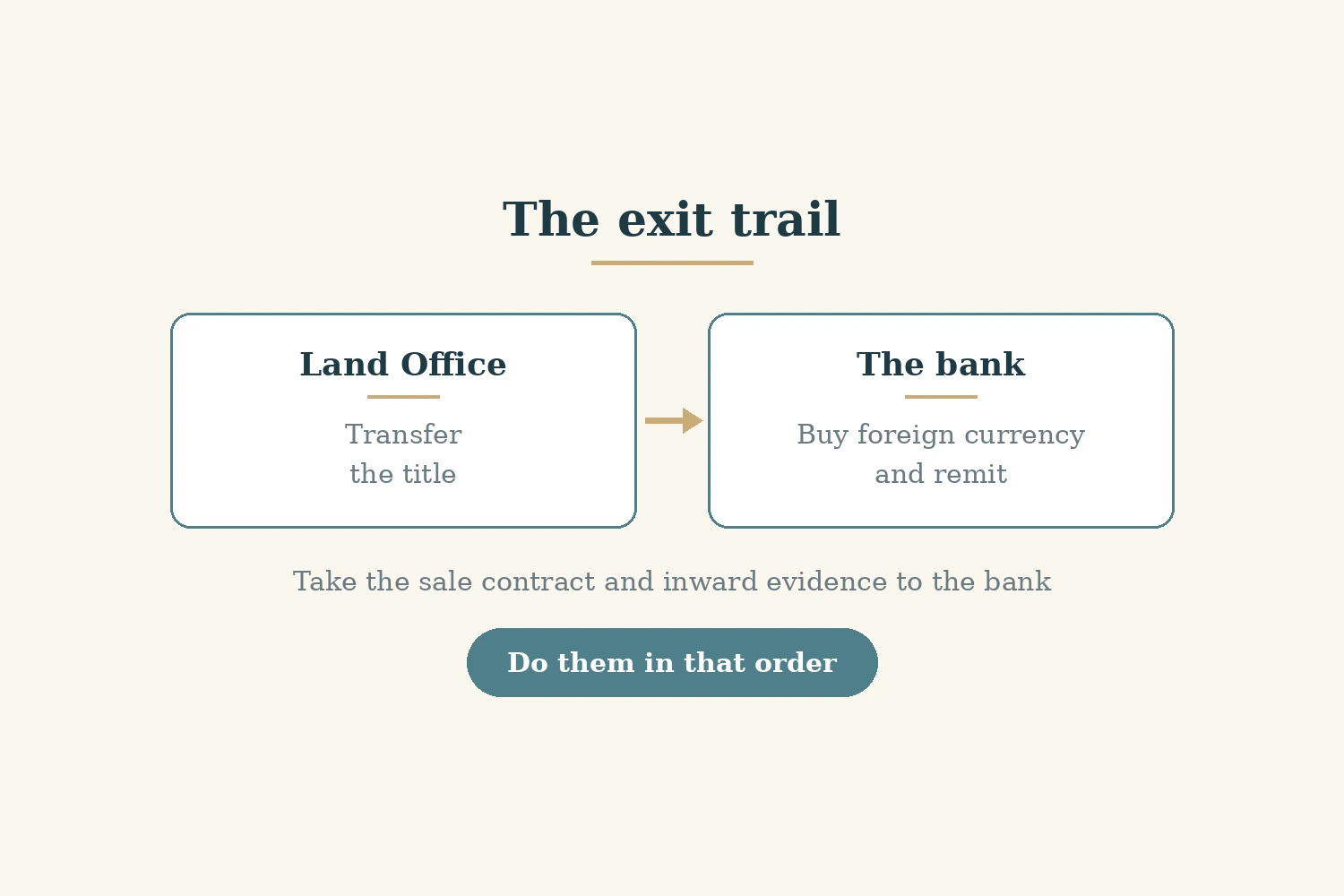
You already own the condominium unit. The hard part of buying is behind you. Selling and taking the money out of Thailand is a different job, and it runs through two rooms: the provincial Land Office, where the title moves and the transfer taxes are paid, and an authorised bank, where you buy foreign currency and send the sale proceeds abroad. The Bank of Thailand (BoT) sets the foreign exchange (FX) rules the bank must follow. Income from the sale of Thai immovable property is a watchlist purpose in the Bank of Thailand's guideline for commercial banks; how that applies to your outward transfer is for the bank to decide. This guide is for a foreign condo owner exiting Thailand, including a non-resident Indian (NRI) seller. It is a short tax recap and a longer remittance trail. It makes no claim about prices or future values, and it is not legal or tax advice.
Exit in two rooms: the Land Office, then the bank
At the Land Office you transfer the unit and settle the fees and taxes due on registration. At the bank you convert Thai baht (THB) into foreign currency and remit. Do them in that order. The bank will want proof that the sale and transfer have happened, so a remittance booked before the title moves is asking for a refusal. Keep every receipt from the Land Office in the same folder as the sale contract; the remittance meeting is built on those papers.
The purchase left a paper trail. Our guide to the Thai foreign exchange transaction form when money moves in covers the inward side. Selling needs the same trail in reverse: the sale contract, proof of ownership or transfer, and the original inward remittance evidence that showed how the money arrived. Our guides to Bangkok, Phuket, Pattaya and Thailand give the market context around the unit you are leaving.
Tax and fee recap at transfer
The full write-up of Thai property taxes and fees sits in our guide to Thailand property taxes and fees. What follows is only the transfer-day recap a seller needs.
As summarised on the Department of Lands (DOL) Rayong frequently asked questions (FAQ) page (DOL Rayong, read 6 Nov 2026):
- transfer fee: 2% of the appraised value;
- personal income tax (PIT) withholding: calculated by years held, and not more than 2.5% of the appraised value, as the Rayong FAQ puts it;
- if the unit has been held for more than 5 years: stamp duty of 0.5% of the higher of the sale price or the appraisal;
- if held for 5 years or less: specific business tax (SBT) of 3.3% of the higher of the sale price or the appraisal.
So generally 5 years is the line that switches stamp for SBT. On a worked example at an appraisal of THB 5,000,000 (about United States dollars (USD) 150,000 at a round figure of THB 33 to the dollar, for scale only), the transfer fee at 2% is THB 100,000. If the unit has been held for 5 years or less, SBT at 3.3% of that same appraisal is THB 165,000; if held for more than 5 years, stamp at 0.5% is THB 25,000. We have no fixed exchange rate for this post, so treat the dollar figure as approximate.
The Revenue Department says a seller who pays SBT is exempt from stamp duty, and that SBT is 3% plus a local levy of 10% of the tax, which is 3.3%. For an individual, the withholding is worked out by deducting a standard expense allowance, dividing by the years held, applying the income tax rates, and multiplying back by the years held (Revenue Department, read 6 Nov 2026). Temporary Land Office transfer-fee cuts reported for some Thai-national residential deals do not apply to a foreign-quota seller; do not expect a reduced rate.
Documents the Land Office will want on sale day
Book the provincial Land Office that holds the condominium title. Both parties, or their attorneys, attend. We could not find a central English checklist for a seller-side condo transfer on an official government site as of 6 Nov 2026. Use the Rayong fee FAQ above, and ask the provincial Land Office for its current document list.
Reports of the government portal's note on ownership of real estate by foreigners list, among the papers for a condo transfer, a debt-free certificate from the condominium juristic person and a juristic-person affidavit that foreign ownership does not exceed 49% of the condominium's unit area. We could not confirm this on an official government site as of 6 Nov 2026. The foreign seller still needs passport or status evidence and the unit title; confirm the full pack with the Land Office that holds the title. Our guides to the condominium foreign quota and Bangkok condominium common fees and the juristic person cover those two papers. Our guide to area measurement across markets helps you read the unit area in square metres that sits behind the 49% test.
What the Bank of Thailand requires, and where the watchlist fits
FX must go through persons licensed by the Minister of Finance: authorised banks, money changers and money-transfer agents (BoT, read 6 Nov 2026). Anyone buying, selling, depositing or withdrawing foreign currencies with an authorised bank must notify the transaction details. For amounts equivalent to USD 200,000 or above, the bank must ask for supporting documents, unless it has performed a know-your-business (KYB) process on the customer. After the transaction, the bank issues evidence of such transactions to the customer (BoT, read 6 Nov 2026).
That is the current rule. Do not treat an older "Foreign Exchange Transaction form at USD 50,000" line as current BoT law. The bank's job today is to take the purpose, apply the USD 200,000 document trigger where it applies, and issue evidence of the transaction. On about USD 250,000, the bank must ask for supporting documents.
BoT's commercial-bank FX guideline dated 29 September 2026 lists income from the sale of Thai immovable property as a watchlist purpose: from USD 200,000 the bank must ask for documents showing where the money came from, and KYB cannot replace them (BoT guideline, read 6 Nov 2026). Below USD 200,000 the guideline asks only for the purpose. Separately, commercial-bank checklists ask for sale papers at any amount (see below).
The paper trail banks ask for
BoT itself does not publish a single page that lists the exact outbound document pack for condo sale proceeds. What commercial banks ask for appears on a Thai Bankers' Association outward-remittance supporting-documents list hosted by Siam Commercial Bank (SCB). That list is bank practice, not a BoT regulation.
Item 12 covers remittance of proceeds from the sale of immovable property to a non-resident, and it is required for all amounts: the sale or lease agreement; evidence of transfer or ownership holding by the non-resident; and, if an agent remits, the agency agreement (SCB / Thai Bankers' Association checklist, read 6 Nov 2026). Item 13 covers repatriation of funds previously brought into Thailand: inward remittance evidence or a statement showing funds from abroad, and a statement showing the funds remain (same checklist, read 6 Nov 2026).
In market speech the inward paper is still often called a foreign exchange transaction (FET) form or Thor Tor 3. After the 2017 reform, BoT's language is "evidence of such transactions", with the USD 200,000 document trigger above. Bring the original purchase-side bank evidence to the remittance meeting. If the purchase was funded in several transfers, bring evidence for each one; a single partial letter leaves a gap the bank will notice. Our guide to foreign property ownership and our guide to cross-border property due diligence cover the ownership papers that sit beside it. Avoid nominee structures on the way out as on the way in; see our note on nominee ownership risk.
If the original inward evidence is missing
If the original inward remittance evidence is lost, was never issued, or covered only part of what you paid, ask the bank that handled the inward transfer for a duplicate or confirmation letter before you sell. Start that request weeks before the Land Office date, not on the morning of the remittance. We could not find an official statutory cure for a missing inward trail on an official government site as of 6 Nov 2026. Do not invent a workaround. The bank decides against the evidence you produce.
Timing, and why cash in a suitcase is not the plan
Book the Land Office slot first. Attend with the buyer, pay the fees and taxes, and collect the transfer papers. Then go to an authorised bank with the sale contract, the ownership or transfer proof, and the inward remittance evidence. Do not convert the money abroad first and try to justify it later. Same-day remittance after the transfer is possible in principle; whether your branch can do it depends on its cut-off times and on how complete your pack is.
A short checklist before the two appointments:
- Land Office: title, passport, sale agreement, tax money ready, and any juristic-person letters the Land Office asks for (reported to include a debt-free certificate and a foreign-quota letter).
- Bank: sale agreement, transfer or ownership proof, original inward FX evidence or a bank confirmation letter, and the receiving account details abroad.
Cash is not the plan. Thai baht banknotes may be taken to countries bordering Thailand, to Vietnam and to China (Yunnan province only) up to THB 2 million, and to other countries up to THB 50,000, without Competent Officer approval (BoT, read 6 Nov 2026). A Customs declaration is needed above THB 450,000 in baht notes, or above USD 15,000 in foreign-currency notes (BoT, read 6 Nov 2026); we could not check this against a Customs Department notice as of 6 Nov 2026. Remit through the bank.
If you cannot attend in person, our guide to what needs you there when buying remotely covers powers of attorney. Our guide to snagging and defect liability is the handover companion from the purchase side. For a different freehold and leasehold map, see our guide to Dubai freehold and leasehold zones.
Who this is not for
This is not for buyers still looking for a first Thai condo, or for sellers of land, houses or leasehold interests outside the foreign condominium quota. It is not a full tax treatise, and it does not cover company sales, inheritance or Thai-national transfer-fee cuts. It is not legal or tax advice. It makes no claim about prices or future values.
Where that leaves you
Selling a Thai condo and taking the money out is two appointments. At the Land Office, pay the transfer fee, the withholding and either stamp or SBT, and collect the transfer papers. At an authorised bank, show the sale contract, the ownership or transfer proof and the original inward remittance evidence, and buy FX under BoT's rules, where sale of Thai property is a watchlist purpose at USD 200,000 and above. If the inward evidence is missing, ask the issuing bank early. Remit through the bank, not in a suitcase. Keep copies of every bank evidence letter with the Land Office receipts.
Sources
- Department of Lands, Rayong: FAQ on condo transfer taxes
- Revenue Department: taxes on the sale of immovable property
- Bank of Thailand: Exchange Control Regulation
- Bank of Thailand: commercial bank FX guideline, 29 September 2026
- SCB / Thai Bankers' Association: outward remittance supporting documents
- Department of Lands homepage
Ready to find your next holiday home?
Browse our curated collection of vacation homes and managed farmland across India and beyond.