Letting to a Long-Term Tenant: India, Dubai and Thailand

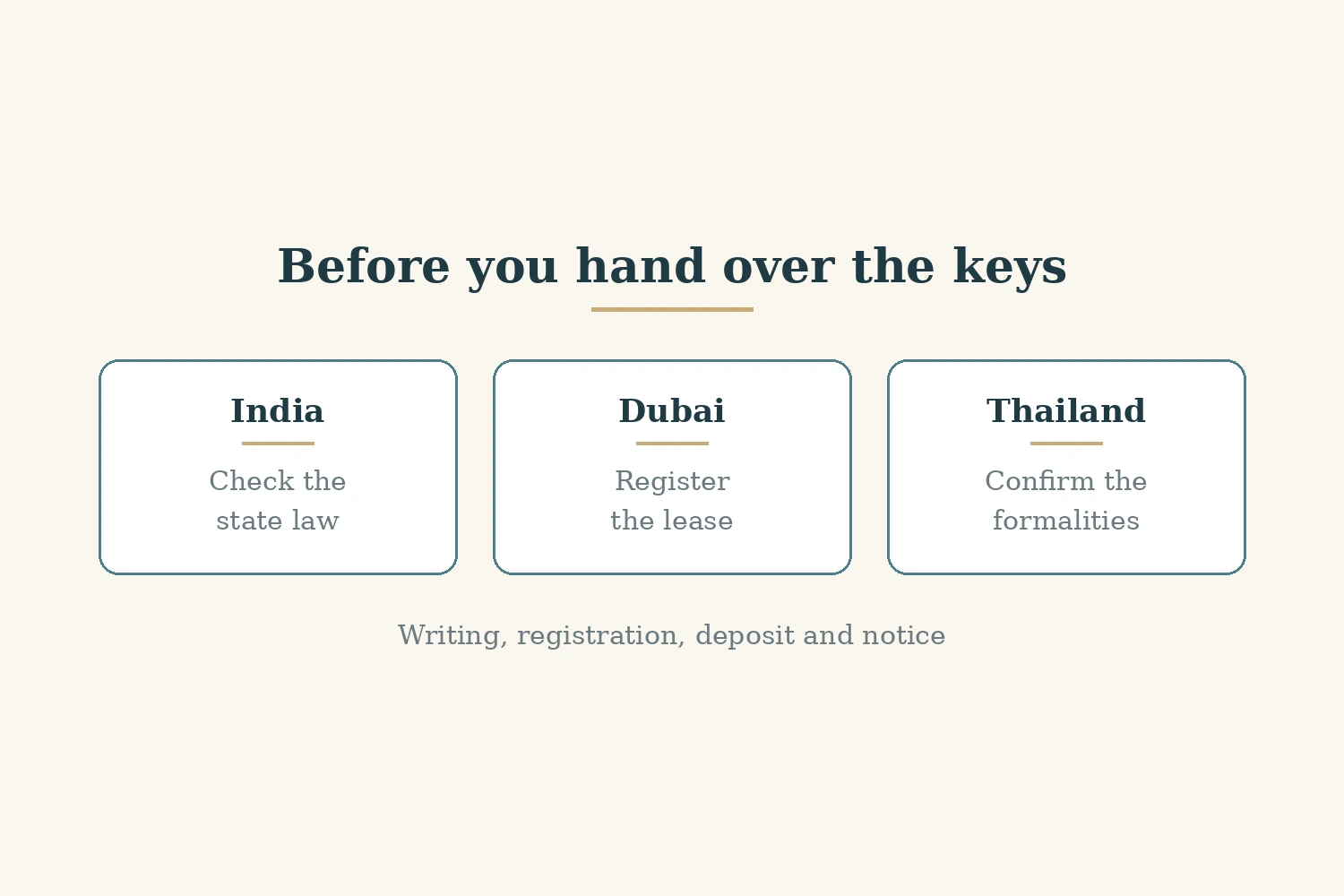
You already own the home. The next question is how to put a long-term tenant in it for about twelve months without leaving the paperwork to chance. India, Dubai and Thailand each answer that question differently. India is state-led: a model statute from Delhi only binds where a state has enacted it, and Maharashtra still runs many short lets under its own Rent Control Act. Dubai registers every lease under Emirate law and uses a rent index for renewals. Thailand relies on the Civil and Commercial Code rules on hiring immovable property. It is not a purchase piece. It covers registration, deposits, notice and eviction, makes no claim about prices or future values, and is not legal advice.
A twelve-month let needs a paper trail in every market
Use a written agreement and check the applicable local formalities before handover. In India, start with the property's state law; Maharashtra requires writing and registration. In Dubai, register the lease under the applicable Emirate law. Have a Thai lawyer confirm the formalities for a Thai lease. Before handover, keep the sale papers and the occupancy certificate from purchase where you have them, and read the building's own rules. Our guide to snagging, defect liability and who fixes what covers the occupancy certificate as a handover document. Our guide to what needs you there when buying remotely and our guide to cross-border property due diligence are purchase companions that can be revisited for document or proxy context after purchase.
India: the Model Tenancy Act is a model, not a nationwide override
The Model Tenancy Act (MTA), 2021, is drafted for a state or union territory legislature to enact. Its short title template is the "(Name of State/Union territory) Tenancy Act" (Ministry of Housing and Urban Affairs (MoHUA), read 6 Nov 2026). The Union Cabinet approved it on 2 June 2021, and the Press Information Bureau (PIB) says it was circulated to all states and union territories on 7 June 2021 for adoption by enacting a fresh law or amending existing rental laws (PIB, read 6 Nov 2026). Check the state's enacted law and transitional provisions for existing tenancies rather than assuming adoption automatically switches them.
So the MTA does not, by itself, apply across India. We could not confirm which states have enacted it from an official government source as of 6 Nov 2026. Check the law actually enacted in the property's state. The MTA text alone does not bind Maharashtra or Goa until that state enacts it.
Where a state has enacted MTA-style rules, the model sets a clear spine. After commencement, no person may let or take premises on rent except by a written agreement, which landlord and tenant must jointly inform to the Rent Authority within two months on the First Schedule form (MTA section 4, MoHUA, read 6 Nov 2026). The security deposit is as agreed, but must not exceed two months' rent for residential premises, or six months' rent for non-residential; it is refunded on vacant possession after due deductions (MTA section 11, MoHUA, read 6 Nov 2026). Eviction during the tenancy runs only on listed grounds through the Rent Court. On a worked example under the model, at a monthly rent of Rs (Indian rupees) 50,000, two months' deposit is Rs 1,00,000; six months would be Rs 3,00,000, which the model allows only for non-residential use.
Maharashtra: leave and licence under the Rent Control Act 1999
For homes in Maharashtra, including the Karjat, Lonavala and Pawna belt, the statute that still matters for many short lets is the Maharashtra Rent Control Act, 1999, not the MTA. Our Lonavala and Pawna Lake neighbourhood guide and our Pune guide place that geography. Do not apply the Maharashtra Act to Goa; check the law applicable to the Goa property. Our Goa guide sits under a different state frame.
Under section 55 of the Maharashtra Act, any agreement for leave and licence or letting after the Act commenced must be in writing and registered under the Registration Act, 1908. The duty to register sits on the landlord. If there is no written registered agreement, the licensee's or tenant's stated terms prevail unless proved otherwise. Contravention is an offence punishable with imprisonment of up to three months, or a fine of up to Rs 5,000, or both (Maharashtra Rent Control Act, read 6 Nov 2026). Our guide to stamp duty and registration by state covers the registration side.
Section 24 deals with a residence licence that has expired. The licensee must deliver possession. If not, the landlord may apply to the Competent Authority, which, on being satisfied that the licence period has expired, orders eviction. A licensee who holds over is liable to damages at double the licence fee until dispossessed (Maharashtra Rent Control Act, read 6 Nov 2026).
Unlike the MTA, the Maharashtra Act has no statutory residential deposit cap in that Act. Section 56 allows a landlord to receive a fine, premium, deposit or other consideration for a grant or renewal (Maharashtra Rent Control Act, section 56, read 6 Nov 2026). Put the deposit in the written registered agreement; do not invent a Maharashtra cap. Once you are letting, our companion on declaring Indian rental receipts covers how those receipts are declared.
Dubai: register the lease with the Real Estate Regulatory Agency (RERA)
In Dubai, the relationship between landlord and tenant is set by Law No. 26 of 2007, as amended by Law No. 33 of 2008. Under Article 4(2) of Law 33, every lease contract governed by the law, and any amendment to it, will be registered with RERA (Dubai Legislation Portal, read 6 Nov 2026). The Dubai Land Department (DLD) tenancy guide describes Ejari as RERA's online tenancy-recording programme and explains registration by the tenant if the lessor does not register. DLD's Register / Renew Tenancy Contract service page lists the current channels and conditions (DLD, read 6 Nov 2026). Our Dubai guide gives the wider setting, and our guide to Oqood, Dubai's off-plan title covers ownership if the unit is still off-plan.
Article 20 of Law 26 allows the landlord to take a security deposit to secure maintenance at expiry, and requires the landlord to refund the deposit or the remainder when the lease ends (Dubai Legislation Portal, read 6 Nov 2026). The article sets no fixed percentage. Put the amount in the lease.
On renewal, unless the parties agree otherwise, a party that wants to amend terms must notify the other at least 90 days before expiry (Law 33, Article 14, read 6 Nov 2026). Decree No. 43 of 2013 then caps any rent increase against the RERA rent index average for similar units: no increase where the current rent is up to 10% below that average; then 5%, 10%, 15% and 20% as the gap widens through the bands 11% to 20%, 21% to 30%, 31% to 40%, and more than 40% below the average (DLD legislation compilation, Decree 43, read 6 Nov 2026). On a worked example, not a quoted rent, if the index average is AED (United Arab Emirates dirhams) 100,000, about United States dollars (USD) 27,229, and the current rent is AED 85,000, about USD 23,145, the rent sits 15% below the average, which is in the 11% to 20% band, so the maximum increase is 5% of AED 85,000, or AED 4,250, about USD 1,157, using the Central Bank of the UAE rate of 3.6725 dirhams to the dollar (Central Bank of the UAE, read 6 Nov 2026).
Dubai eviction: mid-term grounds versus the twelve-month notice after expiry
Keep the two clocks apart. Under Article 25(1) of Law 33, a landlord may seek eviction before the lease expires only on listed grounds, including non-payment within 30 days of notice unless otherwise agreed, unlawful subletting, illegal use, dangerous alterations, use contrary to planning, and failure to meet lease obligations within 30 days of notice. Notice goes through a notary public or registered mail (Dubai Legislation Portal, read 6 Nov 2026).
Under Article 25(2), after expiry the landlord may seek eviction only if the unit will be demolished or rebuilt under the required permits, needs comprehensive maintenance that cannot be done while occupied and for which a Dubai Municipality technical report is required, is needed for the owner's or a first-degree relative's own use with no suitable alternative owned, or is to be sold. For those after-expiry grounds, the landlord must notify the tenant of the reason at least twelve months before the eviction date, again through a notary public or registered mail (Dubai Legislation Portal, read 6 Nov 2026). Twelve months is a full year of notice; it is not the same as a mid-term default notice. Running costs while the unit is let sit in our guide to Dubai service charges and running costs.
Thailand: writing and registration as a secondary source reports them
Thailand's rules for hiring immovable property sit in the Civil and Commercial Code. We could not open the official Thai text on Krisdika as of 6 Nov 2026; what follows is from a secondary English annotation dated 6 Nov 2026, so treat it as secondary until you check the official Thai text.
As published on that secondary source, section 538 treats a hire of immovable property as unenforceable by action unless written evidence is signed by the liable party. The same annotation says a hire for more than three years, or for the life of either party, binds for only three years unless it is written and registered at the Land Office. Section 540 is reported to cap any hire, and each renewal of it, at thirty years. Section 564 is reported to end a fixed-term hire when the term expires, without further notice, and section 566 to let either party end a hire with no agreed period at the close of a rent interval, on notice of at least one rent period and no more than two months.
As that secondary source reports it, a hire is unenforceable by action without written evidence signed by the liable party, and Land Office registration is reported if the hire is for more than three years; we could not confirm those thresholds against Krisdika as of 6 Nov 2026. A plain twelve-month fixed term does not, by itself, force registration under section 538 as that section is reported. Have a Thai lawyer check the proposed term and any renewal arrangement, including whether registration is required. We could not confirm a statutory residential deposit cap in the Code from an official government source as of 6 Nov 2026. Put the deposit and refund timing in the lease, subject to applicable law. We could not confirm an applicable building or condominium juristic-person letting restriction from an official government source as of 6 Nov 2026. Read the regulations for your own building. Our guides to the condominium foreign quota, Bangkok condominium common fees and the juristic person, Bangkok and Thailand cover that side.
An owner checklist before handover
Before the tenant moves in, have in one folder:
India
- the state Act that actually applies to the property, not only the MTA text;
- in Maharashtra, a written leave-and-licence or letting agreement, registered, with the landlord carrying the registration duty;
- the deposit written into that agreement;
- for declaration of receipts once letting starts, the companion linked above.
Dubai
- the lease registered with RERA under Law 33 Article 4;
- the deposit amount and refund rule in the lease;
- the RERA rent index position if you plan a renewal increase;
- a calendar for the 90-day renewal notice and, if you may want the unit back after expiry, the twelve-month Article 25(2) notice.
Thailand
- written evidence of the hire, signed by the liable party, as a secondary source reports it;
- a lawyer's check of the proposed term and any renewal arrangement, including whether registration is required;
- deposit and refund timing in the contract;
- the juristic person's own letting rules, if any.
Our guide to booking amount refund rules across India, Dubai and Thailand is the cousin piece for contract exits on the purchase side.
Who this is not for
This is not for buyers still choosing a market, or for short-stay and holiday letting. It does not set rents, and it does not cover company tenants, retail leases or hotel licensing. For a specific unit, a lawyer in the market concerned should read the agreement and the state or Emirate rules.
Where that leaves you
A twelve-month let is a paper trail. In India, start from the state Act: the MTA binds only where enacted, and in Maharashtra a leave-and-licence agreement must be written, registered and capable of Competent Authority eviction on expiry. In Dubai, register the lease with RERA, write the deposit into it, use the rent index for increases, and keep mid-term eviction grounds separate from the twelve-month notice after expiry. In Thailand, have a Thai lawyer check the proposed term and any renewal arrangement, including whether registration is required, and read the regulations for your own building. Do the paperwork before handover, not after the first missed payment.
Sources
- Model Tenancy Act, 2021, MoHUA English text
- Press Information Bureau: Cabinet approval of the Model Tenancy Act
- Maharashtra Rent Control Act, 1999
- Law No. 26 of 2007 Regulating Landlords and Tenants in Dubai%20of%202007.html)
- Law No. 33 of 2008 Amending Law No. 26 of 2007%20of%202008%20Amending%20Law%20No.%20(26)%20of%202007.pdf)
- Dubai Land Department: English legislation compilation (incl. Decree 43 of 2013)
- Dubai Land Department: tenancy guide
- Dubai Land Department: Register / Renew Tenancy Contract
- Central Bank of the UAE: exchange rates
- Thai Civil and Commercial Code section 538 (secondary annotation)
- Thai Civil and Commercial Code section 540 (secondary annotation)
- Thai Civil and Commercial Code section 564 (secondary annotation)
- Thai Civil and Commercial Code section 566 (secondary annotation)
Ready to find your next holiday home?
Browse our curated collection of vacation homes and managed farmland across India and beyond.