Neighbourhood Guide: The Pawna Lake Belt
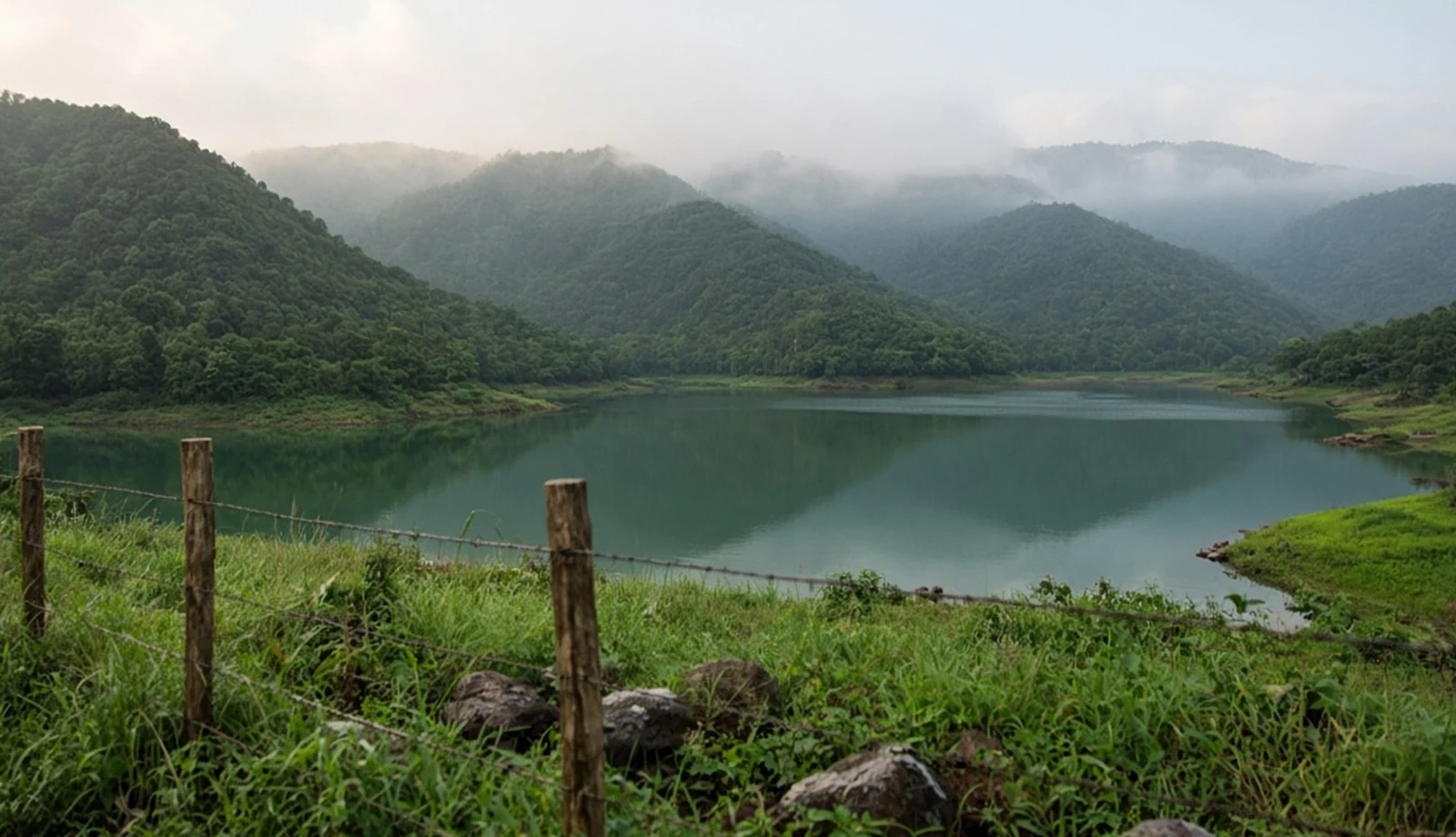
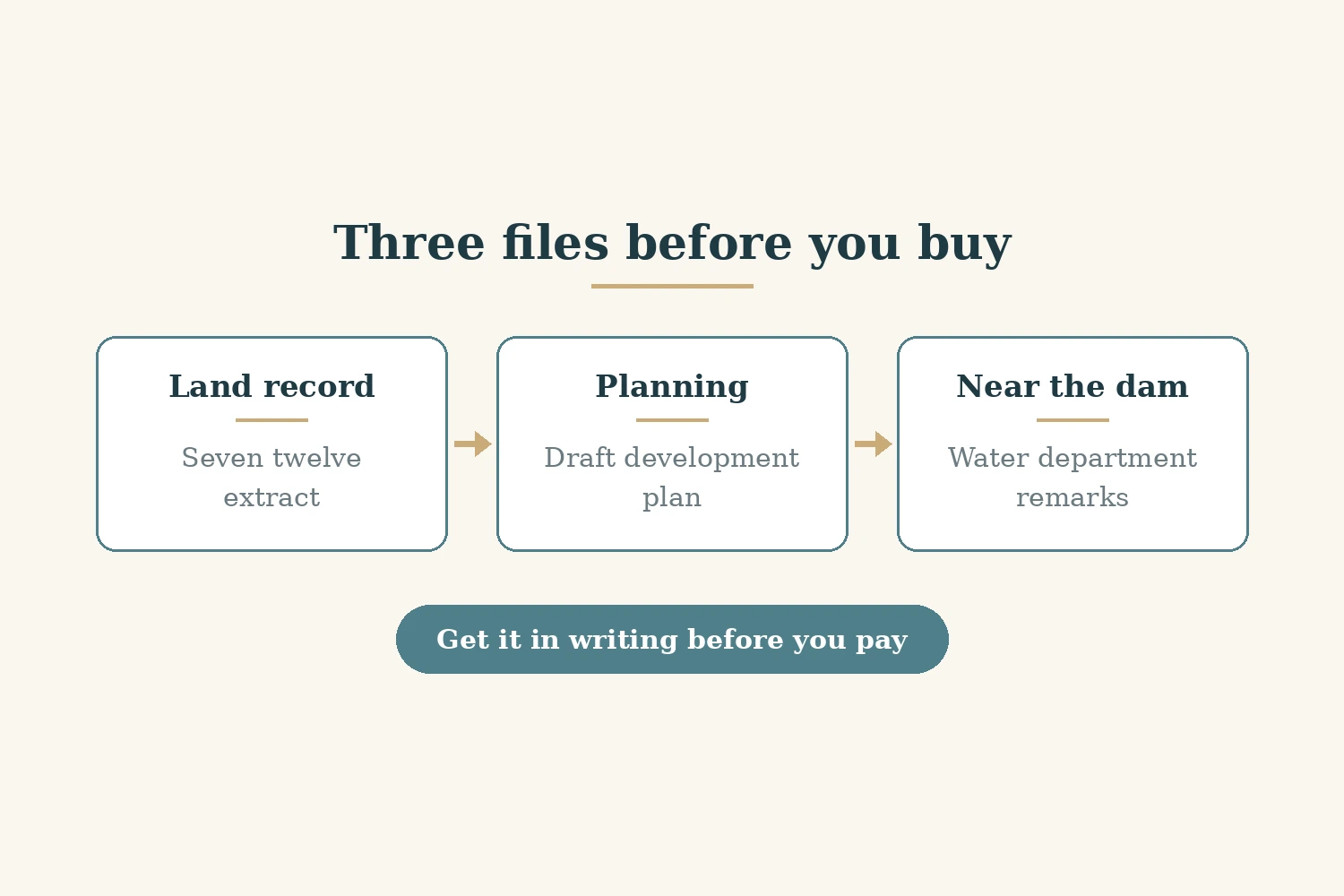
West of Pune, the villages around Pawana Dam and Lake sit in Maval taluka, inside the Pune Metropolitan Region Development Authority (PMRDA) area. The sale pitch is the water and the Mumbai to Pune corridor. The buyer's job is three files: the current 7/12 extract on Mahabhumi, the zone and Development Plan (DP) remarks from PMRDA, and, where the project crosses the legal threshold, a check on the Maharashtra Real Estate Regulatory Authority (MahaRERA) register. This neighbourhood guide maps the belt, says what those files answer, and is honest about what we could not confirm on an official government site as of 6 Nov 2026. The water is the reason people look here; the papers decide whether a weekend house can actually stand. It makes no claim about prices, rents or future values, and it is not legal advice.
Where the belt sits
The belt is the cluster of villages and roads around Pawana Dam and Lake, labelled that way on PMRDA's own draft Development Plan sheet (PMRDA, read 6 Nov 2026). Lonavala Municipal Council sits on the same sheet, and Lonavala town is the nearest service centre for shops, rail and many weekend villas. The lake villages themselves are quieter and more rural than the Tungarli ridge or Khandala. Buyers often treat Lonavala as the brand and Pawna as the water view; the planning papers treat them as different places on the same sheet.
PMRDA's draft Development Plan sheet labels Mawal inside the Pune Metropolitan Region (PMRDA, read 6 Nov 2026); the full list of talukas in PMRDA's remit we could not confirm on an official government site as of 6 Nov 2026. That means a survey number in a Pawna-side village is a PMRDA planning question, not a Lonavala Municipal Council one, unless the land actually sits inside the municipal boundary. Match the revenue village on the 7/12 to the planning map before you assume which office you need. Our Mulshi micro-market map covers the adjacent taluka, and our Lonavala guide and Pune guide give the wider setting.
Access: the expressway, the rail line and the monsoon
Two corridors already run. The Mumbai to Pune Expressway, the Yashwantrao Chavan Expressway, and the Mumbai to Pune rail line that serves Lonavala are both long-standing and operational. From Mumbai or Pune, most weekend buyers reach the belt through Lonavala or the expressway exits towards Maval, then local roads to the lake villages. Those last kilometres are where a dry-season drive and a monsoon drive diverge, and where a seller's "all-weather road" claim needs a site check.
What changes the experience is the Western Ghats monsoon, roughly from June to September. Ghat roads and lake-side tracks can be wet, cut or slow, and a dry-weather site visit is a poor guide to what the plot looks like after rain. Our guide to buying plots in the monsoon covers that check. Our Mumbai guide and Karjat guide sit on the same corridor for comparison.
Land types and the 7/12
On the ground you will see four kinds of offering: agricultural land still recorded as such, land said to be non-agricultural (NA), gaothan or village-site plots, and plotted projects with a layout. Our guide to the Maharashtra Land Revenue Code explains how those categories sit in the revenue system. A brochure label is not the record; the 7/12 is. Agricultural land, NA land and a project plot can sit on neighbouring survey numbers, and only the extract tells you which is which.
Maharashtra's Mahabhumi portal publishes 7/12 extracts and related land records for a survey number (Mahabhumi, read 6 Nov 2026). For any Maval or Pawna-side plot, pull the current 7/12 and its mutations, then get a certified copy from the revenue office. Do not treat the screen as the final certified record. The extract answers who is recorded as holder, what the land use class is, and whether mutations are pending. It does not answer whether a house can be built near the lake, or whether a layout is approved. Read it before you talk price, not after a handshake. Our guide to area measurement across markets helps you read the area figures that sit next to the survey number.
PMRDA planning and the draft Development Plan
PMRDA's Planning Department prepares the Development Plan, Town Planning Schemes, zone certificates, part plans, DP remarks and mean-sea-level certificates, and carries out modifications to the sanctioned Regional Plan (PMRDA Planning Department, read 6 Nov 2026). For a buyer, the practical ask is a zone certificate and DP remarks for the exact survey number.
The sheet most often waved around is the Draft Development Plan of the Pune Metropolitan Region for 2021 to 2041, published under section 26(1) of the Maharashtra Regional and Town Planning Act, 1966. The sheet hosted by PMRDA is labelled a draft, and it marks Mawal, Lonawale Municipal Council and Pawana Dam and Lake (PMRDA, read 6 Nov 2026). Treat it as a draft published for objections, not as a sanctioned plan. Nothing on that sheet is final until the Government of Maharashtra approves it. Until then, use it to see how PMRDA has drawn the belt, and still get formal DP remarks for your survey number rather than reading a colour off a downloaded map alone. The Unified Development Control and Promotion Regulations (UDCPR) that Maharashtra uses for building control sit alongside the plan; we could not confirm their detailed dam-side clauses on an official government site as of 6 Nov 2026.
Near the dam: ask for Water Resources Department remarks
Pawana Dam and Lake is the feature that defines the belt, and it is named on the draft DP sheet. How far from the water a structure may stand, what full supply level applies, and what catchment rules bind a survey number: we could not confirm any of these on an official government site as of 6 Nov 2026. Press reports sometimes quote a metre figure; do not use one.
Before you pay a token on a lake-side plot, ask the seller for Irrigation or Water Resources Department (WRD) remarks for that survey number, and for PMRDA's DP remarks. Without those papers, you do not know what the dam authority will allow, or whether a building plan is even worth applying for. Budget the time for those remarks; they are slower than a weekend site visit. The same caution applies to any claim about a blue or red flood line: we could not confirm a notified line for this reservoir on an official government site as of 6 Nov 2026. For another kind of second map that decides what can be built, see our guide to Coastal Regulation Zone (CRZ) land checks in Konkan and Dapoli.
MahaRERA when the project crosses the threshold
A plotted layout or villa project is not free of the Real Estate (Regulation and Development) Act 2016 (RERA). Under section 3, a promoter may not advertise, book or sell without registration where the land to be developed exceeds 500 square metres or the number of apartments exceeds eight, counting all phases (Real Estate Act, Goa RERA official copy, read 6 Nov 2026). Below that threshold, registration is not required under the same clause.
For anything above it, ask for the MahaRERA registration number and search it on the authority's public register yourself. A brochure line that says the project is approved is a developer statement until the register agrees. Count every phase when you apply the 500 square metre and eight-unit tests; eight plus one across phases is still above the line. We could not confirm what any specific Pawna or Maval project shows on that register on an official government site as of 6 Nov 2026.
A buyer's checklist, and what listings show
Before token money moves, have in one folder:
- the current 7/12 and a certified copy, plus an encumbrance certificate;
- PMRDA zone certificate and DP remarks for the survey number;
- Irrigation or WRD remarks if the plot sits by the lake;
- the NA order, if the seller claims the land is non-agricultural;
- the MahaRERA number, if the project sits above the 500 square metre or eight-unit line;
- a site visit after rain, not only on a dry weekend.
On cost once you own a plot, our guide to the cost of building in Lonavala and our guide to designing a weekend farmhouse cover the next stage. On money, see how to negotiate a land price and financing a plot. If you buy from abroad, our guide to what needs you there when buying remotely covers powers of attorney.
As listed on avacasa.life, 6 Nov 2026, prices around Lonavala, the lake villages and nearby Maval villages start from about Rs (Indian rupees) 30 lakh and run into several crores. Approval claims in listing text are the developer's statements. Match them against the 7/12, the PMRDA remarks, the WRD remarks and the MahaRERA register before you rely on any of them. Our guide to land conversion checks in Jaipur shows how another state handles the planning letter that sits beside the land record.
Who this is not for
This is not for buyers looking for a view on whether the belt is a good purchase, or on rents or future values; it makes no such claims. It does not cover Tungarli or Khandala in detail, building plan approval, or hotel and tourism licences. It does not give a metre figure from the dam. It is not legal advice; for a specific survey number, a local lawyer and the planning and irrigation offices should read the papers.
Where that leaves you
The Pawna Lake belt sits in Maval under PMRDA, with Lonavala as the nearest town and with the expressway and rail line already running. The draft Development Plan for 2021 to 2041 names the dam and the municipal council, and it is still a draft. Start with the 7/12, then the PMRDA zone and DP remarks, then Irrigation or WRD remarks if you are by the water, then MahaRERA if the project crosses the threshold. The monsoon will test the road and the plot. Get those papers before the token, not after. If any file is missing or disagrees with the ground, stop and ask again.
Sources
- PMRDA: Planning Department
- PMRDA: Draft Development Plan of Pune Metropolitan Region 2021-2041
- PMRDA home
- Mahabhumi: Maharashtra land records
- Real Estate (Regulation and Development) Act 2016, Goa RERA official copy
Ready to find your next holiday home?
Browse our curated collection of vacation homes and managed farmland across India and beyond.